We use cookies

Our website uses essential cookies and, with your consent, additional cookies to measure performance and improve our services. Cookie Policy.

You can change your choice at any time.

MMedXYNews
HomeVideos
MedXY AI/MedXY News/Section: Critical Care

Elevated Preoperative Serum Renin Predicts Vasopressor Need and Acute Kidney Injury in Liver Transplant Patients
MedXY Editorial Team•Aug 18, 2026•Critical Care
liver transplantationvasopressor requirementsserum reninacute kidney injury

Highlight

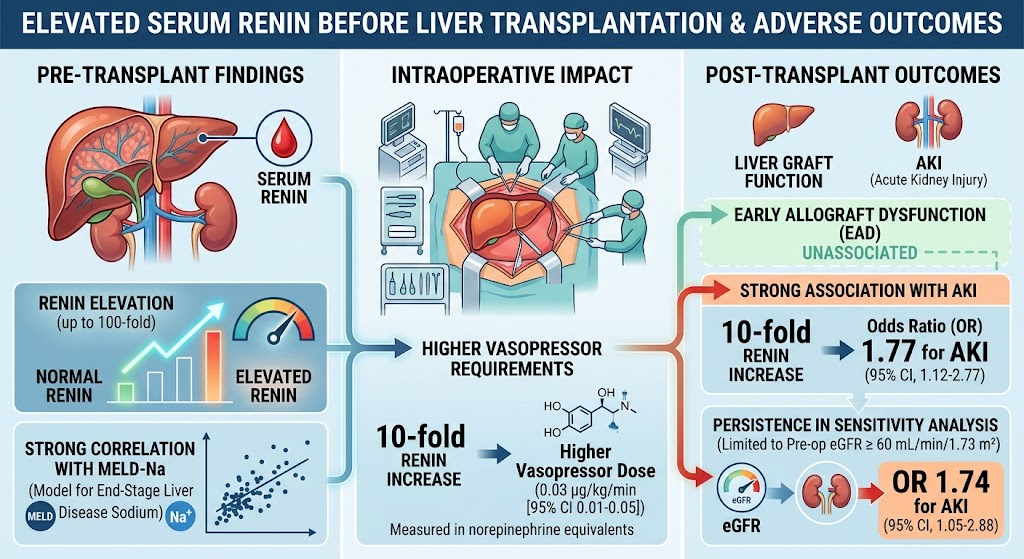
  • Serum renin can be elevated up to 100-fold prior to liver transplantation in patients with cirrhosis.
  • Preoperative renin levels strongly correlate with intraoperative vasopressor requirements during the dissection phase, measured in norepinephrine equivalents.
  • Elevated renin predicts postoperative acute kidney injury independent of preexisting renal function, while no association with early allograft dysfunction was observed.
  • Measurement of serum renin may guide individualized vasopressor strategies, including consideration of angiotensin II infusion during liver transplantation.

Study Background

MedXY registered readers

Sign in free to continue reading

Create or use your MedXY account to unlock the complete article.

This article was created using several editorial tools, including AI, as part of the process. Human editors reviewed this content before publication.

Related articles

Open language-specific specialty feeds and department pages.

Out-of-Hours Liver Transplantation: Identifying High-Risk Timeframes and Implications for Patient OutcomesA Swedish national retrospective study reveals that liver transplantations initiated between 17:00 and 05:59 are linked to significantly increased postoperative complications and healthcare costs, highlighting the need for optimized schedulSep 19, 2026Unlocking the Potential of Novel Biomarkers for Acute Kidney Injury in the Critically Ill: A Comprehensive Evidence MappingThis article reviews over 1100 studies on novel biomarkers for acute kidney injury (AKI) in critically ill patients, highlighting their predictive, diagnostic, and management roles while identifying gaps for future clinical implementation.Sep 18, 2026Integrative Muscle-Adipose Score (IMAS): Enhancing Sex-Sensitive Prognostication After Liver TransplantationThe Integrative Muscle-Adipose Score (IMAS) combines muscle and fat measures into a sex-specific tool that accurately predicts long-term survival and postoperative complications in liver transplant recipients, outperforming existing models.Sep 18, 2026
Loading comments...
MedXY briefing

Get the free newsletter

Evidence-led clinical news, trends, and analysis—delivered to your inbox.

Ask MedXY AI

Most popular

Intimate Health
Five Benefits for Women Continuing Sexual Activity After Menopause
Intimate Health
Why Some Women Have a Strong Sex Drive—And Why Men Shouldn't Worry About It
Nursing & care
How often should a couple have sex?
Intimate Health
Classic Intimacy Recommendations: How to Help Women Reach Orgasm and Enjoy Mutual Pleasure
Intimate Health
What Makes a Woman "Physiologically Addicted" Is Never Money, But These Two Relationship Qualities
© 2026 MedXY
Contact usAbout usPrivacy PolicyMedXY story
Comparative Real-World Outcomes of Hypothermic Oxygenated and Normothermic Machine Perfusion in Liver Transplantation
This international cohort study evaluates hypothermic oxygenated perfusion (HOPE) versus normothermic machine perfusion (NMP) in liver transplantation, revealing comparable high graft survival despite differing donor risk profiles and highl
Sep 12, 2026
Metabolite-Mediated Neurocognitive Revival Following Liver Transplantation: Insights into Cortical Network ReactivationLiver transplantation facilitates early neurocognitive recovery in end-stage liver disease patients by restoring cortical network activities, with S-methyl-5′-thioadenosine playing a pivotal neuroprotective role through modulating neuSep 3, 2026
Advancing Perioperative Risk Stratification: Predicting Acute Kidney Injury Following Lung TransplantationComprehensive pre- and early postoperative models predict acute kidney injury and need for renal replacement after lung transplantation, improving risk stratification and enabling targeted nephroprotection.Aug 20, 2026