We use cookies

Our website uses essential cookies and, with your consent, additional cookies to measure performance and improve our services. Cookie Policy.

You can change your choice at any time.

MMedXYNews
HomeVideos
MedXY AI/MedXY News/Section: Cardiology

Elevated Endogenous Insulin and Insulin Resistance in Progressive Diastolic Dysfunction and Cardiovascular Risk: A Comprehensive Clinical Review

MedXY Editorial Team•Aug 11, 2026•Cardiology
diastolic dysfunctionheart failure with preserved ejection fractioninsulin resistancecardiovascular outcomes
Highlights

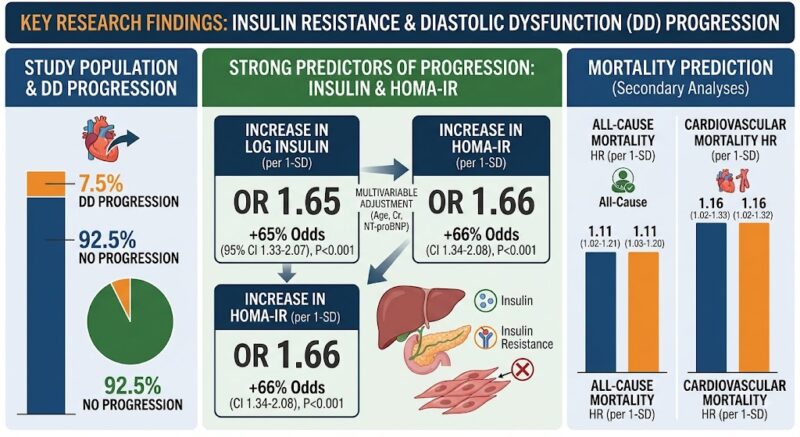
  • Elevated endogenous insulin and insulin resistance independently predict progressive diastolic dysfunction (DD) over four years, preceding overt diabetes onset.
  • Insulin dysregulation associates with increased long-term all-cause and cardiovascular mortality, even after adjusting for body mass index and other confounders.
  • Metabolic perturbations may initiate myocardial stiffening and impaired relaxation in early preclinical stages, offering a potentially actionable window to prevent heart failure with preserved ejection fraction (HFpEF).
  • Findings suggest integration of insulin resistance assessment in cardiovascular risk stratification and highlight the need for therapeutic strategies targeting metabolic abnormalities to halt DD progression.

Background

MedXY registered readers

Sign in free to continue reading

Create or use your MedXY account to unlock the complete article.

This article was created using several editorial tools, including AI, as part of the process. Human editors reviewed this content before publication.

Related articles

Open language-specific specialty feeds and department pages.

Cardiovascular Risks of CAR-T Therapy in Older Adults: Insights from US Medicare DataAmong older adults receiving CAR-T therapy, 5.8% experienced major adverse cardiovascular events (MACE), associated with increased mortality. Pre-existing cardiac conditions heightened risk, underscoring the need for cardiovascular monitoriSep 19, 2026Intracoronary Imaging-Guided PCI: Updated Meta-Analysis Validates Cardiovascular Outcome BenefitsThis updated meta-analysis of 28 RCTs reveals significant reductions in cardiovascular events and mortality with intracoronary imaging-guided PCI versus angiography-guided PCI, highlighting the importance of lesion and geographic factors inSep 19, 2026Impact of Digitalis Glycosides on Cardiovascular Outcomes in HFmrEF and HFrEF: A Comprehensive Evidence SynthesisDigitalis glycosides reduce cardiovascular death or worsening heart failure events in HFmrEF and HFrEF patients over a median of 36–37 months, supported by randomized trials and meta-analyses highlighting their role in select heart failureSep 17, 2026
Loading comments...
MedXY briefing

Get the free newsletter

Evidence-led clinical news, trends, and analysis—delivered to your inbox.

Ask MedXY AI

Most popular

Intimate Health
Five Benefits for Women Continuing Sexual Activity After Menopause
Intimate Health
Why Some Women Have a Strong Sex Drive—And Why Men Shouldn't Worry About It
Nursing & care
How often should a couple have sex?
Intimate Health
Classic Intimacy Recommendations: How to Help Women Reach Orgasm and Enjoy Mutual Pleasure
Intimate Health
What Makes a Woman "Physiologically Addicted" Is Never Money, But These Two Relationship Qualities
© 2026 MedXY
Contact usAbout usPrivacy PolicyMedXY story
Refining Non-Invasive Diagnosis of HFpEF: Enhanced Exercise Stress Echocardiography with Left Atrial Compliance Assessment
This multicentre study reveals that combining resting left atrial compliance with exercise stress echocardiography significantly improves diagnostic accuracy for HFpEF, potentially reducing the need for invasive testing in patients with une
Sep 15, 2026
Advancing Prognostic Precision in HFpEF: The LIFE-Preserved Risk Prediction ModelThe LIFE-Preserved model accurately predicts short-term and lifetime risks of heart failure hospitalization or cardiovascular death in HFpEF patients, enabling tailored clinical risk stratification and improved management.Sep 11, 2026
Glucagon-Like Peptide 1 Receptor Agonists, Mortality, and Cardiovascular Outcomes in Serious Mental Illness: A Comprehensive ReviewGLP-1 receptor agonists reduce mortality and cardiovascular events more effectively than SGLT2 inhibitors in serious mental illness (SMI), with early benefits and consistent effects across bipolar disorder, major depression, and schizophrenSep 2, 2026