Early Prediction of Upper-Limb Recovery Poststroke Using Machine Learning: A Clinically Feasible Approach
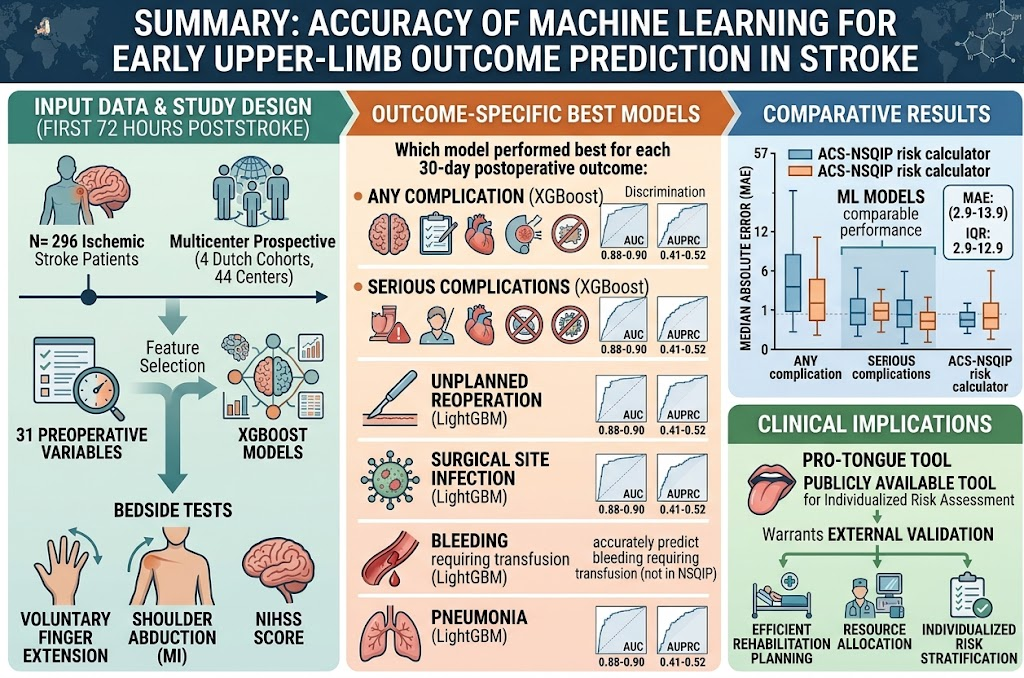
Highlight
A minimal set of bedside clinical tests within 72 hours poststroke predicts 6-month arm motor function with high accuracy.
Machine learning model utilizes Shoulder Abduction, voluntary finger extension, Fugl-Meyer Upper Extremity score, and NIH Stroke Scale.
Median absolute error of 5.9 is below the minimal clinically important difference for the Action Research Arm Test.
Study Background
Stroke remains a leading cause of adult disability worldwide, with upper-limb motor impairment significantly impacting patients’ functional independence and quality of life. Early and accurate prediction of motor recovery trajectories is critical for individualized rehabilitation planning, optimal resource allocation, and informed patient counseling. However, bedside predictive models for upper-limb outcomes within the acute phase (first 72 hours) poststroke face challenges, including balancing clinical feasibility with predictive accuracy. Machine learning (ML) offers potential to refine outcome prognostication by integrating multidimensional clinical data.
Study Design
This study pooled data from 296 first-ever ischemic stroke patients enrolled in four prospective Dutch cohort studies conducted between 2000 and 2019 across 44 centers. The objective was to develop and internally validate an ML model predicting the 6-month upper-limb motor outcome measured by the Action Research Arm Test (ARAT, range 0-57). Researchers compared multiple eXtreme Gradient Boosting algorithms using different sets of readily obtainable bedside clinical tests assessed within the first three days poststroke. The final model was selected based on a balance of minimal predictor variables, clinical feasibility, and prediction accuracy. Subsequently, validation employed a test dataset of 32 patients from the same cohort, evaluating model performance via median absolute error (MAE).
Key Findings
The selected ML model incorporated four clinical measures assessed within 72 hours of stroke onset:
Shoulder Abduction from the Motricity Index
Voluntary Finger Extension
Fugl-Meyer Upper Extremity Score
Total National Institutes of Health Stroke Scale (NIHSS) Score
This parsimonious model demonstrated the best tradeoff between simplicity and predictive accuracy. The MAE for predicting the 6-month ARAT score was 5.9 points (interquartile range 2.9–12.9) in the validation cohort. Notably, this error margin falls below the ARAT minimal clinically important difference (MCID) of 6 points, suggesting that the model predictions are clinically meaningful for guiding therapeutic decisions.
The results underscore the feasibility of combining routine bedside motor assessments with a global stroke severity scale (NIHSS) within the acute phase to accurately forecast long-term motor outcomes using machine learning. This model improves upon earlier predictive tools that either required more complex assessments or lacked sufficient accuracy in the early poststroke period.
Expert Commentary
The development of this model aligns with increasing clinical emphasis on personalized stroke rehabilitation, where early prognosis can influence the type and intensity of therapy provided. Experts may note that the choice of easily obtainable clinical tests enhances the model’s real-world applicability, especially in busy stroke units where time and resources are limited.
However, certain limitations merit consideration. External validation in diverse populations is necessary to confirm generalizability across different healthcare settings. The model’s reliance on the ARAT as the primary outcome, while widely accepted, captures only specific aspects of arm function and may not encompass broader functional recovery. Additionally, while ML improves prediction accuracy, clinicians should remain vigilant about integrating these tools into routine practice without superseding clinical judgment.
Conclusion
This study presents a clinically practical machine learning model that accurately predicts 6-month upper-limb motor outcome using simple bedside assessments conducted within 72 hours poststroke. By achieving prediction errors below the clinical threshold of meaningful change, this approach holds promise for optimizing rehabilitation strategies early in stroke care. Future research should focus on external validation, incorporation of imaging and biomarker data, and integration into clinical workflows to enhance personalized stroke rehabilitation further.
Funding and Registration
The study was conducted by the ICAI Stroke Lab with funding sources not explicitly reported. The clinical trials or cohort registrations for the pooled studies were not specified.
References
1. van der Gun GJ, Selles RW, Meskers CGM, et al. Accuracy of Machine Learning to Predict Upper-Limb Outcome Within the First 72 Hours Poststroke. Stroke. 2026 Jun 10;57(8):2493-2499. DOI: 10.1161/STROKEAHA.126.XXXXXX.
2. Kwakkel G, Lannin NA, Borschmann K, English C, Hackett ML. Predicting upper limb recovery after stroke: systematic review and meta-analysis. Stroke. 2017;48(4):1056-1060.
3. Stinear CM. Prediction of motor recovery after stroke: advances in biomarkers. The Lancet Neurology. 2017;16(10):826-836.
4. Prabhakaran S, Zarahn E, Riley C, et al. Inter-individual variability in the capacity for motor recovery after ischemic stroke. Neurorehabil Neural Repair. 2008;22(1):64-71.
5. Nijland RH, van Wegen EE, Harmeling-van der Wel BC, et al. Presence of finger extension and shoulder abduction within 72 hours after stroke predicts functional recovery: early prediction of functional outcome after stroke: the EPOS cohort study. Stroke. 2010;41(4):745-750.
6. Fugl-Meyer AR, Jaasko L, Leyman I, Olsson S, Steglind S. The post-stroke hemiplegic patient: a method for evaluation of physical performance. Scand J Rehabil Med. 1975;7(1):13-31.
7. Van Kuijk AA, Nijland RH, Zandvliet SB, et al. Neuroimaging correlates of upper limb motor outcome prediction early after stroke: a systematic review. PLoS One. 2014;9(8):e104308.
8. Chen T, Guestrin C. XGBoost: A Scalable Tree Boosting System. Proceedings of the 22nd ACM SIGKDD International Conference on Knowledge Discovery and Data Mining. 2016;785-794.
This article was created using several editorial tools, including AI, as part of the process. Human editors reviewed this content before publication.