Highlight
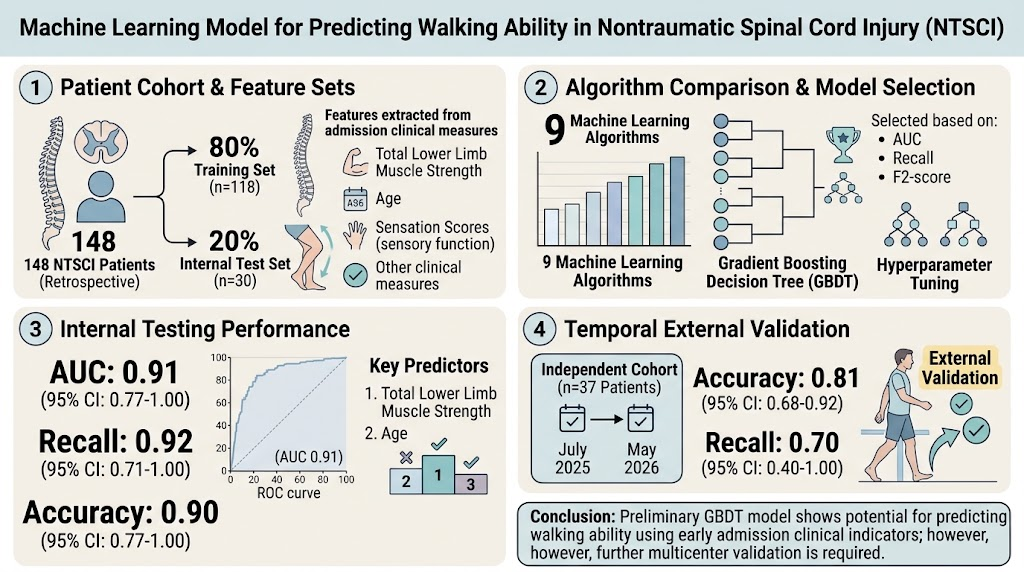
Development of a Gradient Boosting Decision Tree-based model to predict walking ability in patients with nontraumatic spinal cord injury (NTSCI) using admission clinical data.
The model demonstrated strong performance (AUC 0.91, recall 0.92) on internal testing and maintained promising accuracy (0.81) in a temporal external validation cohort.
Key predictive features included total lower limb muscle strength and patient age, highlighting important clinical factors for prognosis.
Findings are preliminary; external multicenter validation and larger sample sizes are needed before clinical integration.
Study Background
Nontraumatic spinal cord injury (NTSCI) refers to spinal cord damage from nonaccidental causes such as degenerative disease, infection, ischemia, or tumors. Unlike traumatic SCI, NTSCI incidence is rising notably with aging populations, posing a significant and growing public health burden globally. Walking ability remains a paramount functional outcome for these patients, directly impacting independence and quality of life. Yet, the prognosis for walking recovery after NTSCI is less well characterized compared to traumatic SCI, largely due to heterogeneous etiologies and limited predictive tools.
Early and accurate prognostication of walking ability at the time of admission could inform personalized rehabilitation plans and set realistic goals, enhancing patient counseling and resource allocation. Traditional prognostic models have relied on clinical scales and clinician experience without integrating complex data patterns. Machine learning (ML) methods enable sophisticated analysis of multidimensional clinical data and may uncover novel prognostic markers, offering promise for improved predictions.
Study Design
This retrospective study sought to develop and validate a machine learning-based prognostic model for walking ability in NTSCI patients, using early admission clinical indicators.
A total of 148 patients with NTSCI were enrolled and randomly divided into training (80%) and internal testing (20%) datasets. Four distinct feature sets constructed from objective clinical measures, including muscle strength and demographic variables, were used as inputs. Nine machine learning algorithms were benchmarked, with Gradient Boosting Decision Tree (GBDT) selected due to superior performance metrics.
The model’s key evaluation parameters included area under the receiver operating characteristic curve (AUC), recall, precision, and F2-score, to emphasize sensitivity given the clinical implications of underpredicting walking recovery potential.
For external validity, temporal validation was performed on an independent cohort of 37 NTSCI patients admitted after the original study period (July 2025 to May 2026). This assesses the model’s applicability over time and mitigates risks of overfitting common in ML studies.
Ethical approval was granted (M202616) with consent waiver, and the study was registered retrospectively (MR-11-26-021748). No patient or public involvement was reported in study design or dissemination.
Key Findings
The Gradient Boosting Decision Tree model demonstrated excellent performance on the internal test dataset, achieving an AUC of 0.91 (95% CI: 0.77–1.00), recall of 0.92 (95% CI: 0.71–1.00), and overall accuracy of 0.90. These metrics indicate high discriminative ability and sensitivity in predicting patients likely to regain walking ability post-rehabilitation.
Importantly, the model identified total lower limb muscle strength and patient age as principal predictors, consistent with clinical knowledge that muscle function and age influence neurological recovery potential.
In the temporal external validation cohort, the model maintained encouraging performance with an accuracy of 0.81 (95% CI: 0.68–0.92) and recall of 0.70 (95% CI: 0.40–1.00). While slightly attenuated, these findings support the model’s generalizability over time and warrant further prospective investigation.
No significant safety or adverse outcome data were reported, consistent with the observational nature of the study.
Expert Commentary
This study contributes novel evidence on leveraging machine learning, particularly GBDT algorithms, to predict walking outcomes in NTSCI—a field lacking robust prognostic models. By incorporating readily available admission clinical parameters and rigorously performing temporal external validation, the research addresses key challenges in ML applications to rehabilitation medicine, including overfitting and reproducibility.
However, limitations include its retrospective design, relatively small cohort size, single-center data source, and lack of diverse etiologies representation. These factors limit immediate clinical translation and underscore the need for larger, multicenter prospective studies to validate and refine the model across heterogeneous NTSCI populations.
The emphasis on recall (sensitivity) is clinically judicious, capturing patients likely to recover ambulation who can most benefit from targeted therapy. Future integration with neuroimaging, electrophysiological data, and patient-reported outcomes could further enhance predictive power.
Emerging clinical guidelines for NTSCI rehabilitation may integrate these predictive tools to personalize rehabilitation intensity and duration, optimizing resource use. Yet, clinicians should interpret current findings cautiously as exploratory and confirmatory work remains pending.
Conclusion
This preliminary study presents a promising machine learning model based on Gradient Boosting Decision Trees that predicts walking ability after rehabilitation in NTSCI patients using early admission clinical measures. The model’s strong internal performance and encouraging temporal validation highlight its potential as an adjunctive tool for rehabilitation planning.
Nonetheless, the findings are exploratory, warranting external validation in larger, multicenter prospective cohorts before integration into routine clinical practice. Ongoing research should aim to expand datasets, incorporate multimodal predictive features, and evaluate real-world clinical impact to fully harness machine learning in improving NTSCI patient outcomes.
Funding and Registration
No specific funding source was reported for this study. Ethical approval was obtained under protocol M202616, and the trial was retrospectively registered with identifier MR-11-26-021748.
References
1. Tong A, Guo J, Cai X, et al. A Machine Learning Model With Temporal Validation for Predicting Walking Ability in Nontraumatic Spinal Cord Injury. Neurorehabil Neural Repair. 2026 Oct 16:15459683261493914. doi:10.1177/15459683261493914. PMID: 42885901.
2. Kirshblum SC, et al. International standards for neurological classification of spinal cord injury (revised 2019). J Spinal Cord Med. 2020;43(1):120-126.
3. Steeves JD, et al. Rehabilitation of patients with spinal cord injury: an overview. Spine (Phila Pa 1976). 2011;36(21 Suppl):S54-S56.
4. Hastie T, Tibshirani R, Friedman J. The Elements of Statistical Learning. Springer; 2009.