We use cookies

Our website uses essential cookies and, with your consent, additional cookies to measure performance and improve our services. Cookie Policy.

You can change your choice at any time.

MMedXYNews
HomeVideos
MedXY AI/MedXY News/Section: Neurology

DWI-Positive Lesions in Acute Intracerebral Hemorrhage: Insights into Cerebral Small Vessel Disease and Prognosis

MedXY Editorial Team•Aug 15, 2026•Neurology
functional outcomeDiffusion-weighted imagingcerebral small vessel diseaseIntracerebral Hemorrhagecerebral small vessel disease
Highlight

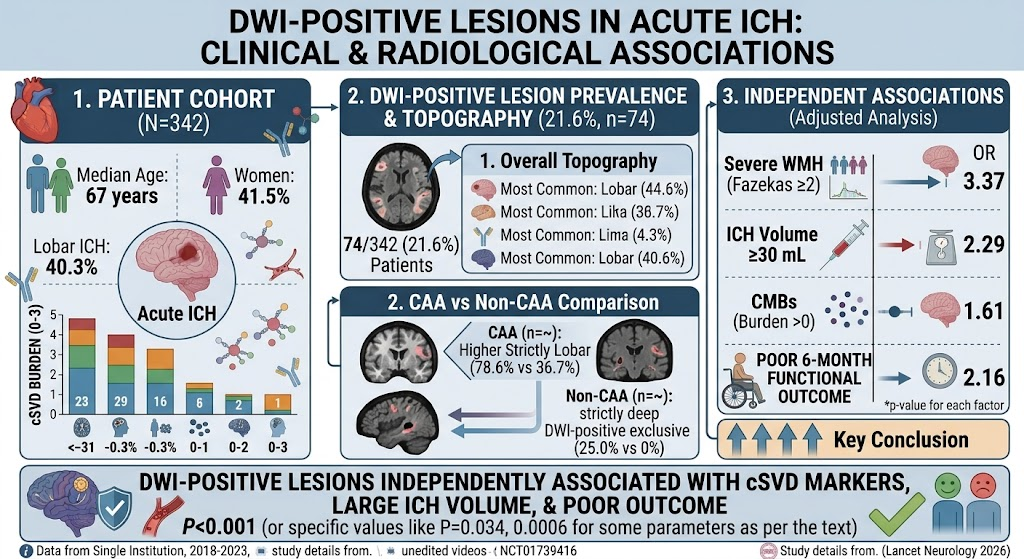
Diffusion-weighted imaging (DWI)-positive lesions are common in acute intracerebral hemorrhage (ICH) patients and independently associate with markers of cerebral small vessel disease (cSVD) and poor 6-month functional outcomes. The anatomical distribution of these lesions differs between cerebral amyloid angiopathy (CAA) and non-CAA subtypes. Larger hematoma volume and severe white matter hyperintensities (WMH) correlate with the presence of DWI-positive lesions.

Study Background

MedXY registered readers

Sign in free to continue reading

Create or use your MedXY account to unlock the complete article.

This article was created using several editorial tools, including AI, as part of the process. Human editors reviewed this content before publication.

Related articles

Open language-specific specialty feeds and department pages.

Metabolic Signatures and Causal Markers in MRI-Confirmed Lacunar Stroke: Insights from Observational and Mendelian Randomization AnalysesThis study identifies glycine and specific lipid cholesterol proportions as metabolomic markers causally linked to lacunar stroke subtypes, enhancing understanding of cerebral small vessel disease pathogenesis and potential biomarkers.Sep 15, 2026Early Detection of Cerebral Small Vessel Disease: Diffusion MRI Reveals a Decade-Long Preclinical Phase Before White Matter HyperintensitiesDiffusion MRI detects microstructural brain changes up to 16 years before white matter hyperintensities appear, offering a valuable early window for cerebral small vessel disease intervention and improved risk stratification.Sep 8, 2026Ticagrelor-Aspirin Dual Therapy After Thrombolysis in Moderate Ischemic Stroke: Insights from Infarct Patterns in the TAPIS TrialTAPIS subgroup analysis reveals that ticagrelor-aspirin combined with thrombolysis may improve outcomes in moderate ischemic stroke patients with multiple acute infarcts, without increasing hemorrhage risk, suggesting infarct pattern as a pSep 6, 2026
Loading comments...
MedXY briefing

Get the free newsletter

Evidence-led clinical news, trends, and analysis—delivered to your inbox.

Ask MedXY AI

Most popular

Intimate Health
Five Benefits for Women Continuing Sexual Activity After Menopause
Intimate Health
Why Some Women Have a Strong Sex Drive—And Why Men Shouldn't Worry About It
Nursing & care
How often should a couple have sex?
Intimate Health
Classic Intimacy Recommendations: How to Help Women Reach Orgasm and Enjoy Mutual Pleasure
Intimate Health
What Makes a Woman "Physiologically Addicted" Is Never Money, But These Two Relationship Qualities
© 2026 MedXY
Contact usAbout usPrivacy PolicyMedXY story
Cilostazol Therapy in Intracerebral Hemorrhage: Enhancing Dural Lymphatic Function for NeuroprotectionCilostazol promotes dural lymphatic remodeling and hematoma clearance post-ICH without increasing bleeding risk, representing a promising therapeutic strategy to improve neurological outcomes.Sep 6, 2026
Balancing Risks: Antiplatelet Therapy After Intracerebral Haemorrhage in the STATICH TrialThe STATICH trial assessed safety and efficacy of antiplatelet therapy after intracerebral hemorrhage, revealing increased hemorrhagic risk but fewer ischemic events among treated patients, highlighting ongoing clinical dilemmas.Aug 18, 2026
Evaluating Low-Dose Colchicine for Preventing Vascular Events After Acute Intracerebral Hemorrhage: Insights from a Placebo-Controlled Pilot TrialThis pilot randomized trial demonstrates the feasibility of using low-dose colchicine after acute intracerebral hemorrhage to prevent vascular events, highlighting considerations for future larger studies regarding recruitment, adherence, aAug 9, 2026