Decoding the U-Shaped Relationship Between Left Ventricular Size and Mortality in Heart Failure Patients
Highlight
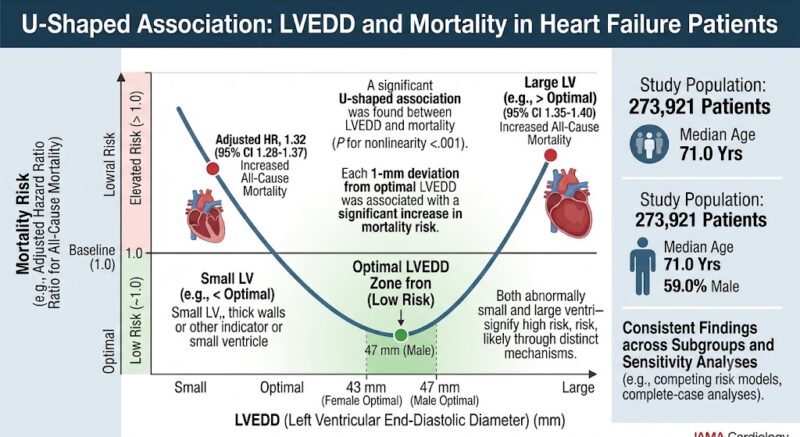
- A large-scale Chinese cohort study of 273,921 heart failure patients identified a U-shaped association between left ventricular end-diastolic diameter (LVEDD) and mortality.
- Both abnormally small and abnormally large LV dimensions independently predict higher all-cause and cardiovascular mortality.
- Sex-specific LVEDD thresholds (47 mm for men and 43 mm for women) were found optimal for mortality risk stratification.
- Findings support incorporating LV dimension assessment into routine heart failure risk evaluation to guide personalized management.
Study Background
Heart failure (HF) is a global public health issue marked by high morbidity and mortality. A key component of HF pathophysiology involves left ventricular (LV) remodeling, which traditionally emphasizes changes in ejection fraction (EF) as a prognostic marker. However, LV size itself, often assessed via the LV end-diastolic diameter (LVEDD), conveys vital structural information that may affect prognosis independently of EF. Prior studies have yielded inconsistent associations between LV dimension and outcomes, and there is a paucity of evidence on the independent prognostic role of LV size in large, diverse, real-world HF populations. Addressing this gap could refine risk prediction and personalized therapeutic strategies in HF management.
Study Design
This investigation was a nationwide cohort study leveraging the Chinese Cardiovascular Association Database-Heart Failure Center Registry. The cohort included 273,921 patients hospitalized with heart failure across 723 centers, spanning all 31 provincial-level administrative regions in mainland China, enrolled from January 2018 to May 2022. Echocardiographic measurements of LVEDD were used to categorize patients into small, normal, or large LV groups based on American Society of Echocardiography criteria.
The primary endpoint was all-cause mortality, and the secondary endpoint was cardiovascular mortality. Statistical analyses, conducted from March to June 2025, accounted for potential confounders and included sensitivity analyses such as competing risk and complete-case analyses. LVEDD was also indexed to body surface area to validate findings.
Key Findings
The study uncovered a statistically significant U-shaped association between LVEDD and mortality outcomes (P for nonlinearity <.001). Both abnormally small and large LV dimensions conferred greater risk of all-cause and cardiovascular death compared with normal LV size.
Quantitatively, after adjustment for clinical variables, the hazard ratio (HR) for all-cause mortality was 1.32 (95% CI, 1.28–1.37; P < .001) for patients with a small LV and 1.38 (95% CI, 1.35–1.40; P < .001) for those with a large LV. Sex-specific analyses identified optimal LVEDD cutoff points at 47 mm for males and 43 mm for females. Mortality risk increased significantly with every 1-mm deviation from these cutoffs, underscoring the physiological and prognostic importance of precise LV dimension thresholds.
Subgroup analyses demonstrated consistent findings irrespective of key clinical variables, emphasizing robustness and generalizability. Indexing LVEDD to body size did not alter the observed U-shaped relationship. The competing risk models further solidified the independent predictive value of LV dimension for cardiovascular mortality.
Expert Commentary
The revelation of a U-shaped mortality curve in relation to LV size challenges the conventional paradigm that primarily associates larger ventricles with adverse outcomes. Small LV dimensions, while less commonly highlighted, emerged as an independent risk marker, possibly reflecting restrictive physiology, diastolic dysfunction, or myocardial fibrosis. Conversely, large LV size aligns with volume overload and systolic impairment, well-known predictors of poor prognosis.
These findings highlight the complex pathophysiology underpinning HF, wherein both under- and over-enlargement of the ventricle reflect maladaptive remodeling processes with distinct mechanistic pathways. This complexity advocates for nuanced echocardiographic assessment beyond EF alone.
However, the observational nature of the study limits causal inferences. Residual confounding by unmeasured factors such as myocardial strain, biomarker profiles, and treatment variations may exist. Additionally, LV dimension thresholds may vary across ethnicities and imaging modalities, warranting external validation.
Conclusion
This comprehensive, large-scale study firmly establishes a U-shaped association between LVEDD and mortality risk in patients with heart failure, implicating both abnormally small and large ventricles as critical markers of increased mortality. Clinicians should recognize that deviations in LV size—in either direction—are not benign but rather signify heightened risk through likely distinct etiologies.
Incorporation of LV dimension assessment into routine echocardiographic evaluation offers refined risk stratification, potentially guiding personalized therapeutic decisions and optimizing patient outcomes in HF care. Further research is needed to elucidate the mechanistic basis of these associations and to explore interventional strategies targeting LV remodeling across the size spectrum.
Funding and Clinical Trial Registration
This study was supported by the Chinese Cardiovascular Association. No clinical trial registration number was specified in the publication.
References
1. Wang H, Zhang L, Ji C, et al. U-Shaped Association Between Left Ventricular Dimension and Mortality in Patients With Heart Failure. JAMA Cardiol. 2026; PMID: 42555012.
2. Lang RM, Badano LP, Mor-Avi V, et al. Recommendations for Cardiac Chamber Quantification by Echocardiography in Adults: An Update from the American Society of Echocardiography. J Am Soc Echocardiogr. 2015;28(1):1-39.e14.
3. Ponikowski P, Voors AA, Anker SD, et al. 2016 ESC Guidelines for the diagnosis and treatment of acute and chronic heart failure. Eur Heart J. 2016;37(27):2129-2200.
This article was created using several editorial tools, including AI, as part of the process. Human editors reviewed this content before publication.