We use cookies

Our website uses essential cookies and, with your consent, additional cookies to measure performance and improve our services. Cookie Policy.

You can change your choice at any time.

MMedXYNews
HomeVideos
MedXY AI/MedXY News/Section: Internal Medicine

Deciphering the Link Between Postoperative Delirium, Rehospitalization, and Cognitive Decline in Older Adults
MedXY Editorial Team•Aug 10, 2026•Internal Medicine
rehospitalizationpostoperative deliriumolder adultscognitive decline

Highlight

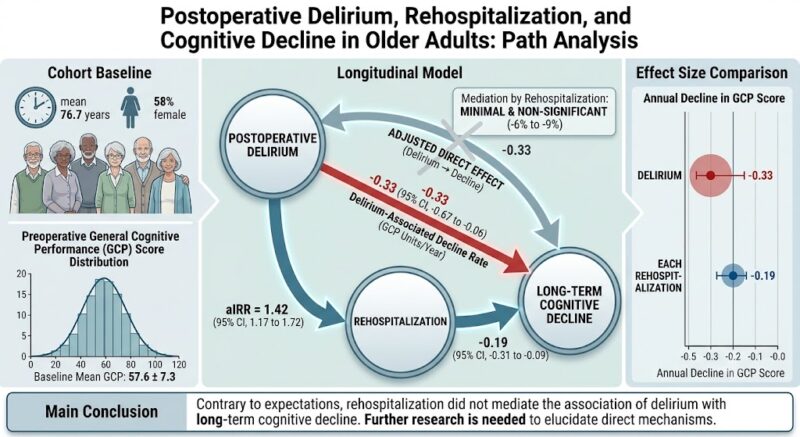
Postoperative delirium is linked to significant long-term cognitive decline in adults aged 70 and older. Rehospitalizations, more frequent in patients experiencing delirium, are independently associated with cognitive deterioration but do not mediate the delirium-cognitive decline relationship. These findings suggest other underlying mechanisms beyond acute illness episodes contribute to the lasting impact of delirium on cognition.

Study Background

MedXY registered readers

Sign in free to continue reading

Create or use your MedXY account to unlock the complete article.

This article was created using several editorial tools, including AI, as part of the process. Human editors reviewed this content before publication.

Related articles

Open language-specific specialty feeds and department pages.

Arterial Spin Labeling Hemodynamic Metrics Predict Cognitive Decline and Small Vessel Disease Progression Over 11 YearsThis study demonstrates that arterial spin labeling spatial coefficient of variation (ASL-sCoV) correlates with cerebral small vessel disease burden and predicts cognitive decline over 11 years, outperforming traditional cerebral blood flowSep 19, 2026Cardiovascular Risks of CAR-T Therapy in Older Adults: Insights from US Medicare DataAmong older adults receiving CAR-T therapy, 5.8% experienced major adverse cardiovascular events (MACE), associated with increased mortality. Pre-existing cardiac conditions heightened risk, underscoring the need for cardiovascular monitoriSep 19, 2026Early Life Vascular Risk and Midlife Markers of Brain Aging: Insights from Longitudinal Neuroimaging and Cognitive Trajectory StudiesThis review synthesizes longitudinal evidence linking early adulthood vascular risks, particularly elevated systolic blood pressure and smoking, to midlife cognitive decline and brain structural alterations. It highlights critical interventSep 17, 2026
Loading comments...
MedXY briefing

Get the free newsletter

Evidence-led clinical news, trends, and analysis—delivered to your inbox.

Ask MedXY AI

Most popular

Intimate Health
Five Benefits for Women Continuing Sexual Activity After Menopause
Intimate Health
Why Some Women Have a Strong Sex Drive—And Why Men Shouldn't Worry About It
Nursing & care
How often should a couple have sex?
Intimate Health
Classic Intimacy Recommendations: How to Help Women Reach Orgasm and Enjoy Mutual Pleasure
Intimate Health
What Makes a Woman "Physiologically Addicted" Is Never Money, But These Two Relationship Qualities
© 2026 MedXY
Contact usAbout usPrivacy PolicyMedXY story
Rethinking Surgical Quality Metrics: The Role of Operative-to-Nonoperative Management Ratio in Elderly Emergency General Surgery Outcomes
This study analyzes how the balance between operative and nonoperative management in emergency general surgery for older adults relates to their odds of discharge home, proposing ONR as a novel quality benchmark beyond traditional metrics.
Sep 15, 2026
Unveiling the Cardiovascular Toll of Long-Term Wildfire Smoke PM2.5 Exposure in Older AmericansLong-term cumulative exposure to wildfire smoke PM2.5 significantly increases cardiovascular hospitalizations among U.S. older adults, with notable risks in ischemic heart disease and arrhythmias, highlighting the need for targeted public hSep 15, 2026
Improved Glycaemic Control and Vascular Outcomes After MiniMed 780G Usage in Older Adults with Type 1 Diabetes: A Randomised Controlled TrialThis study demonstrates that using the MiniMed 780G hybrid closed-loop system significantly improves glycaemic management and shows a trend toward better microvascular function in adults aged 65 and above with type 1 diabetes, without increSep 8, 2026