Consistent Efficacy of Vutrisiran in Transthyretin Cardiac Amyloidosis Amidst Concomitant Disease-Modifying Therapies
Highlight
– Vutrisiran, an RNA interference agent, significantly lowers all-cause mortality and recurrent cardiovascular events in transthyretin amyloid cardiomyopathy (ATTR-CM).
– Concomitant use of disease-modifying therapy (tafamidis) or standard heart failure medications does not alter vutrisiran’s efficacy.
– The HELIOS-B trial provides evidence for the safe and effective combination of vutrisiran with established treatments in ATTR-CM management.
– Initiation rates of mineralocorticoid receptor antagonists and SGLT2 inhibitors were higher in the placebo group during follow-up, indicating differential management strategies.
Study Background
Transthyretin amyloid cardiomyopathy (ATTR-CM) is a progressive infiltrative cardiomyopathy caused by deposition of misfolded transthyretin proteins in myocardial tissue, leading to restrictive heart failure and increased morbidity and mortality. Disease-modifying therapies, notably tafamidis, have improved outcomes by stabilizing transthyretin tetramers, reducing amyloid formation. However, heart failure management typically involves multiple pharmacologic agents including beta-blockers, mineralocorticoid receptor antagonists (MRAs), renin-angiotensin system (RAS) inhibitors, and sodium-glucose cotransporter-2 (SGLT2) inhibitors. Vutrisiran, an RNA interference (RNAi) therapeutic targeting hepatic transthyretin synthesis, has recently shown promise in reducing mortality and cardiovascular events in the HELIOS-B trial. Understanding whether concomitant use of tafamidis or heart failure drugs modifies vutrisiran’s treatment effect is clinically crucial for optimal management of ATTR-CM patients.
Study Design and Methods
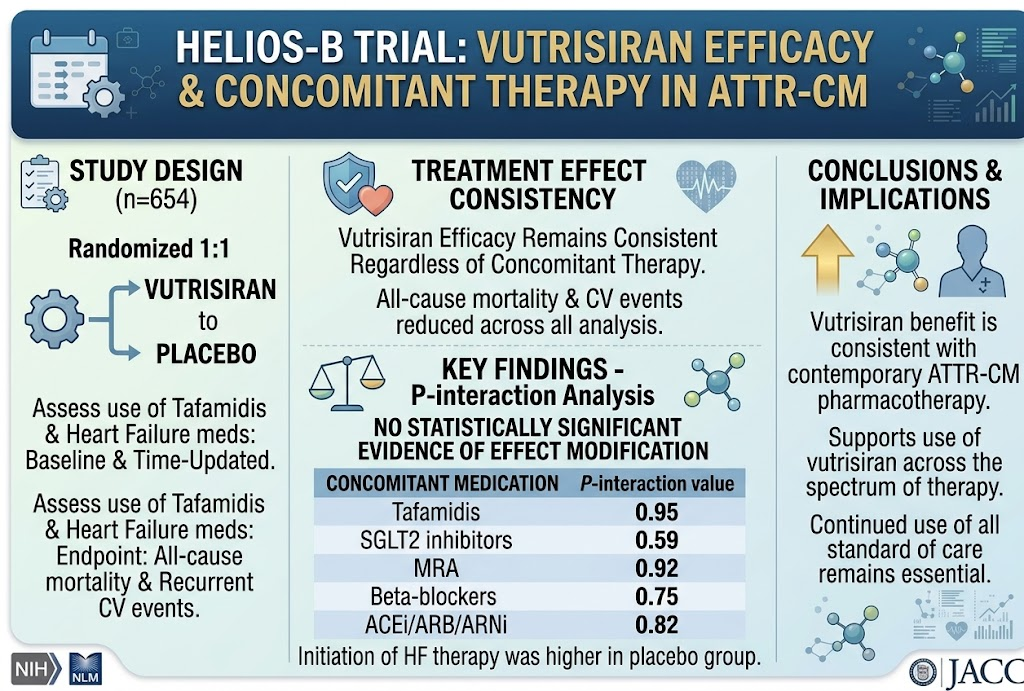
The HELIOS-B trial is a randomized, placebo-controlled study recruiting 654 patients with ATTR-CM who received either vutrisiran or placebo. The trial’s primary composite endpoint comprised all-cause mortality and recurrent cardiovascular events such as hospitalizations for heart failure and other cardiac complications. Baseline medications assessed included tafamidis, SGLT2 inhibitors, MRAs, beta-blockers, and renin-angiotensin system inhibitors (ACE inhibitors, angiotensin receptor blockers, and angiotensin receptor–neprilysin inhibitors). The analysis utilized time-updated Lin-Wei-Yang-Ying models to scrutinize whether baseline or newly initiated medications influenced the effect of vutrisiran on clinical outcomes.
Key Findings
At enrollment, 40% of patients were on tafamidis, and a substantial 77% were receiving at least one heart failure medication class. MRAs and SGLT2 inhibitors were the most frequently initiated therapies during the study period, with initiation rates generally higher in the placebo group across all heart failure medication categories—reflecting possible adjustments in standard care when vutrisiran was not administered.
The statistical analyses found no significant interaction between the use of any concomitant medication and the efficacy of vutrisiran on the composite endpoint. Specifically, P-interaction values were 0.95 for tafamidis, 0.59 for SGLT2 inhibitors, 0.92 for MRAs, 0.75 for beta-blockers, and 0.82 for RAS inhibitors. These non-significant interaction P-values suggest that the survival and cardiovascular benefit of vutrisiran persisted regardless of background therapy.
This robustness was evident despite diverse baseline therapies and postrandomization medication initiations, highlighting vutrisiran’s consistent therapeutic effect across different pharmacologic backgrounds. Importantly, no safety signals indicating adverse interactions or compromised efficacy due to combined therapies emerged during follow-up.
Expert Commentary
The HELIOS-B findings represent a meaningful advance in the treatment landscape for ATTR-CM. Prior to this study, clinical decision-making concerning combining vutrisiran with established disease-modifying and heart failure therapies was uncertain. The demonstration of consistent efficacy irrespective of background drugs addresses a critical gap, supporting the integration of RNAi therapeutics into complex multimodal treatment regimens.
Biologically, vutrisiran’s mechanism of reducing transthyretin production complements tafamidis’s stabilizing effect on circulating tetramers, potentially offering additive benefits without pharmacodynamic interference. Meanwhile, maintenance or initiation of heart failure medications remains crucial for symptomatic management and may address hemodynamic and neurohormonal aspects not directly influenced by RNAi therapy.
Limitations include the relatively short follow-up period for longer-term interaction effects and the predominantly certain demographic and clinical profiles enrolled in HELIOS-B, which may limit generalizability. Ongoing real-world studies and further mechanistic research will refine understanding of optimal therapeutic combinations and sequencing.
Conclusion
The HELIOS-B study robustly establishes that vutrisiran’s efficacy in reducing mortality and recurrent cardiovascular events in transthyretin cardiac amyloidosis is not significantly influenced by concomitant use of tafamidis or typical heart failure medications. These findings support a unified therapeutic approach combining disease-modifying RNA interference with stabilized transthyretin tetramers and conventional heart failure management to optimize patient outcomes. Clinicians can confidently initiate or continue vutrisiran alongside other treatments without concern for diminished efficacy, promoting comprehensive care for this challenging cardiomyopathy.
Funding and ClinicalTrials.gov
The HELIOS-B trial (NCT04153149) was supported by Alnylam Pharmaceuticals, the manufacturer of vutrisiran. Funding sources did not influence data analysis or interpretation.
References
-
- Abovich A, Fontana M, Claggett B, et al. Influence of Disease-Modifying Therapy on the Efficacy of Vutrisiran in Transthyretin Cardiac Amyloidosis. J Am Coll Cardiol. 2026 Aug 5; PMID: 42669069.
- Maurer MS, Schwartz JH, Gundapaneni B, et al. Tafamidis Treatment for Patients with Transthyretin Amyloid Cardiomyopathy. N Engl J Med. 2018;379(11):1007-1016.
- Gillmore JD, Damy T, Fontana M, et al. Non‐invasive Evaluation and Prognosis in Transthyretin Amyloid Cardiomyopathy. Circulation. 2021;143(14):1489-1500
- Vaduganathan M, Claggett BL, Jhund PS, et al. SGLT2 Inhibitors in Heart Failure: Evidence and Clinical Guidance. Circulation. 2022;146(13):984-998.
This article was created using several editorial tools, including AI, as part of the process. Human editors reviewed this content before publication.