Colchicine for Secondary Prevention After Stroke According to the Presence of Atherosclerosis: Clinical Evidence and Implications
Highlights
- Colchicine shows promise in reducing major adverse cardiovascular events (MACEs) in patients with stroke and concomitant atherosclerosis, though results in non-atherosclerotic populations are less clear.
- Post hoc analyses of the CONVINCE trial suggest on-treatment colchicine benefits are more pronounced in patients with documented atherosclerosis, implicating plaque-driven inflammation in therapeutic response.
- Meta-analyses confirm colchicine reduces ischemic events such as myocardial infarction and stroke, predominantly in atherosclerotic cardiovascular disease cohorts.
- Gastrointestinal adverse effects are the main safety concerns but are dose- and duration-dependent; long-term adherence improves benefit-risk balance.
Background
Stroke remains a leading cause of morbidity and mortality worldwide, with ischemic stroke attributable in large part to atherosclerotic disease of cerebral and systemic arteries. Despite advances in antithrombotic and lipid-lowering therapies, residual risk of recurrent stroke and cardiovascular events persists. Chronic vascular inflammation contributes significantly to atherosclerosis progression and destabilization, making anti-inflammatory therapies a rational adjunct for secondary prevention. Colchicine, a microtubule inhibitor with potent anti-inflammatory properties, has garnered attention due to its efficacy in reducing major adverse cardiovascular events (MACEs) in coronary artery disease (CAD). However, its efficacy post-stroke, particularly stratified by the presence of atherosclerosis, warrants evaluation.
Key Content
1. Rationale and Biological Mechanism
Inflammation is central to atherosclerotic plaque formation and rupture. Colchicine inhibits microtubule polymerization, interfering with neutrophil and inflammasome activity, reducing release of IL-1β and other cytokines implicated in vascular inflammation. This anti-inflammatory modulation is hypothesized to stabilize plaques and reduce thrombosis risk.
2. Evidence from the CONVINCE Trial and Post Hoc Analyses
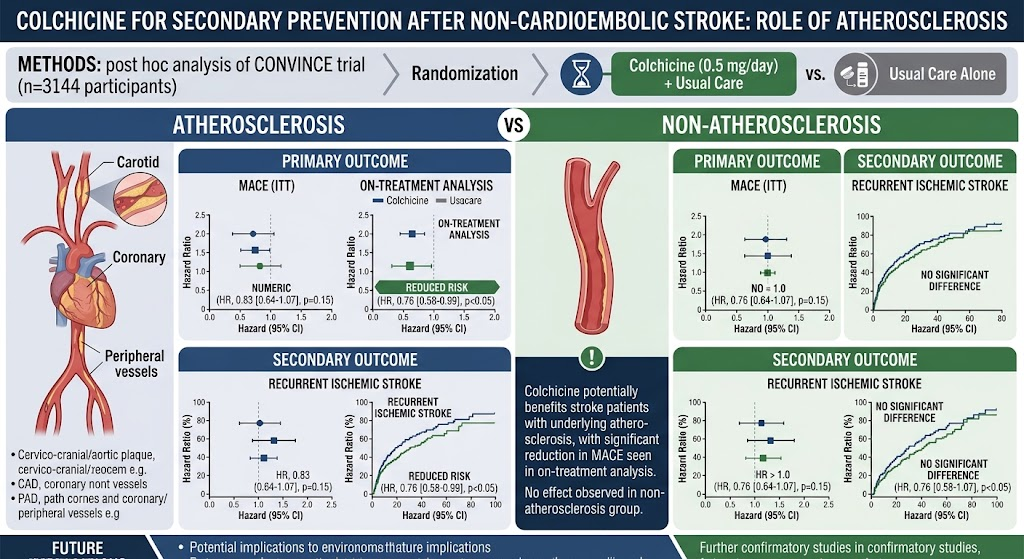
The CONVINCE trial (NCT02898610) randomized 3,144 patients with recent non-cardioembolic ischemic stroke or transient ischemic attack (TIA) to colchicine 0.5 mg daily plus usual care vs usual care alone, assessing major adverse cardiovascular events (MACE) over a median 33.6 months.
A post hoc subgroup analysis stratified patients by presence or absence of atherosclerosis—defined by cervico-cranial/aortic artery plaques, coronary disease, peripheral arterial disease, or carotid revascularization. Among patients with atherosclerosis, colchicine reduced MACE events numerically (11.1% vs 14.2%), yielding a hazard ratio (HR) of 0.83 (95% CI, 0.64–1.07) in intention-to-treat analysis, though not statistically significant. No benefit was observed in non-atherosclerotic patients (HR, 0.94; 95% CI, 0.64–1.39).
Importantly, the on-treatment analysis showed significant MACE risk reduction in atherosclerotic patients (HR 0.76 [0.58–0.99]) but not in those without atherosclerosis (HR 0.95 [0.63–1.42]), emphasizing adherence’s role. Similarly, recurrent ischemic stroke risk trended lower with colchicine in atherosclerotic patients.
3. Efficacy by Stroke Subtype and Atherosclerosis Burden
Another CONVINCE secondary analysis showed colchicine’s MACE risk reduction did not differ significantly by ischemic stroke subtype (large-artery atherosclerosis, small-vessel occlusion, cryptogenic), though the direction of effect favored colchicine consistent with coronary disease trials. This suggests anti-inflammatory benefit may be driven primarily by underlying atherosclerosis rather than stroke subtype per se.
Further stratification by atherosclerotic cardiovascular disease (ASCVD) risk using the SMART-REACH score demonstrated increasing MACE incidence with higher baseline ASCVD risk. Though treatment interaction was not significant statistically, absolute risk reductions with colchicine were greater in high and very high-risk groups, supporting targeted prevention in patients with substantial atherosclerotic burden.
4. Broader Meta-Analytic Evidence in Cardiovascular and Cerebrovascular Disease
Systematic reviews and meta-analyses encompassing over 30,000 participants with atherosclerotic cardiovascular disease have shown that low-dose colchicine (0.5 mg daily) reduces the risk of MACE by approximately 17-23%, largely driven by decreases in non-fatal myocardial infarction and ischemia-driven coronary revascularization. Stroke risk is also reduced, though with variable statistical significance.
Compared to placebo or standard care, colchicine consistently demonstrates a favorable safety profile, with gastrointestinal adverse events the most common cause of discontinuation. These adverse events are dose-dependent and tend to diminish with sustained therapy beyond 6 months. No significant increase in all-cause or cardiovascular mortality has been reported.
5. Colchicine in Peripheral Arterial Disease and Other Vascular Beds
Evidence extending to lower extremity peripheral arterial disease (LEPAD) suggests colchicine reduces major adverse limb events, cardiovascular events, stroke, and need for amputations. However, mortality benefits remain unconfirmed, and larger randomized studies are needed.
6. Mechanistic Insights from Mendelian Randomization and Biomarker Studies
Mendelian randomization studies implicate colchicine’s target gene TUBB6 inhibition in cardiovascular risk reduction, complementing clinical trial data. Observational and meta-analytic evidence supports inflammatory markers such as interleukin-6 (IL-6) and high-sensitivity C-reactive protein (hsCRP) as predictors of recurrent vascular events post-stroke irrespective of atherosclerosis status, underscoring inflammation’s role across patient subgroups.
Expert Commentary
Colchicine’s anti-inflammatory action targets a key pathogenic axis in atherosclerosis progression and post-stroke vascular events. The CONVINCE trial’s post hoc sub-analyses indicate that patients with established atherosclerosis derive more substantial benefit, aligning with pathophysiologic expectations. The lack of definitive efficacy in non-atherosclerotic stroke patients may reflect differing underlying mechanisms or insufficient power within subgroups.
The on-treatment analysis highlights the critical role of adherence in achieving cardiovascular benefit, emphasizing the need for strategies to mitigate gastrointestinal side effects and support sustained colchicine use.
Current guidelines do not yet uniformly recommend colchicine for secondary stroke prevention; however, accumulating evidence supports integrating inflammation modulation into vascular prevention, particularly among patients with atherosclerosis. Future clinical trials should prospectively include atherosclerosis presence as an inclusion criterion and assess the effect of colchicine in patients stratified by inflammatory biomarkers and atherosclerotic burden.
Safety concerns remain centered on dose-dependent gastrointestinal tolerability. Long-term surveillance is warranted to monitor rare adverse outcomes such as infections or hematologic abnormalities.
Conclusion
Colchicine represents a promising adjuvant for secondary prevention of stroke and cardiovascular events, particularly in patients with concomitant atherosclerosis. The CONVINCE trial data suggest that atherosclerosis status may refine patient selection, augmenting therapeutic efficacy. Meta-analyses corroborate colchicine’s role in reducing ischemic cardiovascular events predominantly in atherosclerotic populations. Optimizing treatment adherence and addressing gastrointestinal adverse effects are paramount for maximizing the benefit-risk ratio.
Further randomized controlled trials with predefined stratification by atherosclerosis and inflammatory markers, along with long-term safety monitoring, are essential to delineate colchicine’s role in secondary stroke prevention and guide clinical practice.
References
- McCabe JJ et al. Colchicine for Secondary Prevention After Stroke According to the Presence of Atherosclerosis. Stroke. 2026 Aug 20; PMID: 42619594.
- Fiolet ATL et al. Colchicine for secondary prevention of cardiovascular disease. Cochrane Database Syst Rev. 2025 Nov 13;11(11):CD014808.
- Martínez GJ et al. Cardiovascular Benefit and Gastrointestinal Risk of Colchicine in Secondary Prevention: Risk Associated with Dose and Treatment Duration. Am J Cardiovasc Drugs. 2026 Jul;26(4):435-451.
- Nidorf SM et al. Colchicine in patients with chronic coronary disease. N Engl J Med. 2020;383(19):1838-1847.
- Zhang X et al. Efficacy of colchicine compared to placebo for preventing ischemic stroke among individuals with established atherosclerotic cardiovascular diseases: a systematic review and meta-analysis. Scand Cardiovasc J. 2025 Dec;59(1):2441112.
- Ridker PM et al. Anti-inflammatory therapy with canakinumab for atherosclerotic disease. N Engl J Med. 2017 Sep 21;377(12):1119-1131.
- Interleukin-6, C-Reactive Protein, and Vascular Recurrence After Stroke With and Without Atherosclerosis, Stroke. 2025 Sep;56(9):2588-2596.
- Mikulik R et al. Effect of colchicine for secondary prevention according to stroke subtype: A secondary analysis of the CONVINCE randomized trial. Int J Stroke. 2026 Aug;21(7):1009-1018.
This article was created using several editorial tools, including AI, as part of the process. Human editors reviewed this content before publication.