Charcot Neuro-Osteoarthropathy in Diabetes: High Risk of Hospitalization, Amputation, and Mortality Revealed by Regional Cohort Study
Highlight
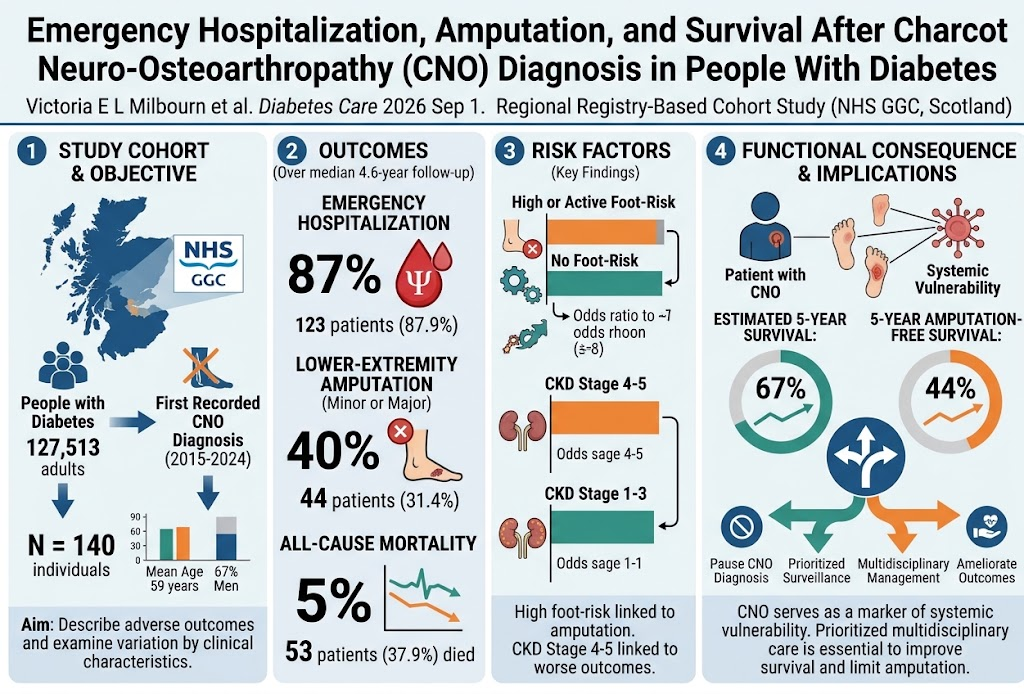
- Emergency hospitalization occurred in nearly 88% of diabetic adults newly diagnosed with Charcot neuro-osteoarthropathy (CNO) within a median follow-up of 4.6 years.
- More than 30% had a lower-extremity amputation, and nearly 38% died during the follow-up period, demonstrating poor overall prognosis post-CNO diagnosis.
- Advanced chronic kidney disease and active foot risk status strongly predicted amputation and mortality, underscoring systemic vulnerability in this population.
- Five-year amputation-free survival was only 44%, emphasizing the critical need for early identification and targeted multidisciplinary interventions.
Study Background
Charcot neuro-osteoarthropathy (CNO) is a debilitating complication predominantly seen in individuals with diabetic peripheral neuropathy. It is characterized by progressive destruction of bones, joints, and soft tissues of the foot and ankle, often leading to deformity, instability, and heightened risk of ulceration and infection. These consequences frequently culminate in lower-extremity amputation, a major adverse outcome linked to increased healthcare utilization and mortality.
Despite the recognized severity of CNO, there remains a paucity of comprehensive large-scale data that delineate long-term adverse clinical outcomes such as emergency hospitalization rates, amputation incidence, and survival after CNO diagnosis in people with diabetes. Understanding these outcomes and their relationships with clinical and sociodemographic factors is essential to improve prognostication and guide multidisciplinary management strategies.
Study Design
This investigation was a regional, registry-based cohort study utilizing linked routinely collected healthcare data from the National Health Service Greater Glasgow and Clyde in Scotland, spanning 2015 to 2024. From a large diabetes population (n=127,513 adults), 140 individuals with a first recorded diagnosis of CNO were identified. The cohort’s mean age was 59 years, with 67% men.
The study endpoints included all-cause emergency hospitalization, lower-extremity amputation (both minor and major), all-cause mortality, and amputation-free survival. Time-to-event analyses and multivariable regression modeling were applied to estimate event probabilities and identify clinical risk factors associated with outcomes.
Key Findings
During a median follow-up of 4.6 years, 123 patients (87.9%) experienced at least one emergency hospital admission, reflecting the high burden of acute complications following CNO diagnosis. Lower-extremity amputations were observed in 44 individuals (31.4%), indicating substantial limb loss risk associated with CNO progression or its complications.
Mortality was also significant, with 53 patients (37.9%) dying during the follow-up period. The estimated 5-year survival rate was 67%, underscoring high mortality in this vulnerable group. Importantly, 5-year amputation-free survival was only 44%, with a median amputation-free survival time of approximately 4 years, indicating a substantial likelihood of either death or amputation within five years following CNO diagnosis.
Clinically, advanced chronic kidney disease (stage 4 or 5) was a strong predictor of worse outcomes across all studied endpoints. This highlights the impact of systemic comorbidities on prognosis. Additionally, having a high or active foot-risk status—a classification denoting current foot ulceration, infection, or deformity—was independently associated with substantially increased risk of amputation (subdistribution hazard ratio 8.52; 95% confidence interval [CI], 2.05 to 35.45) and shorter amputation-free survival (hazard ratio 2.09; 95% CI, 1.15 to 3.80).
Older age was another independent risk factor, particularly associated with higher mortality rates (hazard ratio 3.04; 95% CI, 1.50 to 6.16), reflecting the compounded vulnerability in aged individuals with diabetes and CNO.
Expert Commentary
This study provides valuable real-world evidence that CNO in people with diabetes is a critical indicator of systemic health vulnerability. The remarkably high rates of emergency hospitalizations, lower-extremity amputations, and death shortly after diagnosis challenge clinicians to prioritize proactive, integrated care approaches.
While previous literature has recognized the destructive local foot pathology in CNO, this study expands understanding by quantifying broader adverse outcomes and their timing. The strong association with advanced kidney disease emphasizes the need for holistic patient assessment beyond the foot. Moreover, the findings reinforce the importance of foot-risk stratification in predicting amputation risk, urging clinicians to closely monitor and aggressively manage patients identified as high risk.
Study limitations include the moderately small sample size of CNO cases due to the rarity of the condition, and the observational design which may be subject to residual confounding. However, the use of high-quality, linked registry data with long follow-up strengthens the validity and applicability of the findings within similar healthcare settings.
Conclusion
Adults with diabetes diagnosed with Charcot neuro-osteoarthropathy face a precarious clinical course marked by frequent emergency hospital admissions, a high incidence of limb amputation, and substantial mortality within five years. Advanced chronic kidney disease and active foot pathology further exacerbate these risks. Recognizing CNO as a marker of systemic vulnerability mandates enhanced vigilance, prioritized surveillance, and coordinated multidisciplinary care in clinical practice to mitigate adverse outcomes and improve patients’ quality of life and survival.
Funding and Trial Registration
The study was conducted using routine healthcare data from NHS Greater Glasgow and Clyde. There is no specific funding or clinical trial registration documented for this observational study.
References
1. Milbourn VEL, Barn R, Tieges Z, et al. Emergency Hospitalization, Amputation, and Survival After Charcot Neuro-Osteoarthropathy Diagnosis in People With Diabetes: A Regional Registry-Based Cohort Study. Diabetes Care. 2026 Sep 01;49(9):1738-1746. PMID: 42520058.
2. Armstrong DG, Stevens CM, Attinger CE, et al. Charcot neuroarthropathy: The complete treatment guide. Wound Repair and Regeneration. 2020;28(4):366-377.
3. Petrova NL. Diabetic neuro-osteoarthropathy (Charcot foot): challenges and solutions. Diabetes, Metabolic Syndrome and Obesity: Targets and Therapy. 2014;7:507-517.
This article was created using several editorial tools, including AI, as part of the process. Human editors reviewed this content before publication.