We use cookies

Our website uses essential cookies and, with your consent, additional cookies to measure performance and improve our services. Cookie Policy.

You can change your choice at any time.

MMedXYNews
HomeVideos
MedXY AI/MedXY News/Section: Cardiology

Comparative Effectiveness of Carvedilol Versus Other Nonselective β-Blockers in Cirrhosis: A Clinical Review
MedXY Editorial Team•Aug 27, 2026•Cardiology
cirrhosisPortal Hypertensionnonselective beta-blockerscarvedilol

Highlights

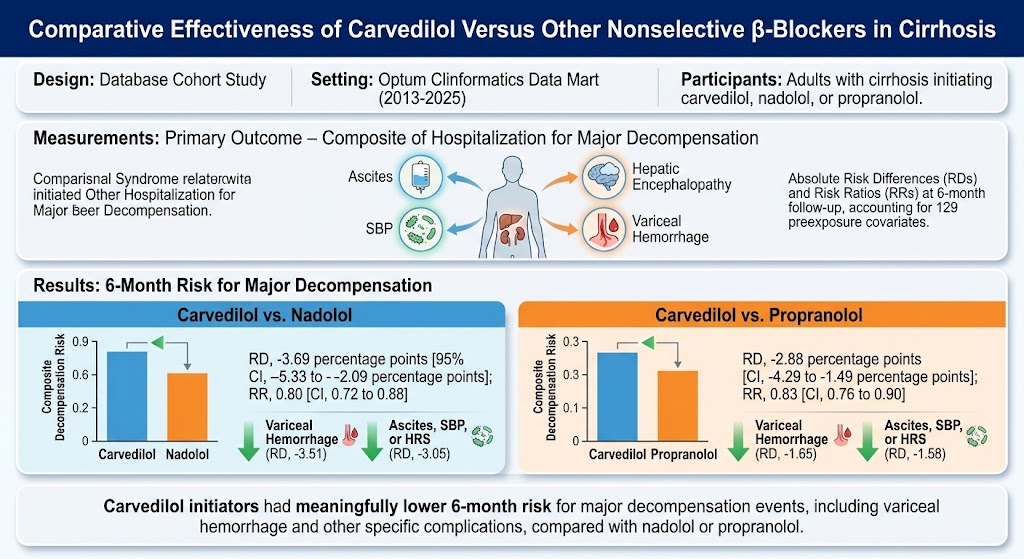
  • Carvedilol reduces the risk of major cirrhosis decompensation events more effectively than nadolol and propranolol.
  • Meta-analyses and randomized trials reveal carvedilol’s superior reduction of hepatic venous pressure gradient (HVPG) in cirrhotic patients.
  • Real-world observational studies confirm carvedilol’s protective effect against variceal hemorrhage, ascites, spontaneous bacterial peritonitis (SBP), and hepatorenal syndrome (HRS).
  • Carvedilol’s dual beta- and alpha-1 adrenergic blockade provides mechanistic advantages in managing portal hypertension.

Background

MedXY registered readers

Sign in free to continue reading

Create or use your MedXY account to unlock the complete article.

This article was created using several editorial tools, including AI, as part of the process. Human editors reviewed this content before publication.

Related articles

Open language-specific specialty feeds and department pages.

From Pressure Metrics to Personalized Prognosis: Transforming Risk Assessment in Advanced Chronic Liver DiseaseA shift from static portal pressure thresholds to dynamic, non-invasive risk prediction models offers improved prognostic accuracy for decompensation in advanced chronic liver disease, enabling personalized patient management and better cliAug 31, 2026Optimizing Diabetes Management in Cirrhosis: A Practical Clinical GuideCirrhosis entwined with diabetes presents unique clinical challenges. This article offers a pragmatic framework for diagnosis, tailored therapies, and multidisciplinary care to enhance outcomes across liver disease stages.Aug 18, 2026Rapid Skeletal Muscle Loss in Cirrhosis: Predictors, Outcomes, and Implications for Clinical ManagementRapid skeletal muscle loss occurs in a significant subset of cirrhosis patients and independently predicts waitlist mortality, highlighting sarcopenia as a critical therapeutic target in liver disease management.Aug 4, 2026New A-TANGO Organ Failure Score Refines ACLF Diagnosis and Risk Stratification in Global Cohorts
Loading comments...
MedXY briefing

Get the free newsletter

Evidence-led clinical news, trends, and analysis—delivered to your inbox.

Ask MedXY AI

Most popular

Intimate Health
Five Benefits for Women Continuing Sexual Activity After Menopause
Intimate Health
Why Some Women Have a Strong Sex Drive—And Why Men Shouldn't Worry About It
Nursing & care
How often should a couple have sex?
Intimate Health
Classic Intimacy Recommendations: How to Help Women Reach Orgasm and Enjoy Mutual Pleasure
Intimate Health
What Makes a Woman "Physiologically Addicted" Is Never Money, But These Two Relationship Qualities
© 2026 MedXY
Contact usAbout usPrivacy PolicyMedXY story
A new organ failure score, A-TANGO, improves ACLF diagnosis and risk stratification compared to standard CLIF-C criteria, validated in large international cohorts.
Jul 26, 2026
Circulating Methylated SEPT9 as a Novel Biomarker for Early Detection of Hepatocellular Carcinoma in Cirrhotic PatientsCombining circulating methylated SEPT9 with alpha-fetoprotein significantly enhances early hepatocellular carcinoma detection in cirrhotic patients, outperforming AFP alone and allowing improved surveillance sensitivity and specificity.Jul 9, 2026
HBsAg Seroclearance Lowers Hepatocellular Carcinoma Risk Beyond Viral Suppression in Cirrhosis, but Does Not Reduce Hepatic DecompensationIn NA-treated cirrhotic chronic hepatitis B with complete viral suppression, HBsAg seroclearance was linked to lower HCC risk but not lower hepatic decompensation, reinforcing functional cure as a meaningful but incomplete clinical endpointJun 10, 2026