Belatacept and Sirolimus Show Promise as Safer Immunosuppression in Islet Transplantation for Type 1 Diabetes
Highlight
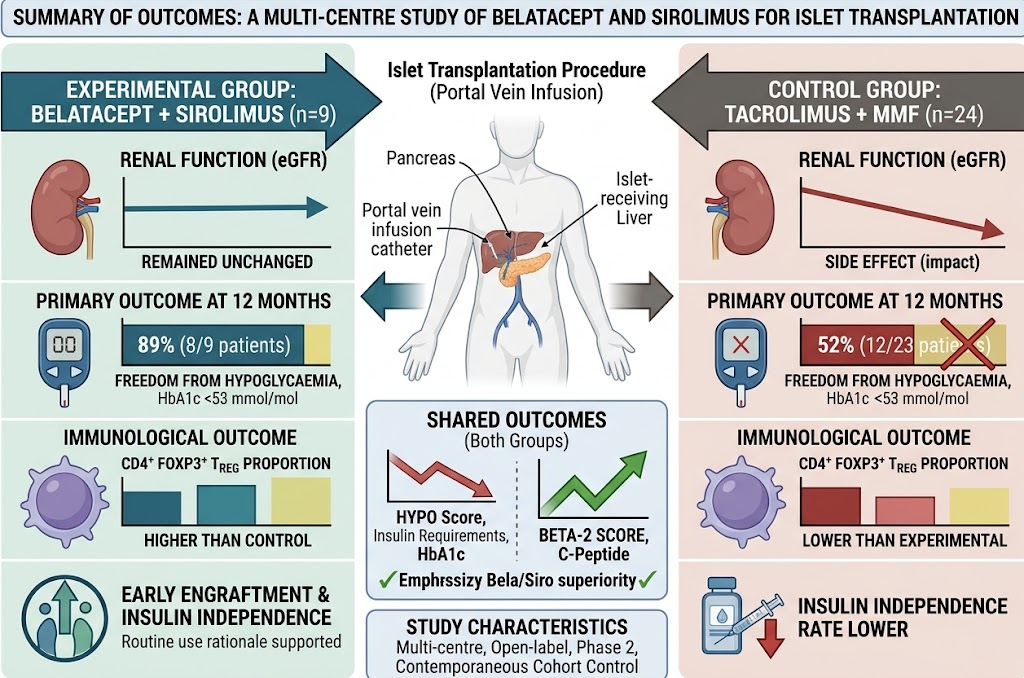
This multi-centre phase 2 study evaluated belatacept combined with sirolimus as an alternative immunosuppressive regimen in human islet transplantation for patients with type 1 diabetes and hypoglycaemia unawareness. Key findings are: 1) 89% of patients on belatacept/sirolimus achieved insulin independence and freedom from hypoglycaemia at 12 months, surpassing the tacrolimus/mycophenolate mofetil cohort; 2) renal function was preserved in the belatacept/sirolimus group, unlike the tacrolimus group; 3) regulatory T-cell proportions were increased with belatacept/sirolimus, potentially underpinning graft tolerance; and 4) the combination therapy demonstrated sustained immunosuppression across relevant immune cell subsets without compromising metabolic outcomes.
Study Background
Type 1 diabetes mellitus (T1DM) is a chronic autoimmune condition characterized by destruction of pancreatic beta cells, leading to insulin dependence. For select patients with severe hypoglycaemia unawareness, islet transplantation represents a vital therapeutic option that can restore endogenous insulin production and reduce glycaemic variability. However, maintenance immunosuppression traditionally relies on calcineurin inhibitors (CNIs) like tacrolimus, which are effective but associated with significant nephrotoxicity and other adverse effects limiting long-term outcomes.
Belatacept, a co-stimulatory blockade agent that inhibits CD28-CD80/86 signaling, and sirolimus, a mammalian target of rapamycin (mTOR) inhibitor, have demonstrated favorable efficacy and safety profiles in solid organ transplantation but remain untested rigorously in human islet transplantation. Addressing this knowledge gap could offer safer immunosuppressive strategies that improve graft survival while minimizing patient morbidity.
Study Design
This was an open-label, non-randomised, multi-centre phase 2 clinical study involving adult participants with T1DM undergoing at least one islet transplant. The study compared immunosuppression with belatacept and sirolimus (bela/siro) against a contemporaneous cohort treated with standard tacrolimus and mycophenolate mofetil (tac/MMF).
The primary outcome was a composite endpoint at 12 months post-transplant: freedom from hypoglycaemia symptoms, presence of detectable C-peptide indicating islet function, and an HbA1c <53 mmol/mol (7.0%). Secondary endpoints included metabolic control according to Igls criteria and BETA-2 score, incidence of allosensitization, and changes in peripheral blood immune cell populations.
Key Findings
Nine patients received bela/siro, and 24 patients received tac/MMF immunosuppression. The bela/siro group demonstrated superior outcomes, with 8 of 9 (89%) achieving the primary composite endpoint versus 12 of 24 (52%) in the tac/MMF group, suggesting enhanced early islet engraftment and function.
Both groups showed significant reductions in HbA1c, hypoglycaemia scores, and insulin requirements, but only the bela/siro group maintained stable renal function over the 12-month period. This supports the hypothesis that avoiding CNIs mitigates nephrotoxic effects associated with standard immunosuppression.
Immunophenotyping revealed sustained suppression of major monocyte, natural killer, T cell, and B cell populations in both groups, consistent with effective immunosuppression. Notably, the bela/siro group had significantly increased proportions of CD4+FOXP3+ regulatory T cells, which play a crucial role in inducing graft tolerance and may contribute to improved outcomes.
No significant safety concerns or opportunistic infections were reported with the bela/siro regimen during the follow-up, underscoring its tolerability.
Expert Commentary
The findings from this trial suggest that belatacept-based immunosuppression combined with sirolimus provides an efficacious and safer alternative to conventional tacrolimus regimens in islet transplantation for T1DM. The observed preservation of renal function is clinically meaningful, as renal impairment is a major limitation in long-term transplant care.
Increased regulatory T-cell populations further bolster the biological plausibility of this approach’s ability to promote immune tolerance. However, the study’s non-randomised design and relatively small sample size require cautious interpretation. Randomized controlled trials with larger cohorts and longer follow-up are needed to confirm these promising results and evaluate graft longevity and patient survival comprehensively.
Conclusion
This study provides evidence supporting the use of belatacept plus sirolimus as a baseline immunosuppressive regimen in human islet transplantation, achieving high rates of insulin independence and hypoglycaemia avoidance while preserving renal function. These results highlight a potential paradigm shift away from CNIs that may improve long-term transplant outcomes and patient quality of life.
Further investigations should focus on optimizing dosing, monitoring immune tolerance mechanisms, and extending follow-up to assess long-term efficacy and safety.
Funding and Trial Registration
The study was registered with the Australian New Zealand Clinical Trials Registry (ANZCTR) under ACTRN12619000268145. Details of funding sources were not provided in the abstract.
References
1. Rogers NM, Hu M, Jimenez-Vera E, et al. A multi-centre study of belatacept and sirolimus for islet transplantation. Diabetologia. 2026 Aug 17. PMID: 42608595.
2. Shapiro AMJ, Lakey JRT, Ryan EA, et al. Islet transplantation in seven patients with type 1 diabetes mellitus using a glucocorticoid-free immunosuppressive regimen. New England Journal of Medicine. 2000 Jul 27;343(4):230-8.
3. Larsen CP, Pearson TC, Adams AB, et al. Rational development of LEA29Y (belatacept), a high-affinity variant of CTLA4-Ig with potent immunosuppressive properties. American Journal of Transplantation. 2005 Sep;5(9):443-53.
4. Kandaswamy R, Stock PG, Adams M, et al. Belatacept in renal transplantation: a critical review. Expert Opinion on Biological Therapy. 2014 Feb;14(2):297-307.
This article was created using several editorial tools, including AI, as part of the process. Human editors reviewed this content before publication.