Baseline Ischemic Burden Influences Tenecteplase Benefit Before Thrombectomy in Acute Stroke: Insights from the BRIDGE-TNK Trial
Highlight
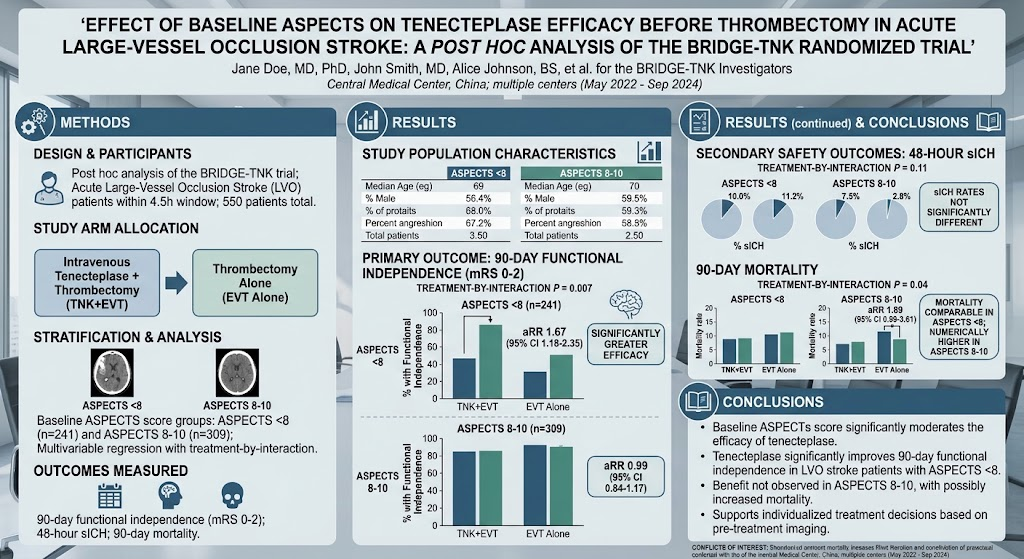
- Tenecteplase prior to thrombectomy improves 90-day functional independence in patients with baseline extensive ischemia (ASPECTS <8).
- No significant benefit and potential safety concerns from tenecteplase were observed in patients with mild to moderate baseline ischemia (ASPECTS 8-10).
- Symptomatic intracranial hemorrhage rates were similar irrespective of ASPECTS subgroup and treatment allocation.
- Findings highlight the need for individualized treatment decisions based on baseline ischemic burden and call for prospective validation.
Study Background
Acute ischemic stroke caused by large-vessel occlusion (LVO) represents a critical neurological emergency associated with substantial morbidity and mortality. Endovascular thrombectomy (EVT) has revolutionized management, achieving reperfusion and improved outcomes when performed timely. However, the role and benefit of intravenous thrombolysis with tenecteplase before thrombectomy remain uncertain, particularly concerning the ischemic extent present on baseline brain imaging. The Alberta Stroke Program Early Computed Tomography Score (ASPECTS) is an established 10-point scale assessing early ischemic changes on non-contrast computed tomography (CT), with lower scores indicating more extensive ischemia.
Previous data suggested that patients with lower ASPECTS may have limited benefit or increased bleeding risk from thrombolysis, but the interactions specifically between baseline ASPECTS, tenecteplase, and thrombectomy outcomes remain inadequately addressed. This post hoc analysis of the BRIDGE-TNK randomized trial investigates whether baseline ischemic extent modifies efficacy and safety of intravenous tenecteplase prior to thrombectomy in acute LVO stroke.
Study Design
The analysis included 550 acute ischemic stroke patients enrolled in the BRIDGE-TNK trial conducted in China from May 2022 to September 2024. Eligible patients presented within 4.5 hours from last known well with anterior circulation LVO. Patients were randomized to receive either intravenous tenecteplase plus thrombectomy or thrombectomy alone.
Baseline ischemic extent was assessed using ASPECTS and dichotomized as low (<8) versus high (8-10). Primary efficacy endpoint was functional independence defined as a modified Rankin Scale (mRS) score of 0-2 at 90 days. Safety outcomes included 48-hour symptomatic intracranial hemorrhage (sICH) and 90-day mortality. Data were analyzed using multivariable regression models incorporating an interaction term for treatment and ASPECTS category to detect modification effects.
Key Findings
Of the 550 patients, 241 (43.8%) had baseline ASPECTS <8 and 309 had ASPECTS 8-10. Median ages and sex distributions were comparable between groups.
In the ASPECTS <8 subgroup, tenecteplase plus thrombectomy significantly increased the likelihood of functional independence at 90 days compared to thrombectomy alone (adjusted risk ratio [aRR] 1.67, 95% confidence interval [CI] 1.18–2.35). Conversely, no benefit was observed in the ASPECTS 8-10 subgroup (aRR 0.99, 95% CI 0.84–1.17), and the interaction test was statistically significant (p=0.007), indicating the effect of tenecteplase varies by ischemic extent.
Regarding safety, sICH rates were not significantly different between treatment arms in either ASPECTS subgroup (ASPECTS <8: 10.0% vs 11.2%; ASPECTS 8-10: 7.5% vs 2.8%; interaction p=0.11). Mortality at 90 days was similar in the ASPECTS <8 subgroup but showed a numerical, though not statistically robust, increase with tenecteplase plus thrombectomy in the ASPECTS 8-10 subgroup (aRR 1.89, 95% CI 0.99–3.61; interaction p=0.04).
Expert Commentary
This post hoc analysis offers intriguing evidence that tenecteplase’s efficacy before thrombectomy may depend critically on the baseline ischemic burden. The greater functional benefit observed in patients with extensive ischemia (ASPECTS <8) is noteworthy, challenging the conventional notion that thrombolysis benefits diminish as ischemic damage worsens. The lack of benefit and potential safety concerns in patients with higher ASPECTS (milder ischemia) might suggest differing pathophysiological responses or procedural variables influencing outcomes.
However, these findings require cautious interpretation. Being a post hoc subgroup analysis, the study is susceptible to confounding and lacks the confirmatory power of prospective stratified trials. Variations in imaging assessment, heterogeneity of stroke location and collateral status, and other unmeasured factors could influence results. Thus, current guidelines should not change based solely on these exploratory data. Ongoing and future randomized trials designed to test the interaction of ASPECTS and thrombolytic treatment will be critical to validate these observations.
Conclusion
The BRIDGE-TNK trial post hoc analysis identifies baseline ischemic extent by ASPECTS as a potential modifier of tenecteplase efficacy before endovascular thrombectomy in acute large-vessel occlusion stroke. Patients with more extensive early ischemia (ASPECTS <8) appear to gain greater functional independence with combined intravenous tenecteplase and thrombectomy compared to thrombectomy alone, without increased bleeding risk. Conversely, patients with less ischemic involvement (ASPECTS 8-10) do not benefit functionally and may face higher mortality risk.
These findings emphasize the importance of individualized patient selection based on imaging characteristics for intravenous thrombolysis bridging therapy. Confirmation in prospectively designed, adequately powered randomized trials is necessary to inform clinical practice guidelines and optimize stroke care paradigms.
Funding and Clinical Trial Registration
The BRIDGE-TNK trial was conducted with funding sources as reported in the original publication. The study is registered at ClinicalTrials.gov with identifier NCT04733742.
References
Huang X, Xu J, Saver JL, et al. Effect of Baseline ASPECTS on Tenecteplase Efficacy Before Thrombectomy in Acute Large-Vessel Occlusion Stroke: A Post Hoc Analysis of the BRIDGE-TNK Randomized Trial. Neurology. 2026 Aug 20;107(6):e218467. PMID: 42623571.
Goyal M, Menon BK, van Zwam WH, et al. Endovascular thrombectomy after large-vessel ischaemic stroke: a meta-analysis of individual patient data from five randomised trials. Lancet. 2016 Apr 23;387(10029):1723-31.
Campbell BCV, Mitchell PJ, Churilov L, et al. Tenecteplase versus alteplase before thrombectomy for ischemic stroke. N Engl J Med. 2018 Jul 19;379(17):1579-1587.
This article was created using several editorial tools, including AI, as part of the process. Human editors reviewed this content before publication.