Balancing Risks: Safety Profiles of Antiseizure Medications in Epilepsy Patients on Direct Oral Anticoagulants
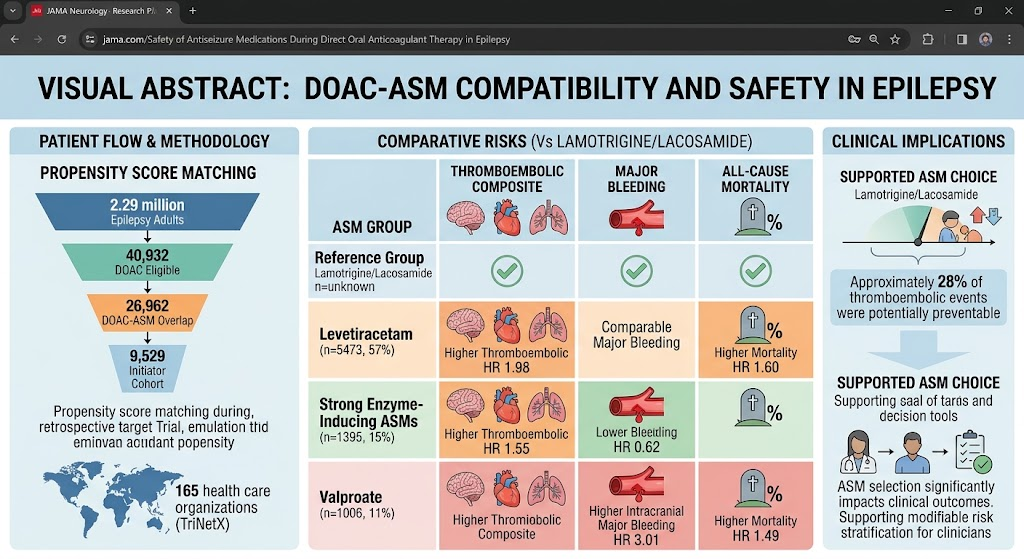
Highlight
1. Antiseizure medication (ASM) choice significantly affects thromboembolic, bleeding, and mortality risks in epilepsy patients treated with direct oral anticoagulants (DOACs).
2. Levetiracetam use is associated with nearly doubled thromboembolic risk and increased all-cause mortality compared to lamotrigine/lacosamide.
3. Strong enzyme-inducing ASMs elevate thromboembolic risk but reduce major bleeding events.
4. Valproate increases all-cause mortality and intracranial major bleeding risk, highlighting the nuanced safety profiles of ASMs during DOAC therapy.
Study Background
Epilepsy is a common neurological disorder often requiring chronic antiseizure medication (ASM) therapy. Many adults with epilepsy also carry cardiovascular risk factors necessitating anticoagulation, frequently with direct oral anticoagulants (DOACs) due to their convenient dosing and improved safety profiles compared to vitamin K antagonists (VKAs). However, concomitant use of ASMs and DOACs raises clinical concerns due to potential drug-drug interactions impacting coagulation and ASM plasma levels, thereby modifying thromboembolic and bleeding risks. Furthermore, the enzyme-inducing properties of certain ASMs can alter DOAC metabolism, complicating safe therapy. Despite its importance, comparative safety data on ASM choice during DOAC use in epilepsy patients remain scarce, posing an unmet need in guiding optimal treatment decisions to minimize adverse events.
Study Design
This retrospective cohort study utilized a large, international electronic health record platform, the TriNetX Global Collaborative Network, encompassing 165 health care organizations worldwide. Adults (≥18 years) with epilepsy treated with DOACs were identified. Exclusions included recent vitamin K antagonist use, strong cytochrome P450 3A4/P-glycoprotein modulators, and recent major vascular events to limit confounding.
The study emulated several target trials comparing four ASM monotherapy groups—levetiracetam, valproate, moderate enzyme-inducing ASMs, and strong enzyme-inducing ASMs (e.g., carbamazepine, phenytoin)—each against a pooled reference group of lamotrigine or lacosamide users. One-to-one propensity score matching was employed within four cohorts to emulate randomization and balance confounders, estimating per-protocol outcomes from sustained ASM monotherapy. Follow-up began after a 90-day landmark period. Primary outcomes included a composite thromboembolic endpoint (ischemic stroke, myocardial infarction, pulmonary/systemic embolism), major bleeding, and all-cause mortality. Sensitivity analyses considered patients treated with VKAs for comparative insight.
Key Findings
From an initial 2.29 million adults with epilepsy, 9529 eligible DOAC-ASM monotherapy initiators formed the study cohort (mean age, 63 years; 51% female). Distribution was 57% on levetiracetam, 15% on strong enzyme-inducing ASMs, 11% on valproate, and 4% on moderate enzyme-inducing ASMs.
Thromboembolic Risk:
- Levetiracetam was significantly associated with increased thromboembolic risk compared to lamotrigine/lacosamide (HR 1.98; 95% CI, 1.37-2.87), nearly doubling the hazard of events such as stroke and myocardial infarction.
- Strong enzyme-inducing ASMs also elevated thromboembolic risk (HR 1.55; 95% CI, 1.02-2.36), though with a lower magnitude.
- Valproate and moderate enzyme-inducing ASMs did not show significant thromboembolic risk elevation in the primary analysis.
Major Bleeding:
- Levetiracetam showed comparable major bleeding rates to reference ASMs.
- Strong enzyme-inducing ASMs were paradoxically associated with lower major bleeding risk (HR 0.62; 95% CI, 0.46-0.83), suggesting possible protective effects or confounding factors.
- Valproate demonstrated a marked increase in intracranial major bleeding risk (HR 3.01; 95% CI, 1.45-6.26), underscoring heightened brain hemorrhage vulnerability.
All-Cause Mortality:
- Levetiracetam users experienced significantly higher all-cause mortality (HR 1.60; 95% CI, 1.23-2.08).
- Valproate use also correlated with elevated mortality risk (HR 1.49; 95% CI, 1.09-2.04).
- Strong enzyme-inducing and moderate enzyme-inducing ASMs showed no statistically significant mortality increases.
Notably, sensitivity analysis in patients on VKAs demonstrated near-null thromboembolic risks across ASM groups, suggesting interaction with DOAC pharmacokinetics may underlie the observed differences.
Approximately 28% of thromboembolic events might be preventable by preferentially using lamotrigine/lacosamide based on this comparative risk analysis.
Expert Commentary
This landmark study provides critical insights into the clinical safety implications of ASM choice during DOAC therapy in epilepsy patients, a frequently encountered and clinically challenging scenario. The differential patterns of thromboembolism, bleeding, and mortality underscore the complexity of managing polypharmacy in this population.
The association of levetiracetam—a widely used ASM—with higher thromboembolic and mortality risk is paradoxical, as it is generally considered devoid of enzyme induction effects. Potential explanations include pharmacodynamic interactions, behavioral or comorbidity confounders, or unrecognized effects on DOAC metabolism or platelet function. Strong enzyme-inducing ASMs such as carbamazepine and phenytoin, known to enhance cytochrome P450 and P-glycoprotein activity, theoretically reduce DOAC plasma levels, increasing thromboembolic risk but seemingly lowering bleeding risk. Valproate’s association with both increased intracranial bleeding and mortality warrants caution, especially given its use in patients with epilepsy complicated by cardiovascular comorbidities.
Study strengths include a large multi-national cohort, robust propensity score matching, and comprehensive outcome assessment. Limitations include observational design residual confounding, unknown adherence levels, and possible indication bias. The study excluded recent major vascular event patients, possibly limiting generalizability to higher-risk groups.
Clinicians should be mindful of these ASM safety profiles when managing epilepsy patients on DOACs. Lamotrigine/lacosamide appear safer reference choices with lower thromboembolic and bleeding risks. Given the preventable proportion of thromboembolic events, these findings support an individualized, evidence-driven approach to ASM selection aligned with anticoagulation therapy.
Conclusion
This retrospective cohort study highlights that antiseizure medication choice significantly impacts thromboembolic, bleeding, and mortality outcomes in adults with epilepsy treated with direct oral anticoagulants. Levetiracetam and strong enzyme-inducing ASMs increase thromboembolism risk, while valproate raises intracranial bleeding and mortality. Lamotrigine/lacosamide offer a safer profile and could reduce preventable thromboembolic events. These data emphasize ASM selection as a modifiable factor in optimizing clinical outcomes and underscore the need for prospective studies to further elucidate mechanisms and confirm guidance for clinical practice.
Funding and ClinicalTrials.gov
No specific funding or ClinicalTrials.gov registration was reported for this retrospective data analysis.
References
- Schubert KM, Ferreira-Atuesta C, Soma A, et al. Safety of Antiseizure Medications During Direct Oral Anticoagulant Therapy in Epilepsy. JAMA Neurology. 2026; PMID:42606848.
- Douros A, Patorno E, Mazzucchelli G, et al. Drug–drug interactions of direct oral anticoagulants: Clinical evidence and mechanisms. Thromb Haemost. 2020;120(10):1378-1389.
- Leypoldt F, Zalewski N. Pharmacokinetic considerations in epilepsy and anticoagulation therapy. Epilepsia. 2019;60 Suppl 3:S69-S78.
- Lip GYH, Banerjee A, Alcalai H, et al. Anticoagulation therapy in patients with stroke and epilepsy: Balancing ischemic and hemorrhagic risks. Stroke. 2021;52(12):3734-3742.
This article was created using several editorial tools, including AI, as part of the process. Human editors reviewed this content before publication.