We use cookies

Our website uses essential cookies and, with your consent, additional cookies to measure performance and improve our services. Cookie Policy.

You can change your choice at any time.

MMedXYNews
HomeVideos
© 2026 MedXY
Contact usAbout usPrivacy PolicyMedXY story
MedXY AI/MedXY News/Section: Nephrology

Balancing Blood Pressure After Endovascular Thrombectomy: Risks of Acute Kidney Injury and Impact on Stroke Recovery
MedXY Editorial Team•Aug 4, 2026•Nephrology
ischemic strokeEndovascular Thrombectomyacute kidney injuryBlood Pressure Management

Highlight

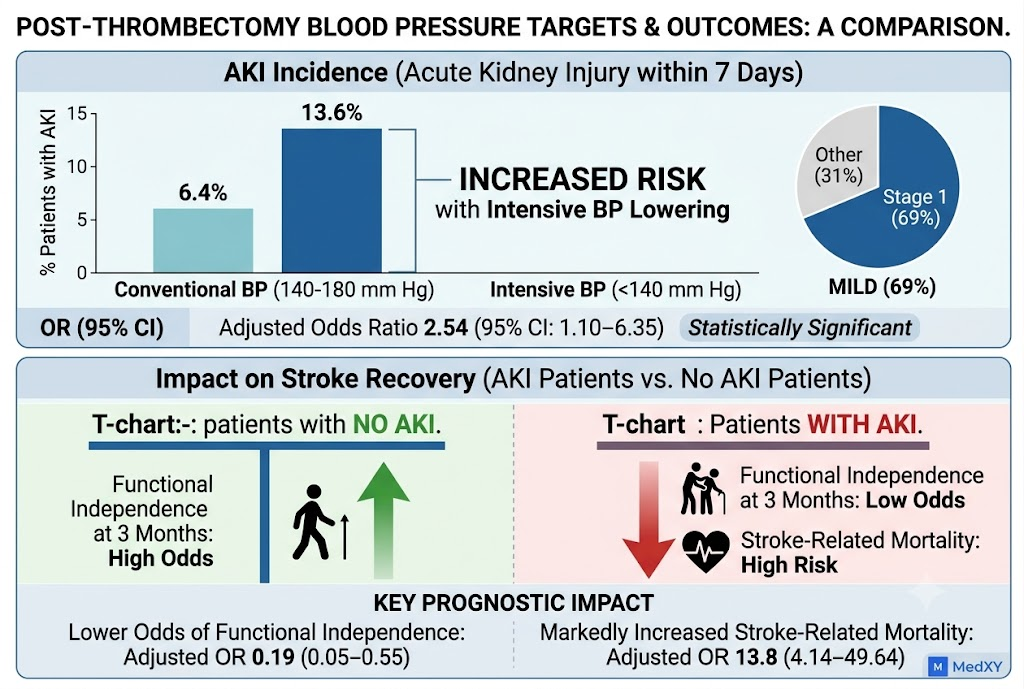
  • Intensive systolic blood pressure (BP) lowering (<140 mm Hg) after successful endovascular thrombectomy significantly increases the risk of acute kidney injury (AKI) compared to conventional BP targets (140-180 mm Hg).

  • Most AKI events observed were mild (stage 1), yet they were associated with markedly worse neurological outcomes, including lower functional independence and higher mortality at 3 months.

  • AKI after thrombectomy represents a marker of systemic hemodynamic vulnerability and indicates the need for cautious post-procedure BP management.

Study Background

MedXY registered readers

Sign in free to continue reading

Create or use your MedXY account to unlock the complete article.

This article was created using several editorial tools, including AI, as part of the process. Human editors reviewed this content before publication.

Related articles

Open language-specific specialty feeds and department pages.

Inpatient Rehabilitation and Major Adverse Cardiovascular Events After Ischemic Stroke: Clinical Implications and Evidence SynthesisPostacute discharge to inpatient rehabilitation facilities (IRF) after acute ischemic stroke (AIS) is associated with a reduced 1-year risk of major adverse cardiovascular events (MACE) compared to discharge to home or skilled nursing facilSep 19, 2026Emergent Interfacility Transfers for Ischemic Stroke in the U.S.: Patterns and Implications from 2016 to 2022This study analyzes national trends in emergent interfacility ischemic stroke transfers among Medicare beneficiaries, revealing shifts in transfer rates, patient characteristics, and hospital features associated with transferred versus nontSep 19, 2026Unlocking the Potential of Novel Biomarkers for Acute Kidney Injury in the Critically Ill: A Comprehensive Evidence MappingThis article reviews over 1100 studies on novel biomarkers for acute kidney injury (AKI) in critically ill patients, highlighting their predictive, diagnostic, and management roles while identifying gaps for future clinical implementation.Sep 18, 2026
Loading comments...
MedXY briefing

Get the free newsletter

Evidence-led clinical news, trends, and analysis—delivered to your inbox.

Ask MedXY AI

Most popular

Intimate Health
Five Benefits for Women Continuing Sexual Activity After Menopause
Intimate Health
Why Some Women Have a Strong Sex Drive—And Why Men Shouldn't Worry About It
Nursing &amp; care
How often should a couple have sex?
Intimate Health
Classic Intimacy Recommendations: How to Help Women Reach Orgasm and Enjoy Mutual Pleasure
Intimate Health
What Makes a Woman "Physiologically Addicted" Is Never Money, But These Two Relationship Qualities
SGLT2 Inhibitors Enhance Recovery After Endovascular Thrombectomy in Diabetic Stroke Patients: A Multicenter Retrospective Study
SGLT2 inhibitors administered after endovascular thrombectomy in diabetic stroke patients significantly improve 3-month functional outcomes, suggesting a promising adjunctive therapy for poststroke diabetes management.
Sep 18, 2026
Evaluating Stroke Risk in Asymptomatic Carotid Stenosis: Transcarotid Artery Revascularization versus Carotid Artery StentingThis comparative analysis assesses ischemic stroke outcomes in patients with asymptomatic carotid stenosis undergoing transcarotid artery revascularization (TCAR) versus carotid artery stenting (CAS), highlighting no significant differenceSep 17, 2026
Impact of an AI-Powered Gamified Mobile Health Application on Blood Pressure Control in a Matched Patient CohortStudy found that use of an AI-driven gamified mobile app integrating home blood pressure monitoring significantly improved blood pressure control compared to usual care in hypertensive patients.Sep 17, 2026