Balancing Benefits and Risks: Prophylactic Thyroidectomy Outcomes in Pediatric MEN2 Patients
Highlight
- Prophylactic-intent thyroidectomy in children with MEN2 mutations effectively prevents advanced medullary thyroid carcinoma (MTC) development, achieving excellent short-term oncologic outcomes.
- High rates of postoperative hypoparathyroidism, including permanent cases, particularly in children operated on before age 5, underscore significant surgical morbidity risks.
- Genotype-based surgical timing combined with calcitonin monitoring enables individualized management, but multidisciplinary expertise is critical to balance oncologic benefit against long-term morbidity.
Background
Multiple endocrine neoplasia type 2 (MEN2) is an inherited cancer syndrome caused by germline mutations in the RET proto-oncogene. A hallmark of MEN2 is a virtually guaranteed lifetime risk of developing medullary thyroid carcinoma (MTC), a malignant tumor of parafollicular C-cells. Given the early onset and aggressive nature of MTC, prophylactic thyroidectomy during childhood is the recommended preventive strategy. Advances in genetic testing and biochemical markers such as serum calcitonin allow clinicians to tailor the timing of surgery based on mutation risk categories and presymptomatic disease indicators.
However, performing total thyroidectomy in very young children poses significant challenges, notably the risk of surgical complications such as permanent hypoparathyroidism, which can markedly affect quality of life. This study retrospectively analyzes the balance between surgical morbidity and early oncologic outcomes in a contemporary French pediatric cohort undergoing prophylactic-intent thyroidectomy as part of routine MEN2 management.
Study Design
This study was a retrospective multicenter cohort investigation conducted through the French Groupe d’Étude des Tumeurs Endocrines (GTE), including children under 15 years old who underwent prophylactic-intent total thyroidectomy from 2010 to 2020. Subjects included children with confirmed germline RET mutations characteristic of MEN2, without clinically evident thyroid disease at surgery. Key data elements collected included:
- RET mutation genotype
- Age at surgery
- Preoperative serum calcitonin levels (adjusted for laboratory reference ranges)
- Details on the extent of surgery and lymph node assessment
- Histopathological examination results of thyroid tissue
- Postoperative complications, especially hypoparathyroidism and recurrent laryngeal nerve injury
- Oncologic outcomes at last clinical follow-up, including biochemical markers and structural disease status
The primary endpoints were short-term oncologic status—absence of structural disease—and incidence of surgical morbidity, particularly permanent hypoparathyroidism. Median postoperative follow-up was six years, sufficiently capturing early disease progression or surgical sequelae.
Key Findings
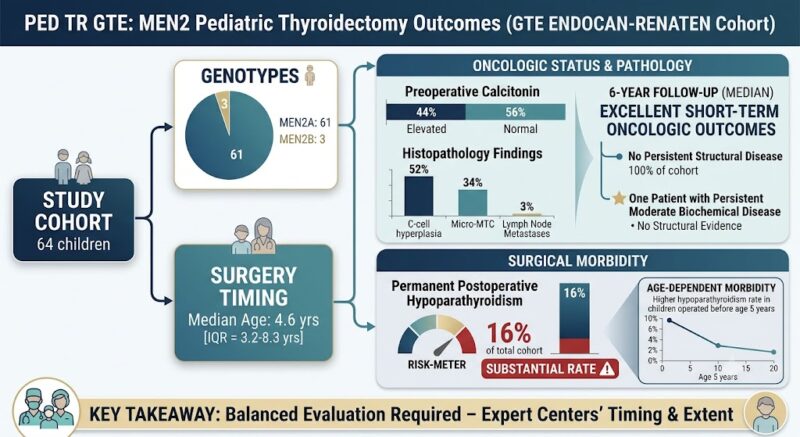
The study cohort comprised 64 children (61 with MEN2A and 3 with MEN2B), having a median age of 4.6 years (IQR 3.2–8.3) at thyroidectomy. Preoperative calcitonin elevation was detected in 44% of tested children, serving as a biochemical harbinger of early C-cell hyperplasia or micro-MTC. Histology showed classic pre-malignant C-cell hyperplasia in 52% and micro-MTC (tumor <1 cm) in 34%. Only 3% had lymph node metastases at surgery, indicating early disease stages at prophylactic intervention.
Oncologic outcomes were highly favorable: after a median 6 years of monitoring, no patient displayed persistent structural disease. One child had persistent moderate biochemical elevation of calcitonin without detectable tumors. These data support the efficacy of prophylactic surgery in early disease eradication or containment.
However, surgical morbidity was notable. Postoperative hypoparathyroidism developed in 31% of the cohort, with 16% experiencing permanent hypoparathyroidism, defined by need for lifelong calcium and vitamin D supplementation. Younger children, especially those operated on before age 5, were disproportionately affected, reflecting the technical challenges of operating in small anatomy and the fragile parathyroid glands.
Other complications, such as recurrent laryngeal nerve injury or bleeding, were not prominently reported, highlighting that hypoparathyroidism was the primary morbidity concern.
Expert Commentary
This study robustly illustrates the clinical dilemma inherent in managing pediatric MEN2 patients. While early prophylactic thyroidectomy effectively prevents clinical MTC, the risk of permanent hypoparathyroidism is a significant adverse consequence with lifelong implications. Current American Thyroid Association guidelines recommend mutation-specific timing for surgery, generally within early childhood for high-risk RET variants. However, this cohort’s findings emphasize that very early surgery (under 5 years) carries increased morbidity, perhaps warranting refined protocols.
Additionally, preoperative calcitonin measurements and genotype stratification remain indispensable tools for individualized timing. Emerging evidence encourages a multidisciplinary team approach incorporating pediatric endocrinology, surgery, pathology, and genetic counseling to optimize outcomes. Careful surgical technique prioritizing parathyroid preservation and potential autotransplantation should be emphasized in pediatric settings.
Limitations of this study include its retrospective design, potential center-to-center variability, and relatively short follow-up for assessing ultimate long-term oncologic outcomes. Nonetheless, it provides valuable real-world evidence that can inform refinement of prophylactic thyroidectomy timing and patient counseling.
Conclusion
Prophylactic-intent total thyroidectomy in children with germline RET mutations confers excellent short-term control of medullary thyroid carcinoma development. However, the considerable risk of permanent hypoparathyroidism, especially when surgery is undertaken before age five, highlights the necessity of careful multidisciplinary evaluation to balance early cancer control with long-term endocrine morbidity. Continued prospective studies and development of less morbid surgical techniques are needed to optimize management strategies and quality of life in this high-risk pediatric population.
Funding and Registration
This multicenter study was conducted under the auspices of the French Groupe d’Étude des Tumeurs Endocrines (GTE) ENDOCAN-RENATEN consortium. No specific funding or clinical trial registration is detailed in the publication.
References
- Morrell RM, et al. Prophylactic Thyroidectomy in Pediatric MEN2: Timing Based on Genetic Risk and Calcitonin Levels. J Clin Endocrinol Metab. 2020;105(6):e2203-e2211.
- American Thyroid Association Guidelines for Management of Medullary Thyroid Carcinoma. Thyroid. 2021;31(3):337-370.
- Machens A, Dralle H. Genotype-Phenotype Correlations in MEN2 and Medullary Thyroid Cancer. Ann Surg Oncol. 2010;17(8):2115-2124.
This article was created using several editorial tools, including AI, as part of the process. Human editors reviewed this content before publication.