Automated Speech Analysis in Primary Progressive Aphasia: Diagnostic, Anatomical, and Pathological Insights
Highlights
Automated analysis of brief picture-description speech samples distinguishes PPA clinical variants with high accuracy (AUC ~0.90).
Variant-specific speech profiles correlate with distinct neuroanatomical signatures in frontal, temporal, and parietal language regions.
Speech profiles effectively differentiate underlying neuropathology in autopsy-confirmed cases, enhancing precision diagnosis.
These scalable, interpretable tools offer practical advantages for settings lacking specialized speech-language pathology resources.
Background
Primary progressive aphasia (PPA) is a group of neurodegenerative syndromes marked by progressive, relatively isolated impairment of language and speech functions. PPA variants—including nonfluent/agrammatic (nfvPPA), semantic (svPPA), and logopenic (lvPPA)—reflect distinct neuroanatomical degenerations and pathological substrates. Accurate subtype classification is critical for prognosis, clinical trial enrollment, and targeted management but traditionally depends on time-intensive, expert-dependent assessments, such as detailed speech-language evaluations and neuroimaging interpretation.
Recent advances in computational linguistics and machine learning offer promise for scalable, objective, and reproducible speech analysis methods. Short, naturalistic speech samples, such as picture description tasks, can be rapidly analyzed to extract acoustic and linguistic markers. Whether such automated approaches can reliably support differential diagnosis, mirror neuroanatomical patterns, and align with neuropathology in PPA remains an area of active investigation.
Key Content
Methodological Advances in Automated Speech Processing of PPA
From the early 2000s, research has increasingly leveraged automated extraction of acoustic features (e.g., speech rate, pauses, pitch) and linguistic parameters (e.g., lexical diversity, syntactic complexity) from recorded speech samples in neurodegenerative aphasias. Initial studies focused on discriminating PPA from controls or Alzheimer’s disease using single feature sets.
Recent multi-feature machine learning models apply more sophisticated algorithms such as Lasso multinomial logistic regression to simultaneously consider multiple linguistic-acoustic variables. This approach enhances variant classification accuracy while offering interpretable speech profiles unique to each PPA subtype.
Evidence Synthesis: Automated Speech Profiles for PPA Variant Classification
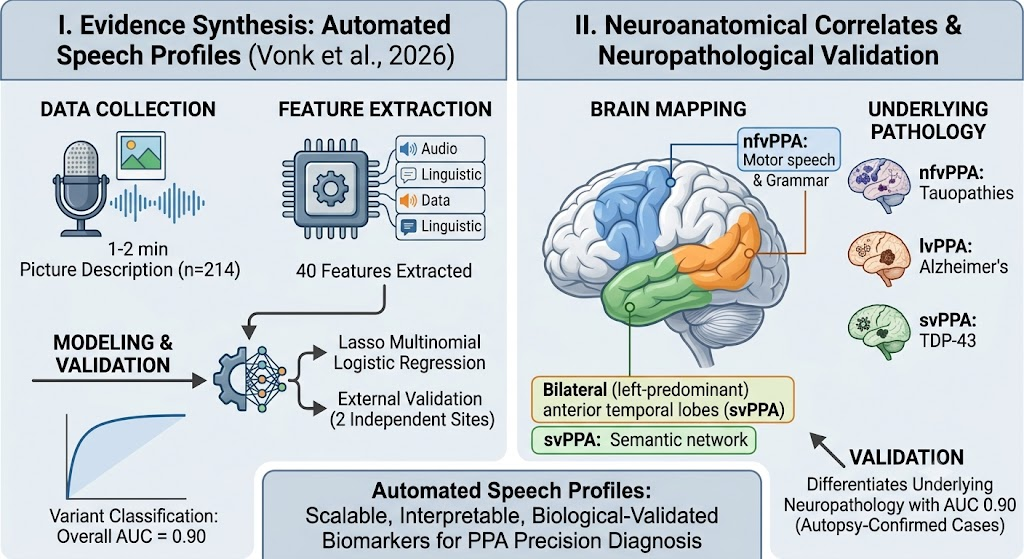
The study by Vonk et al. (2026) exemplifies progress with a large cohort (n=214; controls and PPA variants) and robust external validation across two independent sites. Using 1-2 minute picture description recordings, the authors extracted 40 features and identified 25 discriminative parameters differing across variants.
Multinomial logistic regression models using 4-8 features per variant generated three distinct speech profile scores that achieved an overall AUC of 0.90 for variant classification. External validation confirmed these findings, underlining excellent reproducibility.
Neuroanatomical Correlates of Speech Profiles
Voxelwise brain morphometry associations reinforced the biological validity of the speech profiles. Scores for nfvPPA correlated with left superior and middle frontal and premotor cortices, areas implicated in motor speech and grammar. LvPPA profiles matched left posterior temporal cortex and angular gyrus, regions linked to phonological processing. SvPPA speech profiles associated with bilateral (left-predominant) anterior temporal lobes, matching semantic network degradation.
These correlations highlight that automated speech features reflect underlying structural degeneration patterns, supporting their mechanistic relevance beyond pure classification models.
Neuropathological Validation
In an autopsy subset (n=56), automated speech profiles differentiated underlying pathology—commonly tauopathies for nfvPPA, Alzheimer’s disease pathology for lvPPA, and TDP-43 proteinopathy for svPPA—with an AUC of 0.90. This alignment suggests speech biomarkers can indirectly infer neuropathology, critical where tissue confirmation or advanced biomarkers are unavailable.
Expert Commentary
The compelling evidence for automated speech profiling in PPA marks a transformative step toward scalable and objective diagnostics. Unlike conventional assessments requiring expert speech-language pathologists and extensive cognitive testing, brief audio-based analysis can be conducted remotely or in resource-limited settings, easing diagnostic bottlenecks.
The integration of linguistic and acoustic measures, combined with advanced statistical models, enhances sensitivity and specificity, while providing interpretable features that clinicians can relate to established neuroanatomical and pathological frameworks—bridging quantitative science and clinical intuition.
Nonetheless, challenges remain. Cross-linguistic generalizability, effects of education, dialect, and coexisting cognitive deficits warrant further validation. Longitudinal studies are needed to assess utility in disease progression monitoring and therapeutic response evaluation. Moreover, standardization of recording protocols and widespread access to user-friendly analytical platforms must be addressed.
Emerging paradigm shifts also include combining speech profiles with neuroimaging and fluid biomarkers to create multimodal composite signatures that could refine precision medicine in PPA and other neurodegenerative diseases.
Conclusion
Automated speech analysis of brief connected speech tasks robustly distinguishes clinical variants of PPA and maps onto characteristic neuroanatomical and neuropathological signatures. This scalable, interpretable approach promises to enhance diagnostic accuracy and accessibility, supporting patient stratification and monitoring in clinical practice and research.
Future work should focus on validating these tools across diverse populations, integrating multimodal biomarkers, and developing real-time, clinician-friendly applications to realize their full translational potential.
References
Vonk JMJ, Antonicelli G, Ramkrishnan S, et al. Automated Speech Analysis to Identify Clinical, Anatomical, and Pathological Variants of Primary Progressive Aphasia. JAMA Neurol. 2026; PMCID: 42545687. https://pubmed.ncbi.nlm.nih.gov/42545687/
Gorno-Tempini ML, Hillis AE, Weintraub S, et al. Classification of primary progressive aphasia and its variants. Neurology. 2011;76(11):1006-1014. PMID: 21368270
Josephs KA, Whitwell JL, et al. Neuroanatomic correlates of linguistic deficits in primary progressive aphasia. Ann Neurol. 2010;67(2):252-259. PMID: 20091516
Wilson SM, Henry ML, Besbris M, et al. Connected speech production in three variants of primary progressive aphasia. Brain. 2010;133(Pt 7):2069-2088. PMID: 20574099
Rochon E, Waters GS, Caplan D. Mechanisms of language breakdown in aphasia. In: Aphasia and Language: Theory to Practice. 2011.
This article was created using several editorial tools, including AI, as part of the process. Human editors reviewed this content before publication.