Survival Estimates and Predictors in Genetic Frontotemporal Dementia: Insights from an International Retrospective Cohort Study
Highlights
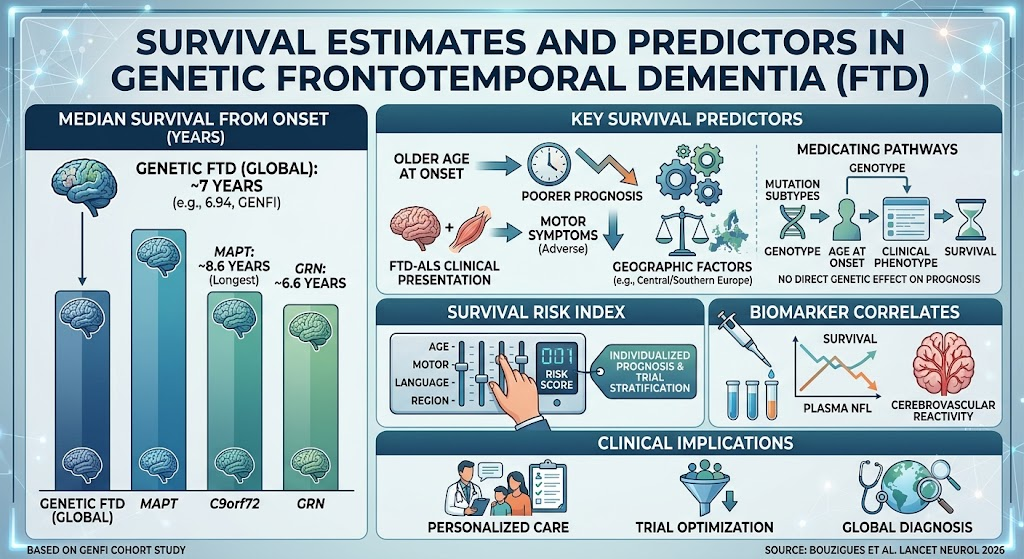
Median survival in genetic frontotemporal dementia (FTD) averages approximately 7 years from symptom onset, with variation by genetic subtype (GRN, C9orf72, MAPT).
Survival heterogeneity is primarily driven by age at onset, clinical presentation—with motor symptoms portending poorer prognosis—and geographic factors rather than direct genetic group effects.
Development of an individual-level genetic FTD survival risk index offers potential for more accurate prognostication and patient stratification in clinical trials.
Motor impairment alongside cognitive and behavioural symptoms should be integrated into prognostic models to better capture disease trajectory in genetic FTD.
Background
Frontotemporal dementia (FTD) encompasses a group of neurodegenerative disorders characterized by progressive cognitive, behavioural, and motor deficits, often linked to pathogenic mutations in genes such as C9orf72, GRN, and MAPT. Genetic forms account for a significant proportion of cases, with phenotypic heterogeneity and variable disease course complicating prognosis and therapeutic development. Understanding survival patterns and their determinants is critical for clinical management, counseling, and optimizing design and stratification strategies in clinical trials targeting genetic FTD.
Key Content
Survival Estimates in Genetic FTD: Results from the GENFI Cohort
The Genetic Frontotemporal Dementia Initiative (GENFI) cohort study retrospectively analyzed 278 individuals harboring pathogenic mutations (138 C9orf72 expansions, 94 GRN, 46 MAPT) across 32 sites in Europe and Canada, with follow-up until June 2024. Median survival from symptom onset was 6.94 years (95% CI 6.59-7.80). Subtype-specific survival medians were 6.63 years for GRN, 7.04 for C9orf72, and notably longer at 8.56 years for MAPT mutation carriers. These estimates underscore meaningful but relatively modest survival differences by genetic subtype, aligning with prior smaller cohorts but providing unprecedented international scope and power.
Predictors of Survival and Disease Trajectory
Multivariate Cox proportional hazards modeling identified older age at symptom onset, shorter duration from onset to enrollment, clinical phenotype featuring frontotemporal dementia with amyotrophic lateral sclerosis (FTD-ALS), first symptom domain involving motor or language function, and residence in Central and Southern Europe as significant independent predictors of reduced survival. Importantly, the genetic mutation subtype influenced survival indirectly via effects on age at onset and clinical phenotype—highlighting mediating pathways rather than a direct genetic effect on prognosis.
Additional studies have augmented understanding of heterogeneity within genetic FTD. For example, TMEM106B polymorphisms modulate age at onset in GRN mutation carriers, and brain asymmetry patterns in GRN-FTD relate to differential clinical progression rates. Neuroimaging investigations reveal distinct composite grey matter atrophy signatures corresponding to each genetic variant, which may further inform prognosis and biomarker development. The presence of motor neuron features significantly worsens survival, consistent with clinical observations linking FTD-ALS presentations to more aggressive disease courses.
Biomarker Correlates and Cognitive-Motor Interactions
Plasma biomarkers such as neurofilament light chain (NfL) and glial fibrillary acidic protein (GFAP) have been evaluated for prognostic value in FTD spectrum disorders. Evidence favors NfL as a more robust biomarker correlating with disease severity and survival, including in genetic FTD cohorts. Vascular dysfunction indicated by cerebrovascular reactivity measures also correlates with cognitive impairment, offering additional mechanistic insights.
Furthermore, cognitive reserve modulates the trajectory of cognitive decline and behavioral symptoms in ALS and FTD, establishing the importance of integrating patient-level factors beyond genetics and clinical phenotype.
Clinical and Research Implications
The GENFI-derived genetic FTD survival risk index represents a pragmatic clinical tool incorporating key predictors to estimate individual patient prognosis more accurately. Its adoption may facilitate patient stratification in clinical trials, allowing enrichment of cohorts for targeted interventions and optimizing trial power.
Diagnostic challenges remain, particularly in resource-limited settings as highlighted by a Brazilian cohort study reporting frequent misdiagnosis and delayed recognition of FTD subtypes. Global harmonization of diagnostic protocols and increased awareness are needed to improve early identification and management.
Future research priorities include prospective validation of risk models, exploration of genetic modifiers, and integration of multimodal biomarkers to capture the complex biology underpinning disease course.
Expert Commentary
This comprehensive multi-center analysis elucidates that survival differences in genetic FTD are better explained by phenotypic expression—especially motor involvement—and age at onset rather than mutation identity per se. This insight challenges simplistic genotype-based prognostic assumptions and emphasizes the complexity of genotype-phenotype interactions mediated by additional genetic, environmental, and regional factors.
The identification of motor symptoms and language/motor onset domains as adverse prognostic markers supports incorporating clinical subphenotypes into routine prognostic assessments. The survival risk index thereby represents a step forward in personalized medicine for genetic FTD, although its clinical utility depends on refinement and external validation.
Translational research should leverage these findings to refine trial designs. Stratification of participants by risk index may enhance detection of therapeutic effects in relatively short time frames, critical for rare genetic disorders.
Molecular and neuroimaging biomarkers offer complementary avenues to track disease progression and treatment response, although broader adoption in clinical practice awaits validation. The complexity of FTD-ALS overlap syndromes and influence of modifiers such as TMEM106B alleles further highlight the need for comprehensive genetic profiling in patient management.
Despite methodological strengths, limitations include retrospective design, censoring effects, and potential geographic biases. Nevertheless, this work sets a new standard in delineating survival and predictors in genetic FTD.
Conclusion
Genetic frontotemporal dementia exhibits a median survival of approximately seven years from onset, with survival heterogeneity influenced more by clinical phenotype-related factors such as motor impairment and age at onset than by genotype alone. The newly developed genetic FTD survival risk index offers a promising tool for individualized prognosis and clinical trial stratification. Continued research integrating genetic modifiers, biomarkers, and cognitive reserve concepts will be paramount to improve prognostic accuracy and therapeutic development. Enhanced diagnostic recognition globally remains essential to ensure timely intervention and optimal patient care.
References
Bouzigues A et al. Survival estimates and their predictors in genetic frontotemporal dementia: an international, retrospective, cohort study. Lancet Neurol. 2026 Aug;25(8):731-740. PMID: 42456683.
Cash DM et al. Composite grey matter fingerprints for genetic frontotemporal dementia. J Neurol Neurosurg Psychiatry. 2026 Jun;97(7):569-580. PMID: 41679970.
Spencer J et al. Cumulative Incidence of Motor and Cognitive Features in the ALS-FTD Spectrum. medRxiv. 2025 Jun 24;2024.04.30.24306638. PMID: 38746326.
Benussi A et al. Protective TMEM106B-rs3173615 delays age at onset in GRN mutation carriers. Mol Psychiatry. 2026 May 18. PMID: 42151443.
Malpetti M et al. Cerebrovascular Reactivity at Rest and Its Association With Cognitive Function in People With Genetic Frontotemporal Dementia. Neurology. 2025 Sep 23;105(6):e213677. PMID: 40906975.
Premi E et al. Comprehensive cross-sectional and longitudinal comparisons of plasma glial fibrillary acidic protein and neurofilament light across FTD spectrum disorders. Mol Neurodegener. 2025 Mar 12;20(1):30. PMID: 40075459.
Brasil A et al. Clinical Presentation and Diagnostic Challenges of Frontotemporal Dementia in Brazil: A 15-Year Cohort Study. Neuroepidemiology. 2026 May 28:1-12. PMID: 42207731.
This article was created using several editorial tools, including AI, as part of the process. Human editors reviewed this content before publication.