Highlight
– The K-Force grip dynamometer shows strong responsiveness in measuring handgrip strength changes in ICU-acquired weakness (ICU-AW) patients.
– Significant improvements in handgrip strength were observed in both dominant and non-dominant hands over one week.
– The dynamometer’s responsiveness aligns well with changes measured by the Medical Research Council (MRC) sum score.
– This supports its use for monitoring muscle recovery and guiding rehabilitation in critically ill patients.
Study Background
Intensive Care Unit-Acquired Weakness (ICU-AW) is a common complication in critically ill patients, characterized by diffuse, symmetric muscle weakness that develops during critical illness and persists beyond ICU discharge. This condition is associated with prolonged mechanical ventilation, increased ICU length of stay, delayed rehabilitation, and worse functional outcomes. Early identification and monitoring of muscle strength recovery are essential for effective management and rehabilitation strategies in this population.
Handgrip strength is a widely accepted surrogate marker of overall muscle strength and functional status in critically ill patients. Various dynamometers have been used to quantify handgrip strength; however, their reliability, validity, and importantly, responsiveness—the ability to detect clinically meaningful changes over time—are critical to their effective application in ICU settings.
The K-Force grip dynamometer has demonstrated reliability and validity for measuring handgrip strength but lacked evidence on responsiveness in ICU-AW patients. This study aimed to fill this knowledge gap by prospectively evaluating the responsiveness of handgrip strength measurements obtained using the K-Force dynamometer over a one-week interval in patients with ICU-AW.
Study Design
This was a prospective longitudinal observational study conducted in adult patients diagnosed with ICU-acquired weakness. The inclusion criteria focused on patients with clinically confirmed ICU-AW using accepted clinical diagnostic criteria, ensuring clear baseline muscle weakness.
Handgrip strength was measured on both dominant and non-dominant hands using the K-Force grip dynamometer at baseline (initial assessment) and after one week. Alongside, the Medical Research Council (MRC) sum score—a well-established composite clinical measure assessing global muscle strength—was evaluated concurrently as a clinical comparator.
Analysis of responsiveness included calculation of effect sizes (r) and standardized response means (SRM) to quantify the magnitude of change in handgrip strength over the study period. The Wilcoxon signed-rank test was employed for assessing statistical significance of changes.
Key Findings
A total of 36 patients with ICU-acquired weakness participated in the study. The key outcomes were as follows:
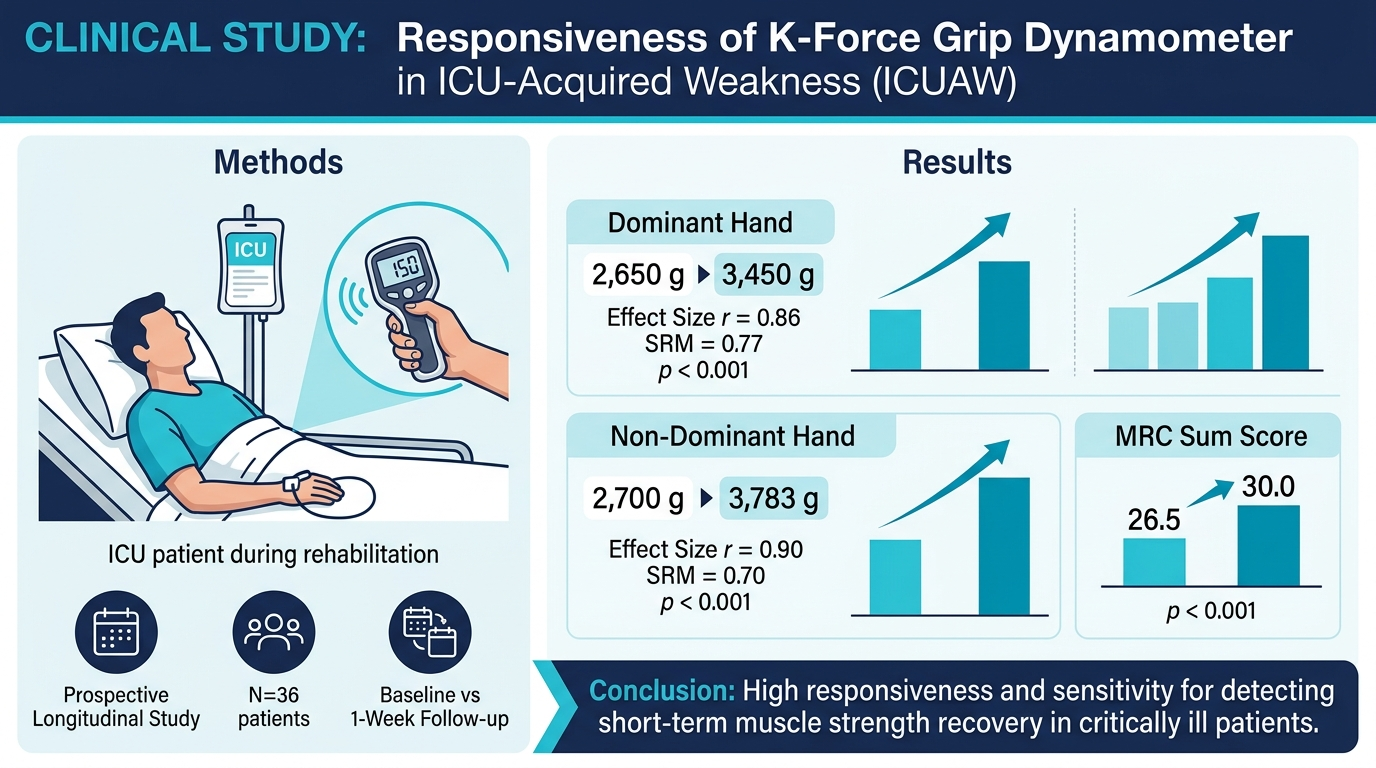
Dominant handgrip strength: Increased from a median of 2650 grams at baseline to 3450 grams after one week. The responsiveness was strong, indicated by an effect size of r = 0.86 and an SRM of 0.77, both statistically significant (p < 0.001).
Non-dominant handgrip strength: Demonstrated an increase from 2700 grams to 3783 grams over the week, with a highly strong effect size of r = 0.90 and SRM of 0.70 (p < 0.001).
MRC sum score: Increased from a median of 26.5 to 30.0, confirming global improvements in muscle strength (p < 0.001).
These significant gains in handgrip strength aligned well with clinical improvements measured by the MRC sum score, confirming the clinical relevance of the dynamometer’s measures. The K-Force dynamometer demonstrated the ability not only to reliably measure handgrip strength but also to sensitively capture short-term clinically meaningful changes in patients recovering from ICU-AW.
Expert Commentary
The assessment of muscle strength recovery in ICU patients remains a challenge due to fluctuations in patient vigilance, variability in measurement techniques, and the presence of generalized weakness. The findings from Van Iperen et al. provide strong evidence supporting the K-Force grip dynamometer as a responsive tool to objectively monitor handgrip strength changes over short periods.
The responsiveness indices (effect size and SRM) reported—above the conventional thresholds for good responsiveness—are noteworthy. These findings align with current critical care rehabilitation guidelines emphasizing early and accurate muscle strength monitoring to guide interventions.
Nonetheless, some limitations merit consideration. The sample size of 36 patients, while sufficient for preliminary responsiveness analysis, is modest and may limit generalizability. Additionally, the study focuses on short-term (one week) follow-up; longer-term responsiveness and correlations with functional outcomes need further exploration.
Moreover, although the MRC sum score is a validated comparator, it is subject to observer variability and may not capture subtle changes in localized hand strength. The K-Force dynamometer adds value by providing quantitative and potentially more granular data.
Conclusion
This prospective longitudinal study robustly demonstrates that the K-Force grip dynamometer is a responsive and clinically meaningful tool for monitoring changes in handgrip strength in patients with ICU-acquired weakness. Its capability to detect short-term improvement supports its integration into critical care rehabilitation protocols, enabling clinicians to track recovery trajectories and tailor interventions.
Future research should expand on these findings with larger cohorts and extended follow-up durations, incorporating functional and patient-reported outcomes to establish the prognostic utility of handgrip strength responsiveness.
Funding and Clinical Trials Registration
The article did not specify funding sources or clinical trials registration for this study.
References
1. Hermans G, Van den Berghe G. Clinical review: intensive care unit acquired weakness. Crit Care. 2015;19:274.
2. De Jonghe B, Sharshar T, Lefaucheur JP, et al. Paresis acquired in the intensive care unit: a prospective multicenter study. JAMA. 2002;288(22):2859-2867.
3. Van Iperen ID, Flim M, Spronk PE. Responsiveness of the K-Force Grip Dynamometer in patients with ICU-acquired weakness: a prospective longitudinal study. J Rehabil Med. 2026;58:jrm46235. PMID: 42802632.
4. Hermans G, De Jonghe B, Bruyninckx F, Van den Berghe G. Clinical review: critical illness polyneuropathy and myopathy. Crit Care. 2008;12(6):238.