We use cookies

Our website uses essential cookies and, with your consent, additional cookies to measure performance and improve our services. Cookie Policy.

You can change your choice at any time.

MMedXYNews
HomeVideos
MedXY AI/MedXY News/Section: Neurology

Assessing Age-Related Bias in EQ-5D-5L Quality of Life Measures Among Acute Ischemic Stroke Patients: Insights from the ACT Trial
MedXY Editorial Team•Sep 5, 2026•Neurology
EQ-5D-5LDifferential Item Functioninghealth-related quality of lifeacute ischemic stroke

Highlight

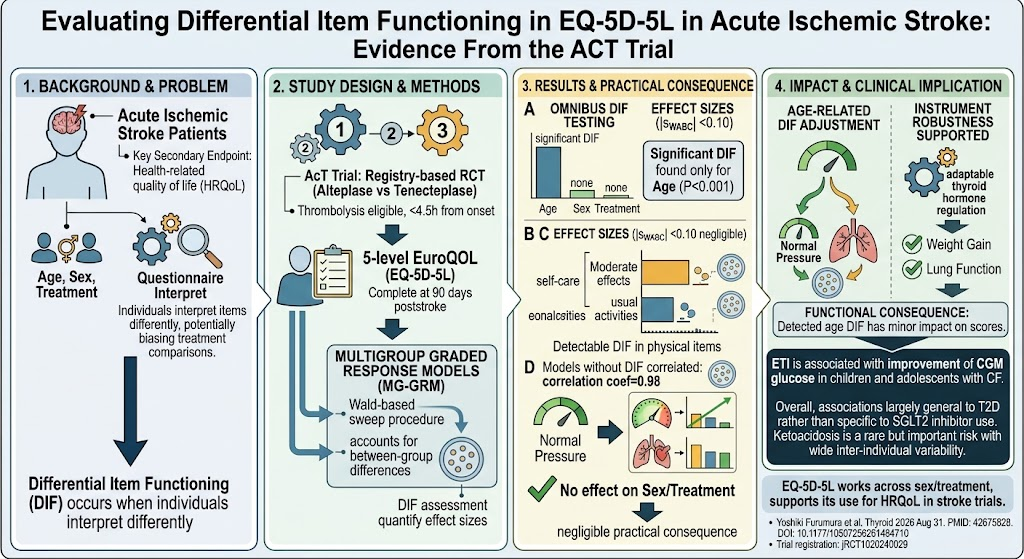
This article examines the potential for differential item functioning (DIF) in the widely used EQ-5D-5L patient-reported outcome measure among stroke survivors. Using robust statistical modeling, the ACT trial data reveal that while some age-related differences exist, especially in physical function items, these differences do not substantially alter individual health-related quality of life (HRQoL) scores. The measure functions equivalently across sex and thrombolytic treatment groups, supporting its validity in acute ischemic stroke trials.

Study Background

MedXY registered readers

Sign in free to continue reading

Create or use your MedXY account to unlock the complete article.

This article was created using several editorial tools, including AI, as part of the process. Human editors reviewed this content before publication.

Related articles

Open language-specific specialty feeds and department pages.

Expanding Horizons: Eligibility and Implications of Thrombolysis in Pediatric Acute Ischemic StrokeThis study evaluates the eligibility of children with acute ischemic stroke (AIS) for thrombolysis with tPA, revealing only 19% potential eligibility under current guidelines, and highlights opportunities to reconsider treatment in small-veAug 28, 2026Body Weight and Alteplase Efficacy in Acute Ischemic Stroke: Insights from the ENCHANTED TrialThe ENCHANTED trial post hoc analysis reveals body weight does not alter alteplase dose effectiveness in acute ischemic stroke, but low body weight independently predicts poorer outcomes without increased hemorrhagic risk.Aug 28, 2026Baseline Ischemic Burden Influences Tenecteplase Benefit Before Thrombectomy in Acute Stroke: Insights from the BRIDGE-TNK TrialA post hoc analysis of the BRIDGE-TNK trial reveals that intravenous tenecteplase before endovascular thrombectomy significantly improves functional independence in acute large-vessel occlusion stroke patients with extensive baseline ischemAug 22, 2026
Loading comments...
MedXY briefing

Get the free newsletter

Evidence-led clinical news, trends, and analysis—delivered to your inbox.

Ask MedXY AI

Most popular

Intimate Health
Five Benefits for Women Continuing Sexual Activity After Menopause
Intimate Health
Why Some Women Have a Strong Sex Drive—And Why Men Shouldn't Worry About It
Nursing & care
How often should a couple have sex?
Intimate Health
Classic Intimacy Recommendations: How to Help Women Reach Orgasm and Enjoy Mutual Pleasure
Intimate Health
What Makes a Woman "Physiologically Addicted" Is Never Money, But These Two Relationship Qualities
© 2026 MedXY
Contact usAbout usPrivacy PolicyMedXY story
Health-Related Quality of Life Following Risk-Reducing Hysterectomy: Insights from a UK Randomised Vignette Study
This study quantifies health-related quality of life impacts associated with risk-reducing hysterectomy, with and without bilateral salpingo-oophorectomy, to aid counseling and economic evaluation in endometrial cancer prevention.
Aug 18, 2026
Deep Learning-Driven Synthetic MR Perfusion Maps: A Breakthrough in Acute Ischemic Stroke ImagingThis study presents a deep learning model that generates synthetic T-max perfusion maps from noncontrast DWI and FLAIR sequences, potentially streamlining stroke imaging and eliminating the need for contrast agents.Aug 12, 2026
Enhancing Stroke Recovery: Adjunctive Normobaric Hyperoxia with Endovascular Thrombectomy in Late-Presenting Large Vessel OcclusionA phase IIb trial shows that adding normobaric hyperoxia to endovascular thrombectomy in acute ischemic stroke patients 6 to 24 hours after onset is safe, improves early neurological outcomes, and reduces infarct volume, warranting larger cAug 11, 2026