Highlight
Sepsis-induced mitochondrial dysfunction impairs platelet respiration and enhances platelet activation. Mitochondria-targeted antioxidant MitoTEMPO reverses these effects in vitro, indicating the critical role of mitochondrial reactive oxygen species (ROS) in platelet hyperactivation. This study suggests mitochondrial ROS scavengers as potential adjunct therapies to prevent sepsis-mediated organ damage.
Study Background
Sepsis remains a significant clinical challenge characterized by a dysregulated host response to infection, often leading to multi-organ failure and high mortality rates despite advances in supportive care. A key pathogenic mechanism in sepsis-induced organ injury is platelet hyperactivation, which promotes microvascular thrombosis and inflammation. Concomitant mitochondrial dysfunction, driven in part by excessive mitochondrial reactive oxygen species (ROS), has been documented in various organs during sepsis in both animal models and human patients. However, its role in platelet pathophysiology during sepsis is less defined.
Given the critical involvement of mitochondria in cellular energy metabolism and redox balance, mitochondrial impairment in platelets could exacerbate their pro-thrombotic and pro-inflammatory phenotype. Antioxidant therapies targeting mitochondria-derived ROS have been proposed, but clinical translation remains limited due to inconsistent results and poorly understood mechanisms. This study by Greco et al. aims to elucidate the relationship between mitochondrial dysfunction and platelet hyperactivation during sepsis and assess the efficacy of the mitochondria-targeted antioxidant MitoTEMPO in reversing these effects in vitro.
Study Design
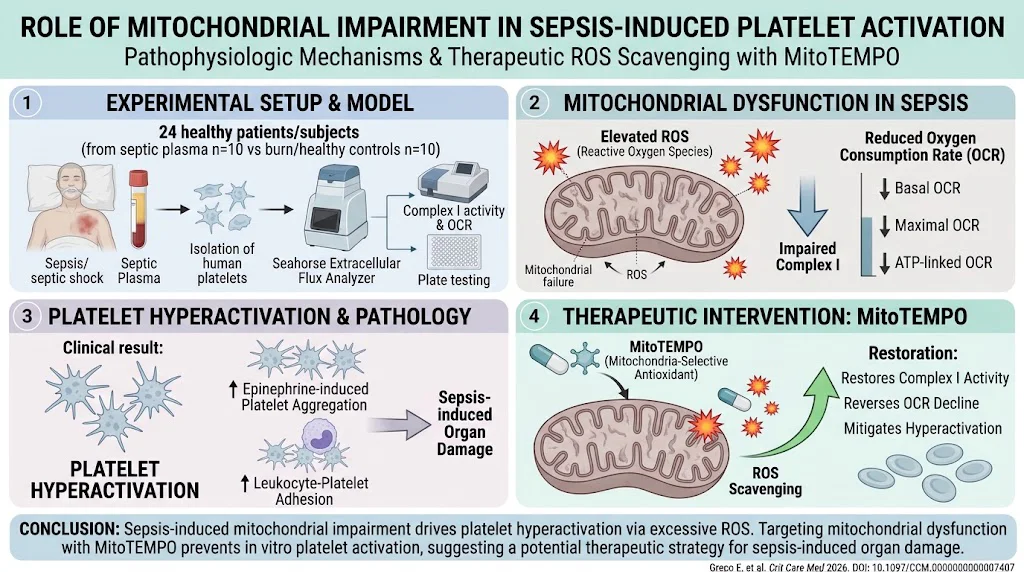
This laboratory investigation was conducted at a university hospital setting. The study population included three groups: patients with sepsis or septic shock (n=10), nonseptic burn patients (n=10), and healthy control subjects (n=10). Isolated human platelets from healthy donors and platelet mitochondria-enriched fractions were incubated in vitro with plasma obtained from these patient groups to simulate the septic environment.
The intervention consisted of preincubation with and without the mitochondria-selective ROS scavenger MitoTEMPO. Outcomes assessed were platelet mitochondrial function via oxygen consumption rates using the Seahorse Extracellular Flux Analyzer, mitochondrial respiratory chain (Complex I) enzymatic activity by spectrophotometry, platelet aggregation by light-transmission aggregometry, and leukocyte-platelet adhesion using flow cytometry.
Key Findings
Results demonstrated that platelets incubated with plasma from septic patients exhibited marked mitochondrial dysfunction, as evidenced by significantly reduced basal, maximal, and ATP-linked oxygen consumption rates compared to those incubated with plasma from healthy or nonseptic burn patients. This indicates compromised mitochondrial respiration in the septic milieu.
Moreover, septic plasma reduced Complex I activity in isolated platelet mitochondria, highlighting specific impairment of a key component of the electron transport chain associated with ROS generation. This mitochondrial dysfunction correlated with increased epinephrine-induced platelet activation, confirming a link between mitochondrial impairment and platelet hyperreactivity.
Critically, treatment with MitoTEMPO effectively reversed these mitochondrial deficits and attenuated platelet hyperactivation by scavenging mitochondrial ROS. This suggests mitochondrial ROS as a pivotal mediator of platelet dysfunction in sepsis and identifies MitoTEMPO as a promising therapeutic agent.
Expert Commentary
The study robustly demonstrates that mitochondrial impairment contributes to platelet hyperactivation during sepsis through enhanced mitochondrial ROS production. The specific targeting of mitochondrial ROS by MitoTEMPO restored mitochondrial function and reduced platelet activation, which may have important implications for improving microcirculatory blood flow and limiting organ damage in septic patients.
However, the study’s in vitro design and small sample size warrant cautious interpretation. The complexity of in vivo sepsis pathophysiology, including immune cell interactions and systemic factors, may influence mitochondrial and platelet behavior beyond isolated plasma effects. Furthermore, the clinical efficacy, dosing, and safety of MitoTEMPO or related molecules require thorough validation in animal models and clinical trials before routine use.
Nonetheless, this investigation adds mechanistic insight into sepsis-induced platelet dysfunction and highlights mitochondria-targeted antioxidants as a novel therapeutic avenue deserving further research.
Conclusion
This study establishes a mechanistic link between sepsis-induced mitochondrial dysfunction and platelet hyperactivation mediated by mitochondrial ROS. The ability of the mitochondria-selective ROS scavenger MitoTEMPO to reverse platelet mitochondrial impairment and hyperactivity in vitro offers an intriguing strategy to mitigate sepsis-associated microvascular thrombosis and organ injury. Further preclinical and clinical studies are necessary to translate these findings into targeted therapies that can improve outcomes in septic shock and critical illness.
Funding and Clinical Trials
The investigators’ funding sources are not specified in the article abstract. No related clinical trials were mentioned. Future studies exploring mitochondria-targeted antioxidants should consider well-designed clinical trials to evaluate safety and efficacy in septic patients.
References
Greco E, Schiavello M, Bosco O, et al. Role of Mitochondrial Impairment in Sepsis-Induced Platelet Activation. Crit Care Med. 2026 Oct 21. PMID: 42925135.
Other relevant literature:
Singer M, Deutschman CS, Seymour CW, et al. The Third International Consensus Definitions for Sepsis and Septic Shock (Sepsis-3). JAMA. 2016;315(8):801-810.
Gandhirajan RK, Chen J, Ruan Z, et al. Platelet–immune cell cross talk and tissue injury. Blood. 2020;136(8): 1021–1030.
Murphy MP, Hartley RC. Mitochondria as a therapeutic target for common pathologies. Nat Rev Drug Discov. 2018;17(12):865-886.