Age-Specific Excess Healthcare Burden of Diabetes: Beyond Traditional Complications
Highlight
- Adults with diabetes experience significantly higher inpatient and emergency department (ED) visits across all age groups compared to those without diabetes.
- Traditional vascular and renal complications remain leading causes but are increasingly overshadowed by emerging nontraditional complications such as pneumonia and mental health disorders, particularly among younger adults.
- Age-specific absolute risk differences (ARDs) highlight varied patterns of diabetes-related healthcare utilization, requiring tailored management approaches.
Study Background
Diabetes mellitus affects an increasing proportion of the population worldwide and is associated with substantial morbidity and healthcare utilization. Shifts in the epidemiology of diabetes, including younger ages at diagnosis and longer life expectancy, have altered the landscape of diabetes-related complications and resulting healthcare needs. Traditionally, diabetes has been linked primarily with vascular and renal complications, but emerging evidence suggests an expanding spectrum of related conditions that drive hospital admissions and emergency department visits. Understanding these age-specific patterns of healthcare burden is critical to improve clinical management and health system planning.
Study Design
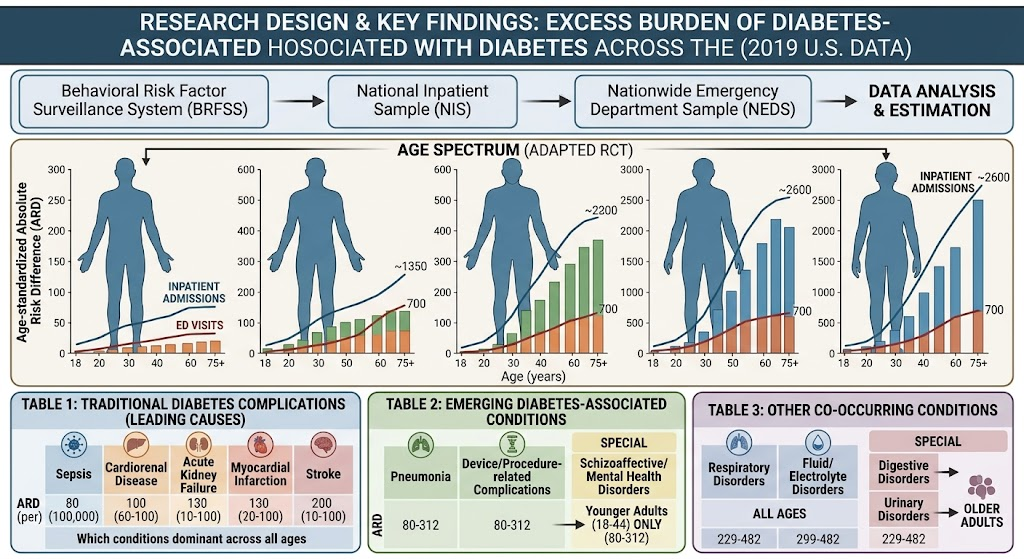
This study by Patel et al. utilized 2019 data from three nationally representative U.S. datasets: the Behavioral Risk Factor Surveillance System (BRFSS), the National Inpatient Sample (NIS), and the Nationwide Emergency Department Sample (NEDS). These data provided estimates of inpatient and ED visits among adults with and without diabetes. Complications were categorized into three groups: 1) traditional diabetes complications (e.g., cardiovascular disease, kidney failure), 2) emerging diabetes-associated conditions (e.g., pneumonia, device-related complications, mental health disorders), and 3) other co-occurring conditions (e.g., respiratory, digestive, urinary disorders). The study calculated age-standardized absolute risk differences (ARDs) to quantify the excess inpatient and ED utilization attributable to diabetes across different age groups.
Key Findings
The study found substantial excess inpatient admissions and ED visits among people with diabetes compared to those without, across the entire adult age spectrum. Specifically:
- Traditional complications: Leading contributors included sepsis, cardiorenal disease, acute kidney failure, myocardial infarction, and stroke. Absolute risk differences for these ranged from 296 to 2,623 per 100,000 individuals with diabetes, indicating a high excess burden.
- Emerging conditions: Notably, pneumonia and device- or procedure-related complications showed ARDs between 125 and 473. Mental health disorders such as schizoaffective conditions were more prominent in younger adults with ARDs of 80 to 312, suggesting new areas for clinical focus.
- Other co-occurring conditions: Respiratory disorders and fluid/electrolyte imbalances contributed to elevated risks across all ages (ARD 100–363), while digestive and urinary disorders were especially relevant in older adults (ARD 229–482).
- Emergency Department visits: Displayed a similar pattern of excess risk but with lower absolute values (ARD ranging from 101 to 707), underscoring a heavy but somewhat less acute burden compared to inpatient admissions.
The data reveal that as the diabetes population ages and expands, the profile of diabetes-associated hospital use evolves, with an increasing fraction attributable to nontraditional complications rather than classic vascular and renal disease alone.
Expert Commentary
This comprehensive analysis underscores the need for health care systems to adapt strategies that address not only the classical diabetes complications but also the emergent and increasingly prevalent associated conditions. Younger adults with diabetes face substantial risks from mental health conditions, highlighting the importance of integrating psychiatric care into diabetes management. The prominence of infections like pneumonia and device-related complications suggests a need for vigilant preventive and peri-procedural care. Furthermore, managing fluid, electrolyte, digestive, and urinary disorders—especially in older adults—may reduce avoidable hospital care.
Limitations include reliance on administrative data that may be subject to coding inaccuracies and inability to capture outpatient care nuances. Nonetheless, the nationally representative datasets provide robust insights. Future research could longitudinally examine the impact of evolving diabetes prevention and treatment on healthcare utilization patterns.
Conclusion
Diabetes imposes a substantial, age-specific excess burden on inpatient admissions and emergency department visits across the U.S. adult population. While classic vascular and renal complications continue to drive much morbidity, emerging nontraditional conditions are playing an increasing role, particularly among younger populations. These findings highlight the need for broadened clinical vigilance and tailored interventions to address the expanded spectrum of diabetes-associated health risks. Optimizing preventive care and integrated management approaches may reduce this excess healthcare utilization and improve outcomes for people living with diabetes.
Funding and ClinicalTrials.gov
The study did not specify funding sources. No clinical trials were registered for this observational study.
References
- Patel R, Uppal TS, Tomic D, Ali MK, Salim A, Magliano DJ, Harding JL. Excess Burden of Inpatient Admissions and Emergency Department Visits Associated With Diabetes Across the Age Spectrum. Diabetes Care. 2026 Aug 18. PMID: 42611023.
- American Diabetes Association. Standards of Medical Care in Diabetes—2024. Diabetes Care. 2024;47(Suppl 1):S1-S100.
- Selvin E, Parrinello CM. Age-specific prevalence of diabetes and prediabetes among US adults, 2011–2016. Diabetes Care. 2020 Apr;43(4):929–31.
- Thomas MC, et al. The evolving burden of diabetes-related chronic complications: A call for focused preventive strategies. Lancet Diabetes Endocrinol. 2023;11(2):99-111.
This article was created using several editorial tools, including AI, as part of the process. Human editors reviewed this content before publication.