Highlight
– The LITMUS study identifies and validates non-invasive biomarkers to diagnose metabolic dysfunction-associated steatotic liver disease (MASLD), including at-risk metabolic dysfunction-associated steatohepatitis (MASH) and fibrosis stages.
– Proteomic multimarker panels, particularly SomaSignal, demonstrate strong diagnostic accuracy, surpassing the 0.80 AUC threshold, supporting potential biopsy replacement.
– Sequential testing strategies incorporating gamma-glutamyl transferase (GGT) enhance diagnostic yield for advanced fibrosis and at-risk MASH.
– Findings inform future clinical guidelines, regulatory assessment, and trial design for MASLD therapies.
Study Background
Metabolic dysfunction-associated steatotic liver disease (MASLD), previously referred to as non-alcoholic fatty liver disease (NAFLD), represents a spectrum of liver pathology prevalent worldwide and closely linked to metabolic syndrome. It encompasses a range of hepatic injury from steatosis to metabolic dysfunction-associated steatohepatitis (MASH), fibrosis, and cirrhosis. With the recent emergence of regulatory-approved pharmacological treatments targeting MASLD, there is an urgent clinical and research imperative to deploy reliable, non-invasive diagnostic tools. Liver biopsy, the current diagnostic gold standard, remains limited by invasiveness, sampling variability, and risks, hampering early diagnosis, stratification, and treatment selection. Consequently, validated non-invasive biomarkers that can accurately identify disease stages, particularly at-risk MASH and advanced fibrosis requiring interventions, are critically needed.
Study Design
The LITMUS (Liver Investigation: Testing Marker Utility in Steatohepatitis) study was a prospective, multicentre diagnostic accuracy investigation spanning 13 countries across Europe and the USA. The cohort comprised 1590 adults with biopsy-confirmed MASLD, confirmed centrally via liver histology scored using the non-alcoholic steatohepatitis Clinical Research Network Scoring System. This histological standard defined key target outcomes: MASH (Non-Alcoholic Fatty Liver Disease Activity Score ≥4 with at least 1 point in each component), at-risk MASH (MASH plus fibrosis stage ≥2), advanced fibrosis (stage ≥3), and cirrhosis (stage 4). The study assessed 12 individual biomarker assays and 18 multimarker panels, including proteomic, imaging-based, and clinical composite scores. Diagnostic performance was evaluated primarily via area-under-the-curve (AUC) from receiver operating characteristic analysis, considering a minimum acceptable criterion (MAC) of AUC >0.80 for potential biopsy replacement.
Key Findings
Out of the 1590 participants analyzed between January 2018 and June 2023, 43% had MASH, 38% at-risk MASH, 37% advanced fibrosis, and 10% cirrhosis. The study produced several notable findings:
At-risk MASH Detection: The proteomic-based panel SomaSignal achieved the highest diagnostic accuracy with an AUC of 0.83 (95% CI 0.80–0.85), surpassing the MAC and outperforming all other evaluated biomarkers. No single test reached the MAC for detecting MASH alone, highlighting the challenge of identifying early inflammatory activity without fibrosis.
Advanced Fibrosis Diagnosis: SomaSignal again demonstrated superior performance with an AUC of 0.92 (0.90–0.94). Other effective multimarker panels included FibroMeter-VCTE (AUC 0.87), Agile 3+ and TSP2 (both 0.84), and NIS4 (0.82), all above the MAC threshold. These tests integrate serum markers with imaging or clinical parameters to enhance fibrosis assessment precision.
Cirrhosis Identification: FibroMeter-VCTE exhibited the highest diagnostic accuracy with an AUC of 0.94 (0.90–0.97), closely followed by SomaSignal (0.92). Other panels such as Agile 3+, Agile 4, ADAPT, ELF, LSM-VCTE, and TSP2 also provided robust results (AUCs between 0.84 and 0.88).
Sequential Testing Strategies: Applying gamma-glutamyl transferase (GGT) as a first-line screening, followed by confirmatory biomarker panels, successfully met the MAC criteria for diagnosing both advanced fibrosis and at-risk MASH, suggesting practical algorithms for clinical screening pathways.
Expert Commentary
The LITMUS study represents a landmark effort in validating non-invasive biomarkers for MASLD across a diverse, multinational cohort. The robust diagnostic accuracy of multimarker panels—particularly those incorporating proteomic data—signals a transformative shift toward less invasive, more accessible disease surveillance. These results support the integration of proteomic assays like SomaSignal into clinical workflows, improving patient stratification and enabling targeted therapeutic intervention without defaulting to biopsy.
However, some limitations exist. Single markers’ variable performance underscores the biological complexity of MASLD pathogenesis, emphasizing that isolated biomarkers rarely capture the multifaceted disease presentation. Additionally, while biopsy remains the gold standard, histological assessment also encounters sampling and interpretation variability which could influence “ground truth” classification.
Future directions will require longitudinal validations to assess biomarker responsiveness to treatment and prognostic prediction. Moreover, standardizing biomarker cutoffs and testing algorithms across healthcare settings is essential for widespread clinical adoption. Regulatory endorsement and inclusion in updated guidelines will also be critical to translating these findings into routine practice.
Conclusion
The LITMUS prospective multicentre study establishes that multimarker, particularly proteomic, non-invasive panels offer strong diagnostic value for detecting at-risk MASH, advanced fibrosis, and cirrhosis in MASLD, with potential to supplant liver biopsy. Sequential testing algorithms integrating conventional liver enzyme measures and validated panels can further refine diagnosis and patient triage. These breakthroughs hold promise for enhancing clinical management, optimizing enrolment in clinical trials, and guiding regulatory frameworks in the evolving landscape of MASLD therapeutics.
Funding and Clinical Trials Registration
This research was supported by the Innovative Medicines Initiative 2 Joint Undertaking. The study involved collaboration across multiple international centers to strengthen evidence generalizability. The study is registered under clinical trial identifiers associated with LITMUS consortium initiatives.
References
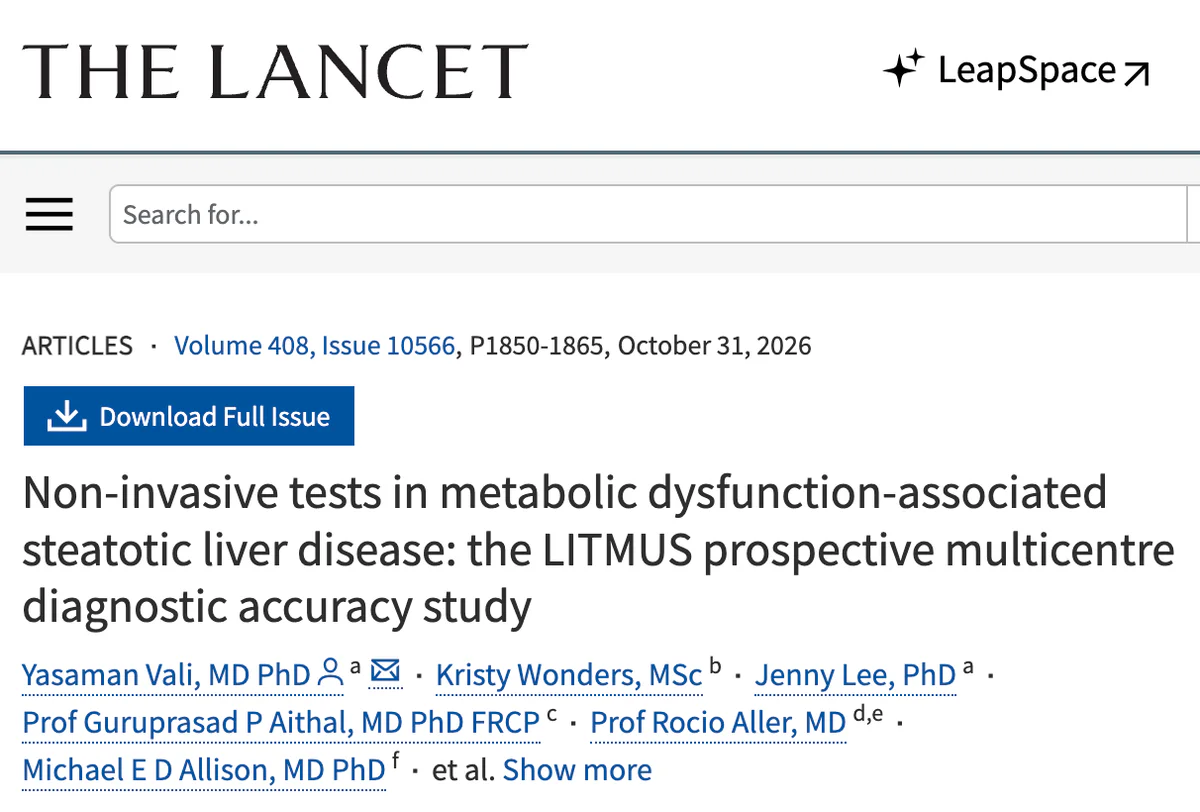
Vali Y, Wonders K, Lee J, et al. Non-invasive tests in metabolic dysfunction-associated steatotic liver disease: the LITMUS prospective multicentre diagnostic accuracy study. Lancet. 2026;408(10566):1850-1865. doi:10.1016/S0140-6736(26)00923-4
Younossi ZM, Koenig AB, Abdelatif D, et al. Global epidemiology of nonalcoholic fatty liver disease—Meta-analytic assessment of prevalence, incidence, and outcomes. Hepatology. 2016;64(1):73-84.
Siddiqui MS, Vuppalanchi R, Van Natta ML, et al. Magnetic resonance imaging versus transient elastography for non-invasive evaluation of liver fibrosis and steatohepatitis in non-alcoholic fatty liver disease. Aliment Pharmacol Ther. 2019;50(3):320-332.