Unveiling Hidden Immune Signatures in Cardiovascular Disease Through Single-Cell Multi-Omics
Highlight
- Comprehensive single-cell multi-omics analyses identify novel immune signatures associated with coronary artery disease (CAD) and cardiovascular mortality.
- Cellular proliferation and T cell activation signatures correlate strongly with poor cardiovascular outcomes independently of traditional inflammatory markers hsCRP and IL-6.
- Findings were validated across multiple independent cohorts and supported by protein-level confirmation in atherosclerotic plaques.
- Immune signatures have potential utility as prognostic tools for cardiovascular risk stratification beyond systemic inflammation.
Study Background
Atherosclerosis and its clinical manifestations such as coronary artery disease (CAD) remain leading causes of morbidity and mortality worldwide. Inflammation and immune mechanisms play central roles in the pathogenesis and progression of these conditions. Established systemic inflammatory markers like high-sensitivity C-reactive protein (hsCRP) and interleukin-6 (IL-6) have been instrumental in assessing cardiovascular risk, yet they do not capture the full complexity of immunological contributions to atherosclerosis. Identifying novel immunological determinants, especially at a cellular and molecular resolution, is crucial for enhancing risk assessment and developing targeted therapies.
Study Design
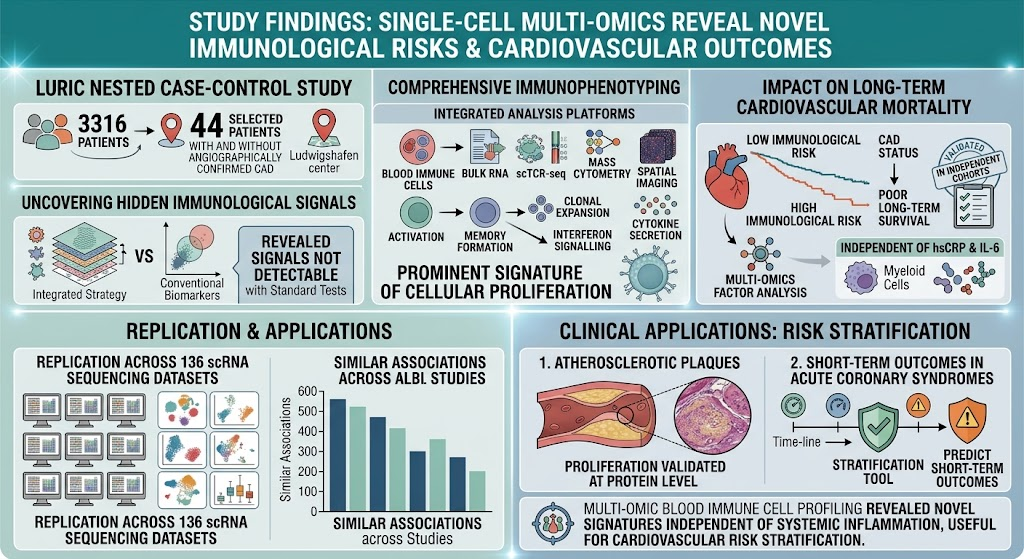
This exploratory proof-of-concept nested case-control study was conducted within the Ludwigshafen Risk and Cardiovascular Health (LURIC) cohort, a well-characterized prospective cohort of 3316 patients. Forty-four individuals were selected based on CAD presence confirmed by angiography and survival status. Comprehensive immunophenotyping was performed on blood immune cells using an integrative multi-omics approach that included bulk RNA sequencing, single-cell RNA sequencing (scRNA-seq), single-cell T-cell receptor sequencing, mass cytometry, spatial imaging, and cytokine secretion assays. Multi-omics factor analysis was employed to identify shared transcriptional programs. The identified immune signals were tested for associations with CAD status and cardiovascular mortality and replicated in two independent cohorts totaling 136 scRNA-seq datasets.
Key Findings
The multi-omics profiling revealed immunological signatures not discernible by conventional biomarkers. A prominent signature of cellular proliferation was identified, closely linked to T cell activation, memory formation, clonal expansion, interferon signaling pathways, and cytokine secretion profiles. These transcriptional programs and associated immune cell subsets were strongly correlated with angiographically confirmed CAD and adverse long-term cardiovascular outcomes.
Importantly, these associations were independent of systemic inflammation markers such as hsCRP and IL-6, which predominantly originate from myeloid cells, underscoring a distinct immunological axis involving adaptive immunity.
Protein-level validation confirmed the presence of proliferating immune cells within atherosclerotic plaques, reinforcing the biological relevance of the findings. Moreover, immune signatures were tested for their prognostic potential, showing promise as stratification tools for short-term cardiovascular outcomes in acute coronary syndrome patients.
The replication of key results across independent cohorts consolidates the robustness and generalizability of the identified immune signatures.
Expert Commentary
This study advances our understanding of the immunological underpinnings of CAD by leveraging cutting-edge single-cell multi-omics technology. The identification of proliferative T cell signatures that are independent of established inflammatory markers represents a paradigm shift from traditional inflammatory risk assessment towards a more nuanced immunophenotyping approach.
Despite its exploratory nature and relatively small initial sample size, the comprehensive experimental design and rigorous validation in independent cohorts strengthen the validity of the conclusions. However, larger prospective studies are warranted to refine these signatures and assess their utility in clinical risk prediction models and therapeutic targeting.
The mechanistic insights suggesting clonal expansion and interferon signaling also open avenues for novel immunomodulatory interventions tailored to individual risk profiles.
Conclusion
The application of single-cell multi-omics in cardiovascular immunology has uncovered novel cellular and molecular immune signatures strongly associated with CAD and cardiovascular mortality, beyond conventional markers of systemic inflammation. These findings hold significant translational potential for improving cardiovascular risk stratification and guiding personalized treatment strategies. Future research integrating longitudinal multi-omics profiling and functional studies will be critical to fully elucidate the role of adaptive immune proliferation in atherosclerosis and its clinical implications.
Funding and Clinicaltrials.gov
This study was supported by research funding from affiliated institutions as detailed in the original publication. The LURIC study is a registered and ongoing prospective cohort providing a valuable resource for cardiovascular research.
References
Horstmann H, Anto Michel N, Losert C, et al. Immunological risk identified by single-cell multi-omics and cardiovascular outcomes. Eur Heart J. 2026 Aug 14. PMID: 42596600.
Ridker PM, et al. Inflammation and Atherosclerosis: Role of C-Reactive Protein. Circulation. 2003.
Libby P. Inflammation in atherosclerosis. Nature. 2002.
This article was created using several editorial tools, including AI, as part of the process. Human editors reviewed this content before publication.