We use cookies

Our website uses essential cookies and, with your consent, additional cookies to measure performance and improve our services. Cookie Policy.

You can change your choice at any time.

MMedXYNews
HomeVideos
MedXY AI/MedXY News/Section: Cardiology

Unraveling Attenuated Risk Factor Associations in Secondary Coronary Prevention: Implications for Clinical Practice

MedXY Editorial Team•Aug 24, 2026•Cardiology
index event biascardiovascular risk predictionSecondary Preventionrisk factorsCoronary heart disease
Highlight

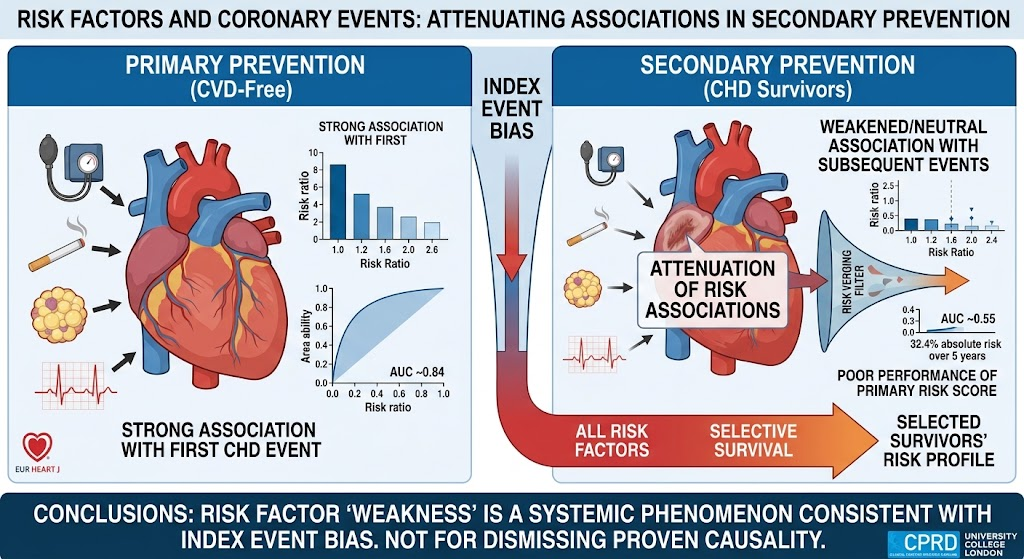
  • Risk factor associations for subsequent coronary events are systematically weaker compared to first events, a phenomenon attributed to index event bias.
  • A 10-year primary prevention risk model performs well for first coronary events but poorly predicts recurrent events after initial coronary heart disease (CHD).
  • Some traditional risk factors exhibit paradoxical or neutral associations post-first event, complicating risk interpretation in secondary prevention.
  • Findings caution against deprioritizing established therapies, such as LDL cholesterol lowering, based on attenuated risk factor associations in CHD survivors.

Background and Clinical Context

MedXY registered readers

Sign in free to continue reading

Create or use your MedXY account to unlock the complete article.

This article was created using several editorial tools, including AI, as part of the process. Human editors reviewed this content before publication.

Related articles

Open language-specific specialty feeds and department pages.

Inpatient Rehabilitation and Major Adverse Cardiovascular Events After Ischemic Stroke: Clinical Implications and Evidence SynthesisPostacute discharge to inpatient rehabilitation facilities (IRF) after acute ischemic stroke (AIS) is associated with a reduced 1-year risk of major adverse cardiovascular events (MACE) compared to discharge to home or skilled nursing facilSep 19, 2026From Mild-to-Moderate to Severe Asthma: Risk Factors and Patient Profiles from the NORDSTAR Cohort and Advances in Severe Asthma ManagementThis review summarizes the progression risk from mild-to-moderate to severe asthma based on the NORDSTAR cohort and integrates emerging evidence on biologic therapies that improve severe asthma outcomes across diverse patient profiles.Sep 17, 2026Ketoacidosis Risk with SGLT2 Inhibitors in Type 2 Diabetes: Insights from a Scandinavian Cohort StudyA large Scandinavian study reveals that ketoacidosis risk during SGLT2 inhibitor therapy in type 2 diabetes varies by patient factors and persists beyond early treatment, highlighting the need for ongoing risk assessment and management straSep 5, 2026
Loading comments...
MedXY briefing

Get the free newsletter

Evidence-led clinical news, trends, and analysis—delivered to your inbox.

Ask MedXY AI

Most popular

Intimate Health
Five Benefits for Women Continuing Sexual Activity After Menopause
Intimate Health
Why Some Women Have a Strong Sex Drive—And Why Men Shouldn't Worry About It
Nursing & care
How often should a couple have sex?
Intimate Health
Classic Intimacy Recommendations: How to Help Women Reach Orgasm and Enjoy Mutual Pleasure
Intimate Health
What Makes a Woman "Physiologically Addicted" Is Never Money, But These Two Relationship Qualities
© 2026 MedXY
Contact usAbout usPrivacy PolicyMedXY story
Long-Term Incidence and Risk Factors for Glaucoma: Insights from the Gangnam Eye Cohort Study
A 10-year Korean cohort study reveals that retinal arteriosclerosis, intraocular pressure, age, serum uric acid, and cholesterol levels significantly increase the risk of structural glaucoma conversion.
Aug 31, 2026
Bridging the Gap: ESC Prevention and Cardiac Rehabilitation Recommendations and What EUROASPIRE VI Reveals About Reality in EuropeEUROASPIRE VI exposes wide gaps between ESC prevention and cardiac rehabilitation recommendations and everyday care across Europe — especially in high-risk regions. This article distills core guideline recommendations, what’s new, andAug 29, 2026
Early Childhood Exposure to Crohn’s Disease-Affected Siblings: Implications for Gut Microbiome and Disease SusceptibilityChildhood exposure to siblings with Crohn’s disease significantly raises disease risk, linked to distinct gut microbiome changes that may drive disease onset through immune modulation.Aug 28, 2026