We use cookies

Our website uses essential cookies and, with your consent, additional cookies to measure performance and improve our services. Cookie Policy.

You can change your choice at any time.

MMedXYNews
HomeVideos
MedXY AI/MedXY News/Section: Cardiology

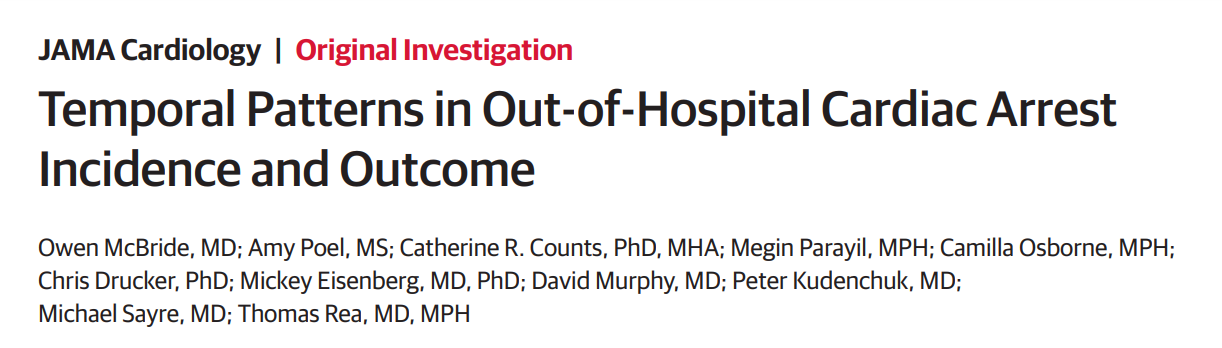
Trends in Out-of-Hospital Cardiac Arrest Outcomes in Seattle and King County, 2001–2020

MedXY Editorial Team•Sep 30, 2025•Cardiology
cardiac arrestpublic health

Out-of-hospital cardiac arrest (OHCA) remains a critical public health concern globally, claiming millions of lives each year. In the United States alone, hundreds of thousands succumb to OHCA annually. This article explores a recent study focusing on the incidence and survival trends of OHCA in Seattle and King County, Washington, from 2001 to 2020.
Overview of OHCA

OHCA is a sudden cessation of cardiac activity outside of a hospital setting. Prompt intervention, particularly through defibrillation and cardiopulmonary resuscitation (CPR), significantly influences survival outcomes. Patients with initial shockable rhythms, such as ventricular fibrillation (VF), have traditionally shown better prognoses compared to those with non-shockable rhythms.

Study Design and Methodology

The study, published in JAMA Cardiology, analyzed data from 25,118 adult OHCA cases managed by emergency medical services (EMS) in King County between 2001 and 2020. Exclusions were cases involving trauma or patients under 18. Data sources included EMS reports, hospital records, and death certificates, organized using Utstein guidelines. Researchers examined annual incidence rates per 100,000 population, stratified by sex, age group, and initial cardiac rhythm.

Key Findings

1. **Incidence Rates:**
– Overall OHCA incidence remained stable at approximately 81.3 cases per 100,000 annually.
– Shockable OHCA incidence decreased from 28.6 cases in 2001 to 17.9 cases in 2020.
– Non-shockable OHCA incidence showed minimal change.
– Incidence among individuals aged 65 and older decreased, while it increased slightly among those aged 18–64.

2. **Survival Outcomes:**
– Survival rates improved notably over the two decades.
– The percentage of patients surviving to hospital discharge increased from 14.7% in 2001–2005 to 18.9% in 2016–2020.
– Improvement was observed across both shockable and non-shockable rhythm subgroups.

3. **Community and EMS Response:**
– Bystander CPR rates rose from 55.5% to 73.9%.
– Use of automated external defibrillators (AEDs) by non-EMS personnel increased from 2.2% to 10.9%.

Implications and Future Directions

The study highlights the critical role of community engagement and advancements in EMS protocols in improving OHCA outcomes. Increased public awareness and accessibility of life-saving interventions like AEDs and CPR training have contributed significantly.

Conclusion

While OHCA incidence shows demographic and rhythm-specific variations, survival rates have improved due to enhanced prehospital and hospital care strategies. Continuous efforts in public health initiatives and emergency preparedness are essential to further reduce OHCA-related mortality.

Reference

McBride O, Poel A, Counts CR, et al. Temporal Patterns in Out-of-Hospital Cardiac Arrest Incidence and Outcome. JAMA Cardiol. Published online July 16, 2025. doi:10.1001/jamacardio.2025.2247

This article was created using several editorial tools, including AI, as part of the process. Human editors reviewed this content before publication.

Related articles

Open language-specific specialty feeds and department pages.

Bridging Social Determinants of Health and Multidimensional Frailty Among Older Adults: A Domain-Specific Latent Class and Network AnalysisThis study explores how economic, educational, healthcare, neighborhood, and social factors link to multiple frailty dimensions in Chinese older adults, highlighting cognition as a key intermediary.Aug 26, 2026Harnessing AI-Enabled ECG for Early Detection of Chagas Disease: A New Frontier in Cardiac ScreeningA pioneering study shows that AI-enhanced ECG screening combined with epidemiological data can identify undiagnosed Chagas disease cases, improving early detection and care in endemic Brazil.Aug 12, 2026ACP 2026 Position Paper: A Policy Roadmap to Make Obesity Prevention and Treatment Affordable, Accessible, and Stigma-FreeThe American College of Physicians’ 2026 position paper calls for comprehensive payer coverage, healthy food access, bias reduction, and research to tackle adult obesity through multisector public policy.Aug 7, 2026
Loading comments...
MedXY briefing

Get the free newsletter

Evidence-led clinical news, trends, and analysis—delivered to your inbox.

Ask MedXY AI

Most popular

Intimate Health
Five Benefits for Women Continuing Sexual Activity After Menopause
Intimate Health
Why Some Women Have a Strong Sex Drive—And Why Men Shouldn't Worry About It
Nursing & care
How often should a couple have sex?
Intimate Health
Classic Intimacy Recommendations: How to Help Women Reach Orgasm and Enjoy Mutual Pleasure
Intimate Health
What Makes a Woman "Physiologically Addicted" Is Never Money, But These Two Relationship Qualities
© 2026 MedXY
Contact usAbout usPrivacy PolicyMedXY story
Lidocaine vs Amiodarone for Shockable Out-of-Hospital Cardiac Arrest: No Significant Difference, but Lidocaine Shows Possible Benefit
A target trial emulation using data from the Resuscitation Outcomes Consortium found no statistically significant difference in survival to hospital discharge or favorable neurologic outcome between lidocaine and amiodarone in patients with shockable out-of-hospital cardiac arrest. However, point estimates and wide confidence intervals suggest a potential survival benefit with lidocaine that warrants further investigation.
Jul 24, 2026
Lidocaine Shows No Significant Benefit Over Amiodarone for Shockable Out-of-Hospital Cardiac Arrest, but Trend Favors LidocaineA target trial emulation analysis of over 2,400 patients with shockable out-of-hospital cardiac arrest found no statistically significant difference between lidocaine and amiodarone in survival to discharge or favorable neurologic outcome, though point estimates favored lidocaine. The study confirms findings from prior randomized trials but leaves room for clinically meaningful benefit.Jul 24, 2026
Hepatitis C Screening Among Persons Experiencing Homelessness in Emergency Departments: Insights from the DETECT Hep C Screening Trial and Related EvidenceEmergency departments serve as vital venues for hepatitis C virus screening, particularly for persons experiencing homelessness who exhibit higher HCV prevalence and face healthcare access barriers. Evidence supports nontargeted screening iJul 17, 2026