We use cookies

Our website uses essential cookies and, with your consent, additional cookies to measure performance and improve our services. Cookie Policy.

You can change your choice at any time.

MMedXYNews
HomeVideos
MedXY AI/MedXY News/Section: Gastroenterology

Targeting NEK7-Mediated EGFR Phosphorylation to Overcome Lenvatinib Resistance in Hepatocellular Carcinoma
MedXY Editorial Team•Aug 21, 2026•Gastroenterology
NEK7Lenvatinib resistanceeGFRhepatocellular carcinoma

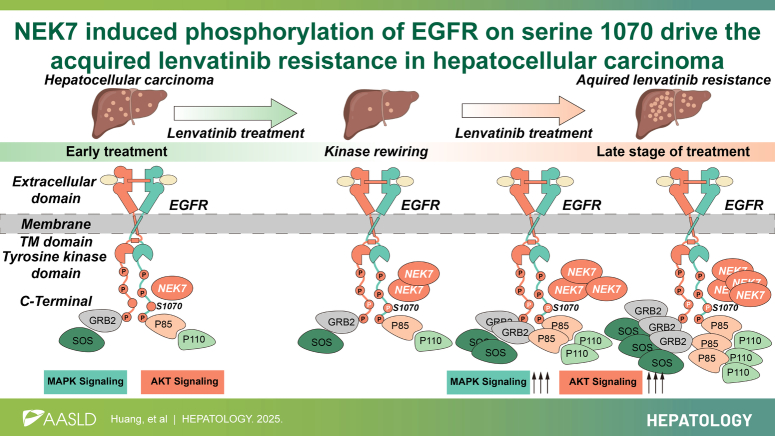
graphic file with name hep-84-378-g001.jpg

Highlight

  • NEK7 identified as a key driver of acquired lenvatinib resistance in hepatocellular carcinoma (HCC).
  • NEK7 phosphorylates endothelial growth factor receptor (EGFR) specifically at serine 1070, activating downstream MAPK and PI3K/AKT pathways.
  • Inhibitory peptides targeting the EGFR domain responsible for NEK7-mediated phosphorylation successfully suppress lenvatinib resistance in HCC models.
  • Targeting the NEK7-EGFR interaction offers a novel therapeutic strategy to overcome treatment resistance in advanced HCC.

Study Background and Disease Burden

MedXY registered readers

Sign in free to continue reading

Create or use your MedXY account to unlock the complete article.

This article was created using several editorial tools, including AI, as part of the process. Human editors reviewed this content before publication.

Related articles

Open language-specific specialty feeds and department pages.

Unraveling the S1P-TREM2 Axis: A Novel Ferroptosis-Resistance Mechanism Driving Immunosuppressive Neutrophils and Tumour Progression in Hepatocellular CarcinomaThis study reveals how the S1P-TREM2-NRF2 signaling pathway protects tumor-associated neutrophils from ferroptosis, sustaining immunosuppression and promoting hepatocellular carcinoma progression, offering new therapeutic avenues.Sep 12, 2026Refining Prognostic Stratification in Hepatocellular Carcinoma: The Critical Role of Vascular Invasion Type and ExtentThis study elucidates how distinct patterns and gradations of vascular invasion in hepatocellular carcinoma differentially impact recurrence timing and overall survival, enabling improved postoperative risk stratification.Sep 5, 2026Decoding CPEB3-Regulated Alternative Polyadenylation: A New Genetic Lens on Hepatocellular Carcinoma PrognosisThis article explores how genetic variants affect CPEB3-mediated alternative polyadenylation in hepatocellular carcinoma, revealing potential prognostic markers and therapeutic targets to improve patient survival.Sep 5, 2026
Loading comments...
MedXY briefing

Get the free newsletter

Evidence-led clinical news, trends, and analysis—delivered to your inbox.

Ask MedXY AI

Most popular

Intimate Health
Five Benefits for Women Continuing Sexual Activity After Menopause
Intimate Health
Why Some Women Have a Strong Sex Drive—And Why Men Shouldn't Worry About It
Nursing & care
How often should a couple have sex?
Intimate Health
Classic Intimacy Recommendations: How to Help Women Reach Orgasm and Enjoy Mutual Pleasure
Intimate Health
What Makes a Woman "Physiologically Addicted" Is Never Money, But These Two Relationship Qualities
© 2026 MedXY
Contact usAbout usPrivacy PolicyMedXY story
Gut Microbiota and Metabolomic Signatures as Predictors of Immunotherapy Outcomes in MASLD and Viral HCC
Distinct gut microbial profiles but shared metabolomic markers, especially fecal acetate, predict response and survival with combination immunotherapy in metabolic dysfunction-associated and viral hepatitis-related hepatocellular carcinoma.
Aug 22, 2026
Decoding Hepatocellular Carcinoma in Fontan-Associated Liver Disease: Genomic and Transcriptomic InsightsThis article explores the unique genomic and transcriptomic features of hepatocellular carcinoma in Fontan-associated liver disease, revealing distinct mutation patterns and poor-prognosis molecular subtypes that inform disease mechanisms aAug 12, 2026
BEACON-HCC: A North American consensus reshaping treatment allocation for hepatocellular carcinomaBEACON-HCC is a multidisciplinary, evidence-based North American consensus that updates HCC treatment allocation—integrating tumor biology, nuanced intrahepatic burden, vascular invasion, and newer modalities (EBRT, TARE, systemic–locoregioAug 9, 2026