We use cookies

Our website uses essential cookies and, with your consent, additional cookies to measure performance and improve our services. Cookie Policy.

You can change your choice at any time.

MMedXYNews
HomeVideos
MedXY AI/MedXY News/Section: Cardiology

Targeting ACKR3/CXCR7 Enhances Platelet Anticoagulant Lipids and Modulates Procoagulant Function: Implications for Thrombosis Management
MedXY Editorial Team•Sep 17, 2026•Cardiology
ACKR3acylcarnitinesanticoagulantChuyển hóa mỡ máuCXCR7plateletsthrombosis

Highlight

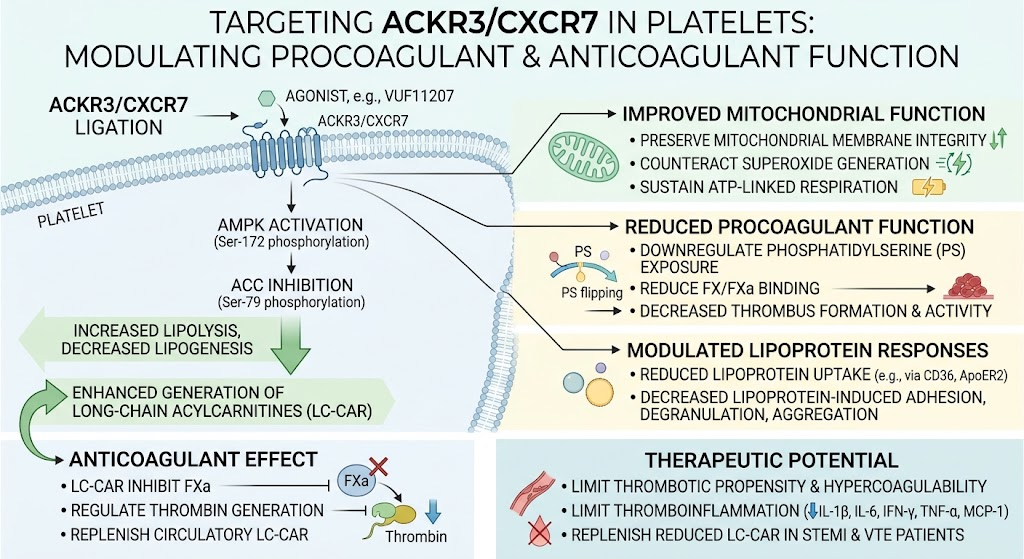
  • Activation of the atypical chemokine receptor CXCR7 (ACKR3) modulates platelet lipid processing, favoring anticoagulant long-chain acylcarnitines (LC-CAR) over prothrombotic lipids.
  • CXCR7 agonist VUF11207 preserves mitochondrial integrity and reduces platelet oxidative stress, thereby limiting procoagulant platelet activation.
  • The CXCR7-AMPK-ACC signaling axis promotes platelet lipolysis, reduces phosphatidylserine exposure, and diminishes FX/FXa binding, cumulatively reducing thrombin generation and thrombosis in vivo.
  • Targeting CXCR7 in thrombosis models decreases inflammation and procoagulant lipid mediators, highlighting its therapeutic potential in cardiovascular conditions such as STEMI and venous thromboembolism (VTE).

Study Background

MedXY registered readers

Sign in free to continue reading

Create or use your MedXY account to unlock the complete article.

This article was created using several editorial tools, including AI, as part of the process. Human editors reviewed this content before publication.

Related articles

Open language-specific specialty feeds and department pages.

Advancing Familial Hypercholesterolemia Diagnosis: Activity-Normalized Prime Editing for Comprehensive LDLR Variant ClassificationA novel prime editing screening method enables precise functional classification of LDLR gene variants, enhancing diagnosis and therapeutic strategies for familial hypercholesterolemia.Sep 6, 2026Histidine-Rich Glycoprotein as a Modulator of Platelet Adhesion and Aggregation: Mechanistic Insights and Clinical ImplicationsHistidine-rich glycoprotein (HRG) directly modulates platelet adhesion and aggregation by binding platelet receptors GPIbα and GPIIb/IIIa, competing with key ligands VWF and fibrinogen, thus attenuating thrombus formation; reduced HRG in seAug 23, 2026Metrnl: A Novel Inhibitor of Platelet Activation Targeting CD36 to Mitigate Thrombosis and Acute Myocardial InjuryMetrnl reduces platelet activation and thrombus formation by promoting CD36 degradation, offering a promising therapeutic strategy for thrombotic diseases including acute myocardial infarction without increasing bleeding risk.Aug 21, 2026
Loading comments...
MedXY briefing

Get the free newsletter

Evidence-led clinical news, trends, and analysis—delivered to your inbox.

Ask MedXY AI

Most popular

Intimate Health
Five Benefits for Women Continuing Sexual Activity After Menopause
Intimate Health
Why Some Women Have a Strong Sex Drive—And Why Men Shouldn't Worry About It
Nursing & care
How often should a couple have sex?
Intimate Health
Classic Intimacy Recommendations: How to Help Women Reach Orgasm and Enjoy Mutual Pleasure
Intimate Health
What Makes a Woman "Physiologically Addicted" Is Never Money, But These Two Relationship Qualities
© 2026 MedXY
Contact usAbout usPrivacy PolicyMedXY story
HIF2 Activation in Cardiac Vasculature: A Novel Mechanistic Insight into Kawasaki Disease’s Cardiovascular Complications
This study reveals how HIF2 activation drives coronary artery remodeling, inflammation, and thrombosis in a mouse model mirroring severe Kawasaki disease, uncovering new therapeutic targets for coronary complications.
Aug 18, 2026
Molecular Mutations and Cardiovascular Risks Shape Prognosis in Triple-Negative Essential ThrombocythemiaThis study reveals that specific gene mutations and cardiovascular risk factors significantly influence prognosis and thrombotic risk in triple-negative essential thrombocythemia, highlighting the importance of molecular profiling for persoJul 15, 2026
Olfactory Receptor Signaling as a Novel Antiplatelet Strategy: OR2L13 Activation, HSP27 Phosphorylation, and Cytoskeletal Control of Arterial ThrombosisA 2026 Circulation study identifies OR2L13 agonism as a first-in-class platelet inhibitory strategy that suppresses aggregation and arterial thrombosis through HSP27-dependent actin remodeling without an apparent hemostatic penalty in preclJun 10, 2026