Highlight
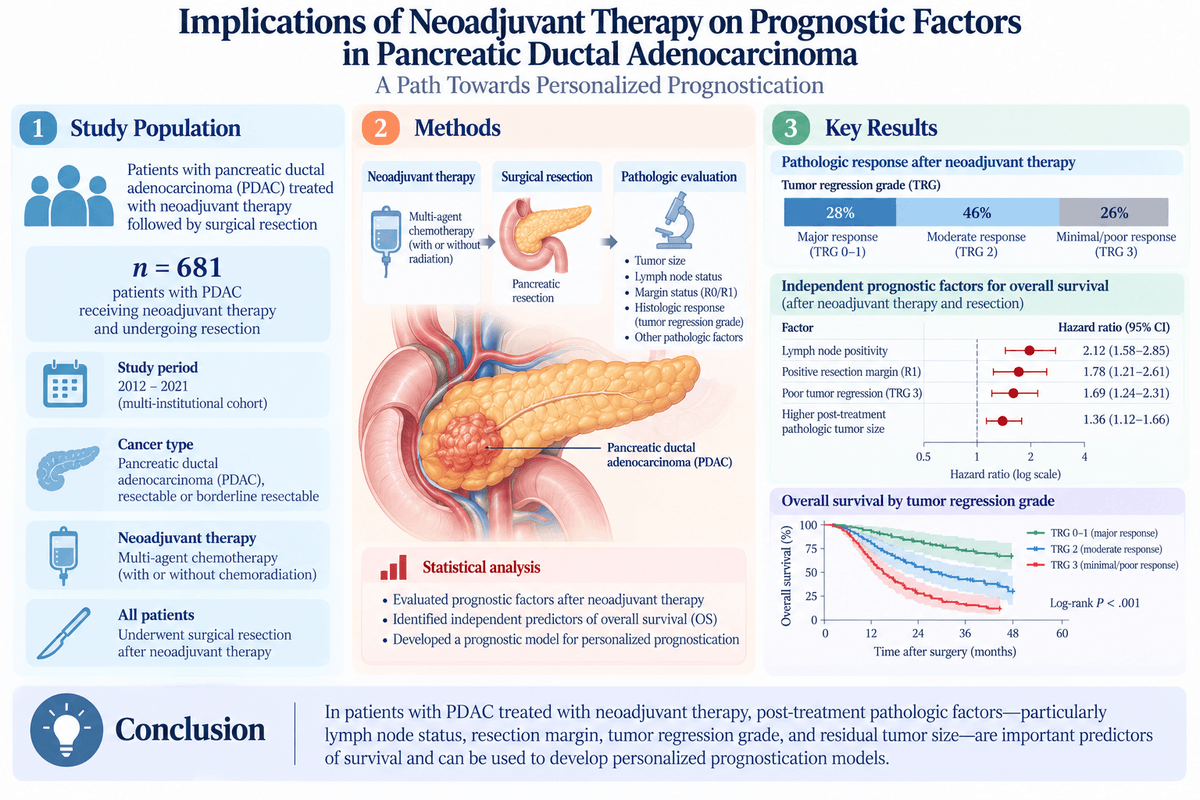
This study demonstrates that neoadjuvant therapy (NAT) significantly modifies established prognostic factors for overall survival in pancreatic ductal adenocarcinoma (PDAC). Personalized predictive models based on treatment context (NAT vs chemotherapy-naïve) improve the accuracy of patient prognostication post-resection.
Key prognostic markers differ markedly between groups, with normalization of carbohydrate antigen 19-9 and treatment response grade being critical for NAT patients, while traditional pathologic features remain dominant predictors in chemo-naïve patients.
The development and availability of interactive, web-based survival prediction tools represent an important clinical advance towards individualized management for patients with resected PDAC.
Study Background and Disease Burden
Pancreatic ductal adenocarcinoma is a highly lethal malignancy, with 5-year survival rates historically below 10%, primarily due to late diagnosis and aggressive tumor biology. Surgical resection remains the only curative option; however, recurrence is frequent even after curative-intent surgery. Neoadjuvant therapy, comprising chemotherapy and/or chemoradiotherapy administered prior to surgery, is increasingly employed to improve resectability, eradicate micrometastases, and select patients for surgery based on tumor biology.
Despite growing utilization, the prognostic implications of neoadjuvant therapy on classical clinicopathologic factors in PDAC remain unclear. Established pathologic parameters such as tumor size, nodal involvement, differentiation grade, margin positivity, and carbohydrate antigen 19-9 (CA 19-9) levels were historically derived from chemo-naïve cohorts. It is critical to reassess these predictors in the NAT context to refine survival estimates for personalized patient counseling.
Study Design and Methods
This retrospective cohort study pooled data from the Dutch Pancreatic Cancer Group Recurrence Database along with institutional registries at NYU Langone Health and Johns Hopkins Hospital between 2014 and 2019. Inclusion criteria encompassed patients with histologically confirmed PDAC who underwent surgical resection, stratified by receipt of neoadjuvant therapy versus chemotherapy-naïve status.
Overall survival (OS) was calculated from the date of surgical resection. Univariable and multivariable Cox proportional hazards models identified prognostic factors associated with OS in the NAT and chemo-naïve subgroups separately. The effect sizes were reported as hazard ratios with 95% confidence intervals. Kaplan–Meier survival curves stratified by key prognostic variables assessed differences in survival.
Based on model findings, predictive survival models were developed for each group. An interactive, online tool was implemented to facilitate individualized OS predictions integrating relevant patient and tumor characteristics according to treatment history (www.pancpals.com/tools).
Key Results
The study analyzed 2760 patients with resected PDAC, of whom 778 (28%) received NAT. Key distinctions in prognostic factors emerged between the chemo-naïve and NAT groups:
Chemo-naïve Group
Age ≥65 years independently predicted worse OS.
High CA 19-9 levels at diagnosis (≥500 U/mL) were strongly associated with decreased survival.
Advanced tumor stage (AJCC T3/4 vs T1/2) and higher nodal involvement (N2>N1>N0) predicted poor outcomes.
Poor tumor differentiation, perineural invasion, and microscopically positive resection margin (R1) correlated with significantly shorter OS.
Neoadjuvant Therapy Group
Failure to normalize CA 19-9 after NAT (levels remaining ≥37 U/mL) was a critical adverse prognostic factor, highlighting tumor biology and treatment resistance.
Nodal involvement predicted worse survival; however, survival did not differ significantly between N1 and N2, indicating nodal burden impacts prognosis differently post-NAT.
The grade of treatment response, assessed histopathologically (moderate/poor vs complete/near complete response), was a powerful predictor of OS.
Notably, several traditional pathological predictors lost prognostic significance following NAT, underscoring the transformative impact of preoperative therapy on tumor biology and residual disease.
Expert Commentary
The findings underscore the necessity to contextualize prognostication within the treatment paradigm for PDAC. Neoadjuvant therapy modifies tumor characteristics and potentially selects for chemo-sensitive phenotypes, which may explain shifts in survival predictors. For example, normalization of CA 19-9 after NAT emerges as a dynamic biomarker reflecting response and residual tumor burden.
These results align with recent literature advocating for biomarker-driven and response-adapted prognostication. The attenuated prognostic gradient between N1 and N2 nodes post-NAT suggests that nodal disease behaves differently after systemic therapy, which may influence decisions on adjuvant strategies.
Limitations include retrospective design and heterogeneity in NAT regimens and response assessment criteria. Nonetheless, the multinational cohort and robust statistical approach provide compelling evidence to refine prognostic models. Prospective validation and incorporation of molecular biomarkers would further optimize prediction accuracy.
Conclusion and Clinical Impact
This comprehensive analysis reveals that neoadjuvant therapy substantially alters the prognostic landscape in resected pancreatic ductal adenocarcinoma. Distinct sets of independent survival predictors apply according to prior treatment exposure. Recognizing these differences is essential for accurate patient counseling, clinical decision-making, and designing future trials.
The development of dedicated, treatment-specific prognostic tools accessible online offers clinicians a practical means to individualize survival predictions, facilitating personalized therapeutic strategies and follow-up plans for PDAC patients.
Future research integrating radiologic, serologic, and genomic markers with clinical and pathological data is warranted to further enhance prognostication and ultimately improve outcomes in this challenging malignancy.
Funding and Trial Registration
The study was conducted under the auspices of the Dutch Pancreatic Cancer Group and the PANC-PALS Consortium. Specific funding sources were not detailed in the publication. No clinical trial registration was reported, consistent with the retrospective cohort nature of the study.
References
Javed AA, Habib JR, Andel PCM, Campbell BA, Rompen IF, Mahmud O, Fatimi A, van Goor IWJM, Schouten TJ, Stoop TF, Salinas CH, van Santvoort HC, Koerkamp BG, Molenaar IQ, Wolfgang CL, Besselink MG, He J, Daamen LA; Dutch Pancreatic Cancer Group and the PANC-PALS Consortium. Implications of Neoadjuvant Therapy on Prognostic Factors in Pancreatic Ductal Adenocarcinoma: A Path Towards Personalized Prognostication. Ann Surg. 2026 Oct 1;284(4):e79-e86. doi: 10.1097/SLA.0000000000006660. Epub 2025 Feb 7. PMID: 39928537.