Surveillance Colonoscopy in Lynch Syndrome: Impact on Colorectal Cancer Outcomes in a National NHS Cohort
Highlight
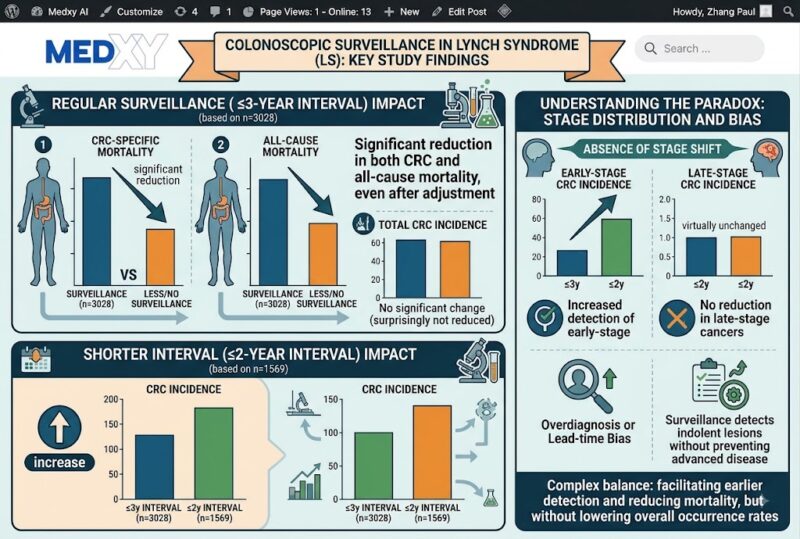
- Regular colonoscopic surveillance (≤3-year interval) in Lynch syndrome (LS) patients correlates with reduced colorectal cancer (CRC) mortality and all-cause mortality.
- No significant reduction in overall CRC incidence was observed with surveillance, suggesting complex detection dynamics.
- Shorter surveillance intervals (≤2 years) were associated with increased detection of CRC, particularly early-stage, with no corresponding late-stage reduction, indicating possible overdiagnosis or lead-time bias.
- Findings highlight potential selection biases inherent to a non-randomized observational design and emphasize the need for careful interpretation of surveillance benefits.
Background: Lynch Syndrome and the Burden of Colorectal Cancer
Lynch syndrome (LS), also known as hereditary nonpolyposis colorectal cancer (HNPCC), is an autosomal dominant inherited cancer predisposition syndrome caused by pathogenic germline variants in DNA mismatch repair (MMR) genes such as MLH1, MSH2, MSH6, and PMS2. LS carriers have a significantly elevated lifetime risk of developing colorectal cancer (CRC) and other malignancies, compared to the general population. Given the increased cancer risk, current clinical guidelines recommend enhanced colonoscopic surveillance for heterozygous MMR gene variant carriers to facilitate early detection and improve prognosis.
Despite these recommendations, the real-world impact of surveillance colonoscopy on CRC incidence, stage at diagnosis, and mortality among LS patients remains incompletely understood, with gaps related to adherence, optimal surveillance intervals, and potential outcomes such as overdiagnosis or stage migration.
Study Design and Methods
This national observational cohort study analyzed data from 4732 confirmed carriers of MMR germline pathogenic variants within the English National Health Service (NHS) between 2010 and 2022. Patient data from a Lynch syndrome registry were combined with longitudinal digital NHS records to evaluate adherence to colonoscopic surveillance guidelines and outcomes.
Surveillance adherence was defined using mean colonoscopy interval stratifications: 0 years and 2 years. Logistic regression identified predictors affecting surveillance adherence.
The investigators compared CRC incidence, cancer stage at diagnosis, and mortality between patients with documented surveillance and those without. Age-specific annual CRC incidence rates (AS-AIRs) and cumulative lifetime CRC risks were estimated. Stage distribution and stage-specific AS-AIRs were analyzed to detect possible shifts in cancer stage at diagnosis. Kaplan-Meier survival analysis and Cox proportional hazards regression assessed CRC-specific and all-cause mortality risks.
Key Findings
The study showed that among LS patients undergoing colonoscopic surveillance at a mean interval of ≤3 years (n=3028), there was a statistically significant reduction in CRC-specific and all-cause mortality compared to patients with less frequent or no surveillance, even after adjustment for confounding variables. Surprisingly, total CRC incidence was not significantly reduced in this group.
When the surveillance interval was shortened to ≤2 years (n=1569), CRC incidence paradoxically increased, predominantly due to detection of more early-stage cancers. This did not translate into a decreased incidence of late-stage cancers. The absence of a stage shift suggests that surveillance led to increased diagnosis of indolent or early lesions, possibly reflecting overdiagnosis or lead-time bias, rather than prevention of advanced disease.
These findings highlight a complex balance where surveillance facilitates earlier CRC detection and reduces mortality but does not necessarily lower overall CRC occurrence rates in LS individuals. The lack of stage shift might also be influenced by the relatively short follow-up period and potential spectrum biases.
Expert Commentary and Interpretation
This comprehensive national cohort reinforces the clinical benefit of regular colonoscopic surveillance in reducing CRC-related death among Lynch syndrome carriers. The reduction in mortality without a commensurate decrease in CRC incidence might seem counterintuitive, but it is consistent with other hereditary cancer surveillance literature where early detection improves survival rather than preventing all cancers.
The observed increase in CRC incidence with more frequent surveillance highlights potential overdiagnosis, a phenomenon where lesions unlikely to progress clinically are detected and treated, possibly leading to patient burden without proportional benefit. The absence of a clear stage shift complicates the interpretation and underscores the challenge of extracting causality from observational studies.
Limitations include the non-randomized design, which can introduce selection bias, as adherent patients may differ systematically in health behavior or comorbidity profiles. Additionally, the relatively short duration of follow-up may limit the ability to observe long-term outcomes such as prevention of late-stage CRC.
Existing guidelines recommend colonoscopy every 1-2 years for LS patients. These real-world data suggest that surveillance intervals can be tailored, but must balance the benefits of early CRC detection and mortality reduction against potential harms of overdiagnosis and patient burden.
Conclusion
This national NHS cohort study provides robust evidence that regular colonoscopic surveillance in Lynch syndrome patients significantly lowers CRC-specific and all-cause mortality despite no reduction in overall CRC incidence. The increased incidence observed with shorter surveillance intervals may indicate overdiagnosis or lead-time bias. These findings underscore the critical need for individualized surveillance strategies and highlight areas for future prospective research to optimize colonoscopy timing and refine patient selection to maximize benefit and minimize harm.
Funding and Clinical Trials
The study was conducted using data from the English NHS and the Lynch syndrome registry, funded by the UK’s cancer research and health institutions. No clinical trial registration was indicated as this was an observational cohort analysis.
References
1. Lynch HT, de la Chapelle A. Hereditary colorectal cancer. N Engl J Med. 2003;348(10):919-932. doi:10.1056/NEJMra012242
2. Giardiello FM, Allen JI, Axilbund JE, et al. Guidelines on genetic evaluation and management of Lynch syndrome: a consensus statement by the US Multi-Society Task Force on colorectal cancer. Gastroenterology. 2014;147(2):502-526. doi:10.1053/j.gastro.2014.04.001
3. Stoffel EM, Koeppe E, Everett J, et al. Clinicopathological features and survival of patients with colorectal cancer and mismatch repair deficiency. Gut. 2020;69(4):619-626. doi:10.1136/gutjnl-2018-317619
4. Huntley C, Loong L, Mallinson C, et al. Impact of surveillance colonoscopy on colorectal cancer incidence and mortality in Lynch syndrome: a national observational cohort study of patients in the English NHS 2010-2022. Gut. 2026 Aug 6. doi:10.1136/gutjnl-2025-334789. PMID: 42562418
This article was created using several editorial tools, including AI, as part of the process. Human editors reviewed this content before publication.