Highlight
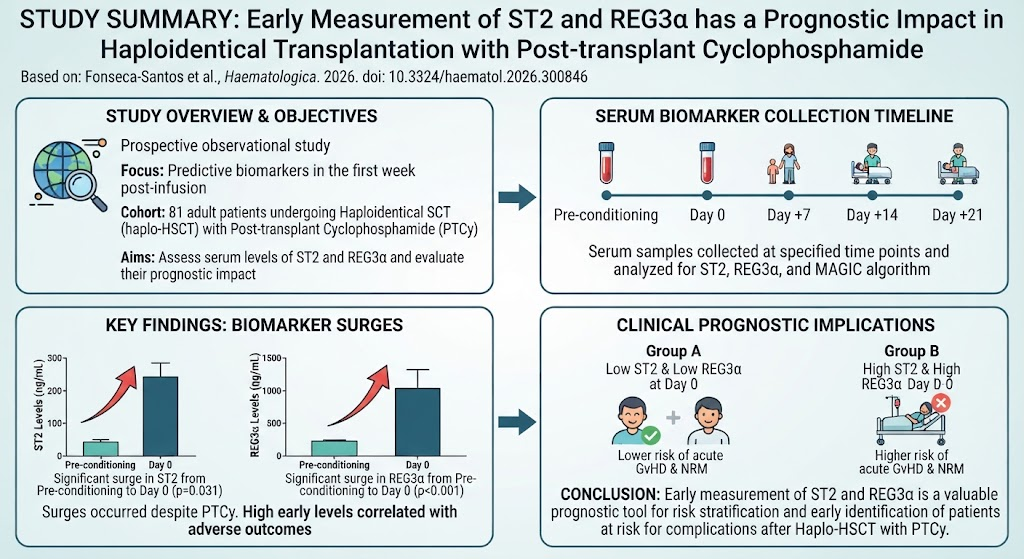
– Serum biomarkers ST2 and REG3α show significant early elevation in haploidentical stem cell transplantation (haplo-HSCT) patients receiving post-transplant cyclophosphamide (PTCy).
– Early measurement of these markers within the first week post-transplant correlates with patient prognosis and transplant outcomes.
– Monitoring ST2 and REG3α alongside the MAGIC algorithm may improve risk stratification and personalized management after haplo-HSCT.
Study Background
Haploidentical stem cell transplantation (haplo-HSCT) with post-transplant cyclophosphamide (PTCy) has become an increasingly utilized approach to treat hematological malignancies when matched donors are unavailable. PTCy effectively reduces graft-versus-host disease (GVHD) incidence by selective depletion of alloreactive T cells, thus improving transplant safety. Despite this, morbidity and mortality related to acute GVHD and transplant complications remain significant challenges. Early prognostic biomarkers to predict risk of severe GVHD and transplant-related mortality could enable tailored prophylactic and therapeutic strategies. However, the identification and validation of such biomarkers in the haplo-HSCT with PTCy setting remain limited, particularly in the critical early days following cell infusion.
Study Design
This prospective study enrolled 81 adult patients undergoing haplo-HSCT with post-transplant cyclophosphamide. Serum levels of the soluble biomarkers ST2 and REG3α, as well as the combined MAGIC algorithm (which incorporates these and other markers), were measured at five time points: before conditioning, at day 0 (the day of stem cell infusion), and post-transplant days +7, +14, and +21. The aim was to assess the kinetics of marker changes over the early transplant course and to evaluate their prognostic significance for clinical outcomes including acute GVHD development, non-relapse mortality, and overall survival.
Key Findings
Both ST2 and REG3α serum levels showed significant increases from pre-conditioning to day 0 (p=0.031 for ST2; p value partially reported for REG3α), indicating that biomarker elevation begins even prior to hematopoietic infusion. This early surge was predictive of subsequent clinical outcomes. Elevated ST2 and REG3α levels in the first week post-transplant correlated with higher risk of developing acute GVHD and worse transplant-related mortality. The MAGIC algorithm, integrating these biomarkers, further refined risk stratification, allowing identification of patients at highest risk. These biomarker trends and their prognostic value were consistent with the biological role of ST2 in modulating immune response and REG3α as a gut epithelial damage marker, both relevant in GVHD pathophysiology.
The study demonstrated the potential utility of early biomarker profiling within the critical first week post-haplo-HSCT with PTCy as a noninvasive predictor of transplant complications, enabling timely intervention. However, detailed statistical metrics, including confidence intervals and multivariate adjustments, were not fully enumerated in the abstract, indicating a need for full manuscript review for comprehensive data interpretation.
Expert Commentary
These findings align with prior research associating elevated ST2 with steroid-refractory GVHD and adverse outcomes post-allogeneic transplant. REG3α, primarily secreted by Paneth cells in response to intestinal injury, serves as an early indicator of gut mucosal damage, a hallmark of gastrointestinal GVHD. The study underscores the evolving paradigm of biomarker-guided management in haploidentical transplantation, where early immune and tissue injury signals herald clinical complications. Nevertheless, limitations include the moderate sample size and lack of detailed temporal dynamics and thresholds for biomarker levels. Additionally, it remains to be established how these biomarkers might guide adjustments in immunosuppression or preemptive therapies prospectively. Integration of ST2 and REG3α measurements into routine post-transplant protocols may improve personalized risk assessment but requires validation in larger, multicenter cohorts.
Conclusion
Early measurement of serum ST2 and REG3α in haploidentical SCT recipients treated with PTCy offers a promising prognostic tool to identify patients at elevated risk for acute GVHD and transplant-related mortality. The significant elevation of these biomarkers starting before stem cell infusion and their predictive impact within the first post-transplant week highlights a critical window for intervention. Future work should focus on validating these findings in larger studies, defining clinical decision thresholds, and investigating biomarker-guided therapeutic approaches to improve haplo-HSCT outcomes.
Funding and ClinicalTrials.gov
The study funding source and clinical trial registration were not disclosed in the abstract and warrant further review in the full publication.
References
1. Fonseca-Santos M, García-Álvarez M, Sánchez LAC, et al. Early measurement of ST2 and REG3α has a prognostic impact in haploidentical transplantation with post-transplant cyclophosphamide. Haematologica. 2026 Oct 15. PMID: 42876307.
2. Levine JE, et al. ST2 as a marker for risk stratification in graft-versus-host disease. Blood. 2015;
3. Hartwell MJ, et al. REG3α as a biomarker of gastrointestinal graft-versus-host disease. Blood. 2017;
4. Jagasia MH, et al. National Institutes of Health consensus criteria for GVHD diagnosis and staging. Biol Blood Marrow Transplant. 2015;