Highlight
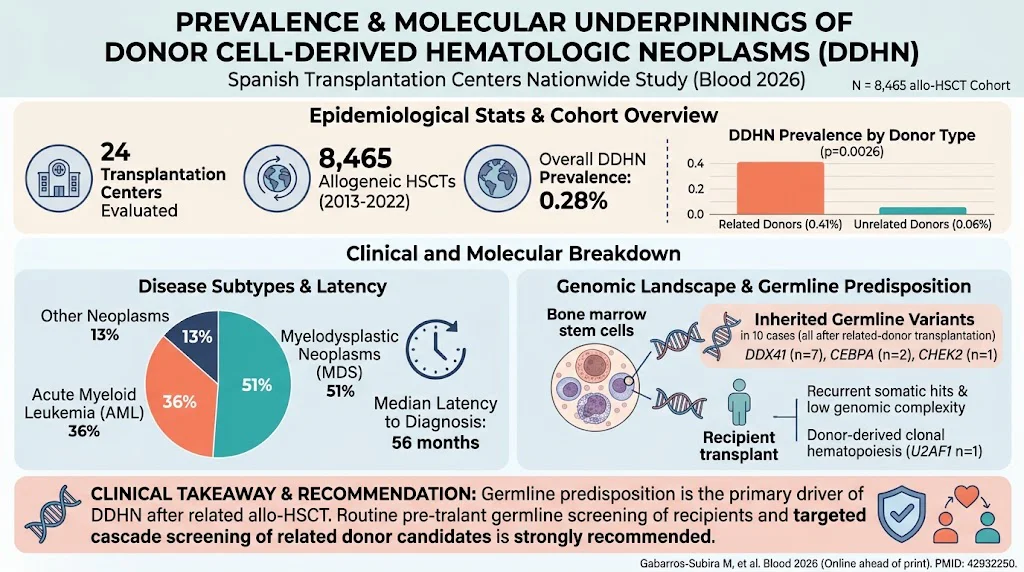
This national Spanish study establishes the prevalence of donor cell-derived hematologic neoplasms (DDHN) at 0.28% among allogeneic hematopoietic stem cell transplants (allo-HSCT), highlighting a significantly higher risk associated with related-donor transplants. Germline mutations, particularly in DDX41, emerge as the primary molecular underpinning, emphasizing the importance of pre-transplant germline genetic screening.
Study Background
Allogeneic hematopoietic stem cell transplantation (allo-HSCT) is a critical therapeutic modality for various hematologic malignancies and disorders. While allo-HSCT often offers curative potential, one rare but serious complication is the development of donor cell-derived hematologic neoplasms (DDHN). DDHN represents a distinct secondary malignancy arising from transplanted donor stem cells rather than the recipient’s original disease. Epidemiological data on DDHN are scarce, and its molecular mechanisms remain largely unknown, complicating risk assessment and donor selection strategies.
Understanding DDHN’s prevalence, latency, clinical spectrum, and molecular etiology is essential for improving transplantation safety and outcomes. This nationwide multicenter Spanish study systematically evaluated DDHN occurrence, integrating cytogenetic and advanced molecular analyses to elucidate the genetic drivers and clinical context of these entities.
Study Design
Twenty-four transplantation centers across Spain conducted a retrospective review of allo-HSCT recipients. The cohort included 8,465 transplants performed between 2013 and 2022, with DDHN cases identified from 2007 through 2025. Diagnosis of DDHN required confirmation of donor-origin hematologic malignancy via cytogenetic or molecular means, distinguishing it from the original recipient’s hematopoietic disease.
Molecular characterization employed germline-augmented targeted next-generation sequencing (NGS), whole-exome sequencing (WES), and comparative analyses of donor and recipient genetic profiles. Study endpoints included the prevalence of DDHN, latency period post-transplant, hematologic neoplasm subtype distribution, and identification of underlying germline or somatic genetic alterations.
Key Findings
Among the 39 confirmed DDHN cases, prevalence was 0.28% overall, markedly higher in related-donor transplants (0.41%) compared to unrelated donors (0.06%), with a significant p-value of 0.0026. Median latency from transplantation to DDHN diagnosis was 56 months, indicating a delayed emergence after initial engraftment.
The majority of DDHN were myeloid neoplasms: 51% myelodysplastic syndromes (MDS) and 36% acute myeloid leukemia (AML). Molecular data, available in 33 cases, revealed germline predisposition as a central pathogenic mechanism. Specifically, pathogenic or likely pathogenic germline variants were identified in 10 cases, exclusively after related-donor transplantation. The involved genes were DDX41 (n=7), CEBPA (n=2), and CHEK2 (n=1).
DDX41-associated DDHN cases exhibited recurrent secondary somatic mutations and a low degree of genomic complexity, suggesting a distinct leukemogenic pathway. Notably, donor-derived clonal hematopoiesis was rare, confirmed only in one myeloid case involving a U2AF1 mutation.
Expert Commentary
This study robustly supports inherited germline predisposition, particularly involving DDX41 mutations, as a principal molecular driver of DDHN after related allo-HSCT. The findings underscore the critical need to incorporate comprehensive germline genetic evaluations at the original disease diagnosis stage. Such assessments enable informed donor selection by targeting cascade screening in potential related donors, thereby minimizing the risk of transplanting pre-malignant clones.
Moreover, the relatively long latency period reinforces the necessity for prolonged post-transplant surveillance for secondary donor-derived malignancies. Limitations include the retrospective design and potential underdiagnosis of DDHN due to diagnostic complexity. Future prospective studies could further refine risk stratification and explore preventive strategies.
Conclusion
Donor cell-derived hematologic neoplasms represent a rare but serious complication of allo-HSCT, predominantly arising from inherited germline mutations in related donors, with DDX41 variants playing a leading role. This study advances understanding of DDHN epidemiology and molecular biology, advocating for routine germline evaluation and targeted donor screening to improve transplantation safety. Enhanced awareness and genetic insights hold promise to reduce DDHN incidence and optimize long-term transplant outcomes.
Funding and ClinicalTrials.gov
The study was conducted under the auspices of Spanish transplantation centers. No specific funding or clinical trial registration is noted in the publication.
References
Gabarros-Subira M et al. Molecular Underpinnings and Prevalence of Donor Cell-Derived Hematologic Neoplasms among Spanish Transplantation Centers. Blood. 2026 Oct 26; PMID: 42932250.
Ongoing literature on DDX41 germline mutations and hematologic malignancies for additional background (not directly cited but relevant for understanding the genetic context).