Spectacle Lenses With Highly Aspherical Lenslets for Myopia Control: A Comprehensive Review of Recent Clinical Trials and Emerging Evidence
Highlights
- Highly aspherical lenslets (HAL) spectacle lenses demonstrated significant myopia control efficacy, with up to 71% relative reduction in progression over 24 months in US pediatric populations.
- Comparative studies validate HAL lenses’ superiority over single-vision lenses (SVL) and demonstrate at least non-inferiority compared to other advanced optical interventions such as Defocus Incorporated Multiple Segments (DIMS) lenses and orthokeratology.
- Long-term follow-up suggests sustained efficacy of HAL and related spectacle lens designs in myopia control without compromise of visual function or safety.
- Visual performance assessments report minimal impact on central and peripheral visual acuity, supporting good tolerability and clinical applicability of HAL lenses.
Background
Myopia is a growing global public health concern, notably in pediatric populations, with increasing prevalence and associated risks for sight-threatening complications. In recent years, optical interventions targeting peripheral defocus and retinal image modulation have emerged as effective strategies to slow myopic progression and axial elongation. Spectacle lenses with highly aspherical lenslets (HAL) represent a novel optical design purported to provide simultaneous myopic defocus while maintaining central visual clarity. Although efficacy in Asian cohorts is well documented, evidence from US populations remained sparse until recent clinical trials.
Key Content
Evidence from Randomized Clinical Trials in Diverse Populations
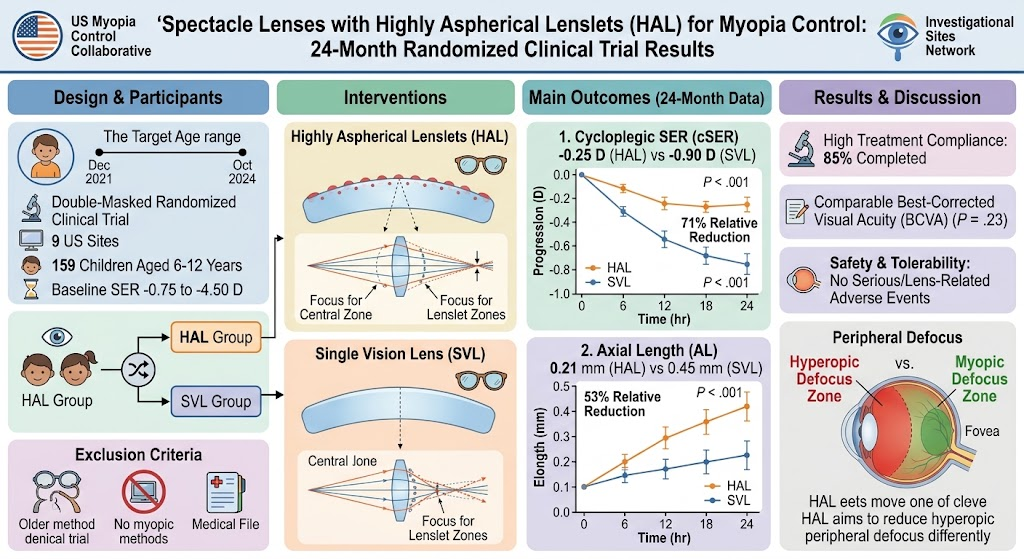
The landmark US-based double-masked randomized clinical trial by Shen et al. (JAMA Ophthalmol. 2026; PMID 42623028) enrolled 159 children aged 6 to 12 years with moderate myopia (-0.75 to -4.50 D). Over 24 months, HAL lenses reduced myopia progression significantly compared to SVL, with adjusted mean cycloplegic spherical equivalent refraction (cSER) progression of -0.25 D vs. -0.90 D (71% relative reduction, P < .001) and axial elongation of 0.21 mm vs. 0.45 mm (53% relative reduction, P < .001). Importantly, HAL lenses demonstrated a safety profile comparable to SVL, with no serious lens-related adverse events and equivalent best-corrected visual acuity outcomes.
Parallel investigations in European children similarly report durability of effects with advanced lens designs. The study assessing cylindrical annular refractive elements (CARE) spectacle lenses documented sustained slowing of axial length (AL) elongation and spherical equivalent refraction (SER) progression over 24 months, with significant reductions in rapid progressors (Ophthalmol Sci. 2026; PMID 42571354).
Long-term data from DIMS lens studies indicate sustained myopia control for over 8 years in subgroups, with efficacy influenced by baseline peripheral refraction characteristics (Ophthalmic Physiol Opt. 2026; PMID 42603847). Furthermore, recent randomized controlled trials suggest that DIMS lenses are non-inferior to orthokeratology lenses in controlling axial elongation up to 18 months (BMC Ophthalmol. 2026; PMID 42595991).
Visual Performance and Safety
Assessment of visual acuity and ocular comfort across various HAL and other myopia control lenses underscores favorable tolerability. Studies integrating detailed visual function metrics show negligible impact on central visual acuity and manageable reductions in peripheral visual acuity that do not compromise daily function (Ophthalmic Physiol Opt. 2026; PMID 41784766). Extended wear studies confirm that neither short- nor long-term wearing of HAL lenses affect visual field sensitivity in children (BMC Ophthalmol. 2026; PMID 41917844).
Additional investigations balance efficacy with astigmatic progression, revealing no clinically significant increases in refractive or corneal astigmatism attributable to lens design over 2 years (Ophthalmol Sci. 2026; PMID 42421756).
Comparative Effectiveness and Combination Therapies
Real-world retrospective data from Chinese pediatric cohorts reveal that HAL lenses outperform DIMS lenses in reducing myopic progression and axial elongation, with combination therapy of HAL plus low-dose atropine (HALA) showing a higher likelihood of strong treatment response compared to other regimens (Eye Vis (Lond). 2026; PMID 42116122). However, the incremental benefit of adding atropine to optical interventions requires further validation in prospective randomized trials.
Emerging optical technologies such as diffusion optics technology (DOT) lenses have also demonstrated promising 12-month efficacy in Chinese populations, providing additional mechanistic diversity for myopia control modalities (Ophthalmol Sci. 2026; PMID 42199728).
Expert Commentary
The accumulated evidence across multiple geographies confirms the robust efficacy and safety of HAL spectacle lenses as a non-invasive, well-tolerated myopia control option for children. The relative consistency of axial length reduction and slowing of refractive progression aligns with mechanistic theories emphasizing peripheral myopic defocus to inhibit scleral remodeling and axial elongation.
Visual performance data alleviate concerns regarding compromised visual function, enhancing clinical acceptance. Notably, the absence of adverse impacts on visual field sensitivity provides reassurance for longer-term use.
Nevertheless, heterogeneity in individual responses, partially moderated by baseline peripheral refraction profiles, heralds the need for personalized approaches to optimize treatment outcomes. The superior efficacy of combination therapy regimens suggests integrating pharmacological and optical strategies may maximize benefits in select high-risk children.
From a regulatory perspective, the corroborative US trial results underpin regulatory approvals, expanding access to these technologies beyond Asian populations.
Limitations remain regarding the need for longer longitudinal data beyond two years to elucidate sustained efficacy and any potential rebound effects post-intervention cessation. Additionally, head-to-head randomized studies comparing various myopia control lenses and combinations will further inform clinical guidelines.
Conclusion
Highly aspherical lenslets (HAL) spectacle lenses have emerged as a validated, effective, and safe modality for pediatric myopia control, with primary data demonstrating significant reduction in myopia progression and axial elongation over 24 months in diverse populations. Visual performance remains well preserved, supporting widespread clinical adoption. Integration of optical and pharmacologic interventions warrants further exploration to tailor individualized myopia management.
Future research should emphasize extended follow-up for durability of effect, mechanistic clarifications, and comparative effectiveness to optimize myopia control strategies globally.
References
- Shen J, Hunt C, Young G, Drobe B. Spectacle Lenses With Highly Aspherical Lenslets for Myopia Control: A Randomized Clinical Trial. JAMA Ophthalmol. 2026 Aug 20. doi:10.1001/jamaophthalmol.2026.3288. PMID: 42623028.
- Lam CSY, et al. Two-Year Efficacy of Cylindrical Annular Refractive Elements Spectacle Lenses for Myopia Control in European Children. Ophthalmol Sci. 2026 Jul;6(9):101309. doi:10.1016/j.xops.2026.101309. PMID: 42571354.
- Lam CSY, et al. Eight-Year Post-Trial Outcomes of a Two-Year Clinical Trial of DIMS Spectacle Lenses. Ophthalmic Physiol Opt. 2026 Aug 15. doi:10.1007/s44402-026-00170-9. PMID: 42603847.
- Yue M, et al. Defocus incorporated multiple segment spectacle lenses versus orthokeratology lenses for myopia control: a non-inferiority randomized clinical trial. BMC Ophthalmol. 2026 Aug 12;26(1):488. doi:10.1186/s12886-026-05144-6. PMID: 42595991.
- Liu YM, et al. Effect of aspherical lens spectacles on axial length progression and refractive error in children with low to moderate myopia: a 24-month randomized controlled trial. J AAPOS. 2026 Apr;30(2):104815. doi:10.1016/j.jaapos.2026.104815. PMID: 41912008.
- Wang J, et al. Effect of the long-term wearing of spectacle lenses with highly aspherical lenslets on visual field sensitivity in children with myopia. BMC Ophthalmol. 2026 Mar 31;26(1):250. doi:10.1186/s12886-026-04781-1. PMID: 41917844.
- Jiang L, et al. Comparison of effectiveness of four myopia control interventions in Chinese children: a real-world retrospective study. Eye Vis (Lond). 2026 May 12;13(1):18. doi:10.1186/s40662-026-00487-z. PMID: 42116122.
- Wang Y, et al. Randomized Clinical Trial of Diffusion Optics Technology Spectacle Lenses in a Chinese Population (CATHAY): 12-Month Results. Ophthalmol Sci. 2026 Mar 11;6(7):101150. doi:10.1016/j.xops.2026.101150. PMID: 42199728.
- Kaizuka N, et al. The Impact of Myopia Control Spectacle Lens Designs on Visual Function. Ophthalmic Physiol Opt. 2026 Mar;46(1):49-59. doi:10.1007/s44402-026-00026-2. PMID: 41784766.
This article was created using several editorial tools, including AI, as part of the process. Human editors reviewed this content before publication.