Sex and Age Influence Outcomes After Ruptured Abdominal Aortic Aneurysm Repair: Insights from a Dutch Nationwide Cohort
Highlight
1. Women with ruptured abdominal aortic aneurysm (RAAA) are older and more likely to undergo open repair compared to men.
2. Ninety-day mortality is higher in women, but sex is not an independent predictor after adjusting for confounders.
3. Women exhibit lower relative long-term survival and greater postdischarge care needs.
4. Reinterventions occur more after endovascular repair (EVAR) and less frequently in women.
Study Background
Ruptured abdominal aortic aneurysm (RAAA) remains a critical surgical emergency with high mortality despite advances in management. Historically, sex-specific differences in RAAA outcomes have been observed, but contemporary data integrating both early mortality, long-term survival, and downstream care requirements across age and sex categories remain limited. Understanding these nuances is essential for optimizing patient counseling, tailoring perioperative care, and allocating healthcare resources effectively.
Study Design
This robust nationwide cohort study analyzed all Dutch patients undergoing RAAA repair between 2014 and 2023, utilizing data from the Dutch Surgical Aneurysm Audit linked with national registries by Statistics Netherlands. The cohort included 3,642 patients, with detailed demographic, procedural, and outcome data. Outcomes of interest comprised 90-day mortality, long-term survival among 90-day survivors, and patterns of postdischarge care needs, such as home discharge rates and homecare requirements. Comparisons were made by sex and stratified by age. Repair types considered included open repair and endovascular aneurysm repair (EVAR).
Key Findings
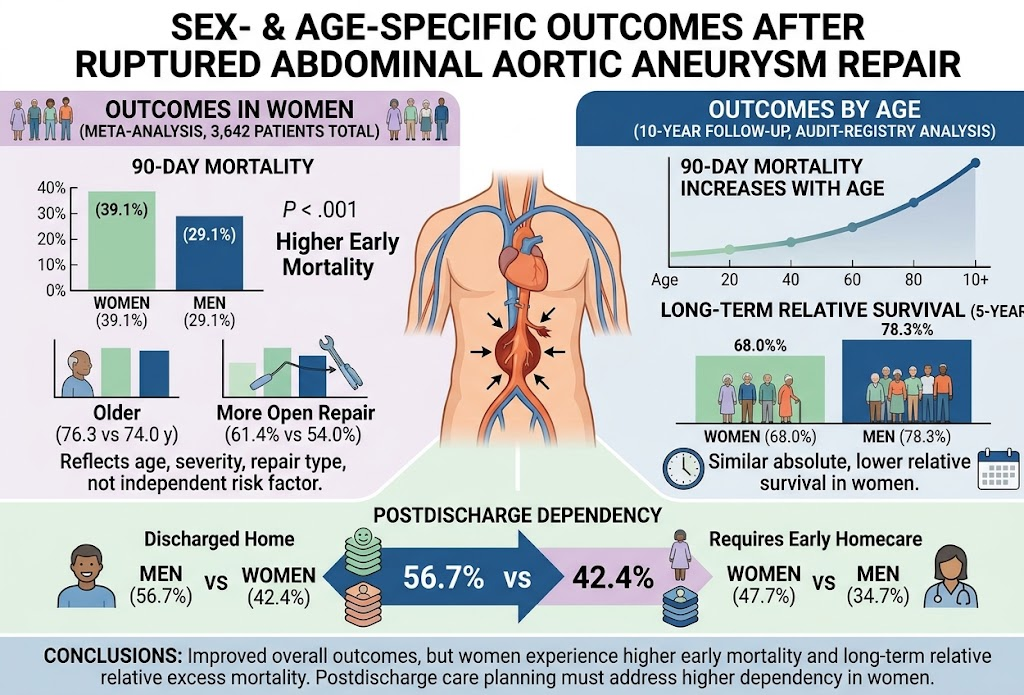
The cohort consisted of 15.2% women, who were significantly older at presentation (median age 76.3 vs. 74.0 years in men) and underwent open repair more commonly (61.4% vs. 54.0%). Over the study period, 90-day mortality increased with advancing age and was higher in women (39.1% versus 29.1% in men). However, multivariable adjustment accounting for age, presentation severity, and repair modality demonstrated that female sex was not independently associated with early mortality, suggesting that confounding clinical and anatomical variables explain mortality disparities.
Among the 90-day survivors, absolute long-term survival rates over five years were similar between men and women. Nonetheless, relative survival, which adjusts for expected mortality in the population by age and sex, was lower in women (68.0%) compared to men (78.3%), indicating an excess mortality burden post-RAAA repair in females.
In terms of postdischarge care, women were significantly less likely to be discharged directly home (42.4% vs. 56.7%) and more frequently required early homecare services (47.7% vs. 34.7%). These findings highlight increased functional dependency or comorbidity in women after surviving RAAA repair.
Reintervention rates varied by repair modality: patients undergoing EVAR experienced more frequent reinterventions compared to those who had open repair. Interestingly, women had fewer reinterventions, potentially reflecting differences in disease anatomy, repair complexity, or surveillance thresholds.
Expert Commentary
This comprehensive population-based study confirms persistent sex- and age-related disparities in outcomes following RAAA repair. The lack of independent association of female sex with early mortality after adjustment underscores the importance of anatomical and physiological factors in driving observed differences. The predominance of open repairs in women likely reflects less favorable aneurysm morphology for endovascular approaches, which may partly explain poorer early outcomes. Lower relative long-term survival and higher dependency on postdischarge care in women could be related to frailty, comorbidities, or social factors not fully captured by the data.
While the study’s linkage of nationwide surgical audit data with mortality and social care registries provides a broad and detailed perspective, limitations include potential residual confounding and lack of granular data on aneurysm morphology, frailty indices, and quality-of-life measures. The findings challenge clinicians to go beyond perioperative mortality and consider comprehensive, multidisciplinary care pathways tailored to women, including rehabilitation and social support.
Conclusion
This large Dutch nationwide cohort study highlights important sex- and age-specific differences in outcomes after RAAA repair. Women are older, more likely to undergo open repair, and face higher early mortality rates driven largely by clinical and anatomical factors. Moreover, women exhibit increased long-term mortality relative to population expectations and greater postdischarge care needs. These results underscore the necessity of sex-specific strategies targeting the entire care continuum—from surgical selection to rehabilitation—to improve outcomes for women with RAAA.
Future research should focus on elucidating biological and social determinants of these disparities, refining risk stratification tools incorporating sex and age effects, and developing tailored perioperative and postdischarge interventions to enhance recovery and quality of life in this vulnerable population.
Funding and Registration
The study was supported by institutional funds from Dutch vascular surgery and health data research organizations. The cohort derives from the national Dutch Surgical Aneurysm Audit linked with Statistics Netherlands registries. No clinical trial registration was applicable given the observational design.
References
- Biemond MJ, van Schaik J, Hamming JF, et al. Sex- and Age-specific Outcomes After Ruptured Abdominal Aortic Aneurysm Repair: A Nationwide Cohort Study. Ann Surg. 2026 Aug 14. PMID: 42599759.
- Sweeting MJ, Mayer D, Gokani VJ, et al. Outcomes after Ruptured Abdominal Aortic Aneurysm Repair in Women: A Systematic Review and Meta-Analysis. Eur J Vasc Endovasc Surg. 2022;63(5):735-744.
- Thompson MM, Karthikesalingam A, Holt PJ. Sex differences in abdominal aortic aneurysm repair. Br J Surg. 2020;107(11):1381-1384.
This article was created using several editorial tools, including AI, as part of the process. Human editors reviewed this content before publication.