We use cookies

Our website uses essential cookies and, with your consent, additional cookies to measure performance and improve our services. Cookie Policy.

You can change your choice at any time.

MMedXYNews
HomeVideos
MedXY AI/MedXY News/Section: Neurology

Severe Parsonage-Turner Syndrome vs. Traumatic Brachial Plexopathy: Insights into Motor Recovery and Treatment Outcomes
MedXY Editorial Team•Aug 29, 2026•Neurology
functional recoveryMotor ReinnervationNerve ReconstructionParsonage-Turner SyndromeTraumatic Brachial Plexopathy

Highlight

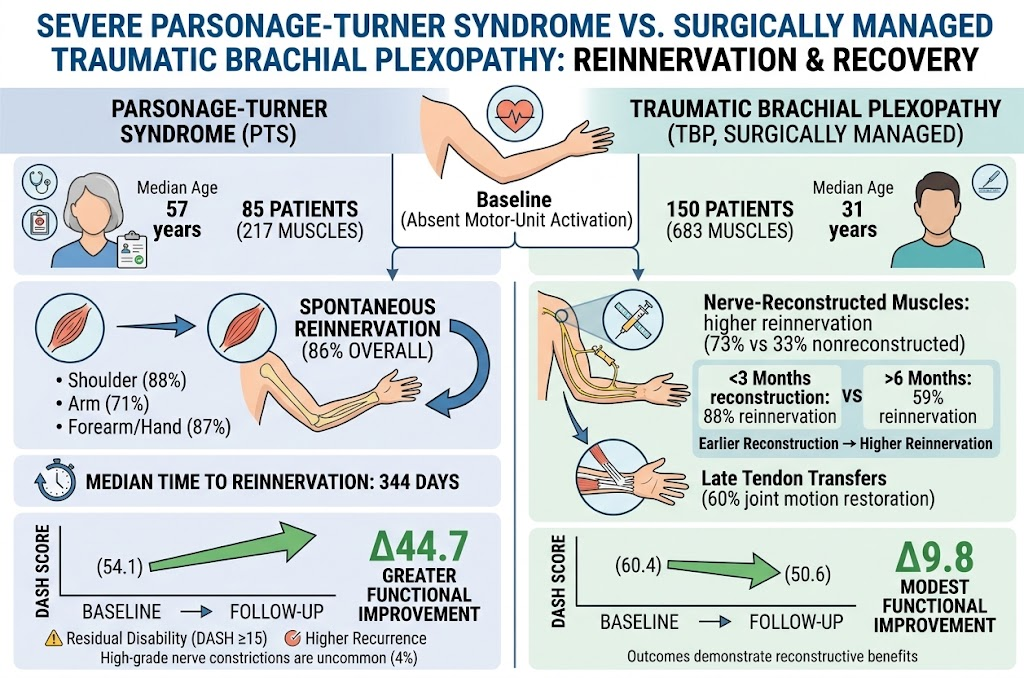
1. Severe Parsonage-Turner syndrome (PTS) shows a high rate (86%) of spontaneous motor-unit reinnervation despite absent activation on EMG, contrasting with lower recovery in traumatic brachial plexopathy (TBP) requiring surgery.
2. Functional recovery measured by DASH scores improved substantially in PTS (mean improvement of 44.7 points) compared to modest gains in surgically treated TBP (mean improvement of 9.8 points).
3. High-grade focal nerve constrictions identified by MRI are uncommon in PTS (4%), limiting the role for surgical intervention in this immune-mediated plexopathy.
4. In TBP, earlier nerve reconstruction (<3 months) yields higher reinnervation rates, emphasizing the benefit of timely surgical management.

Study Background

MedXY registered readers

Sign in free to continue reading

Create or use your MedXY account to unlock the complete article.

This article was created using several editorial tools, including AI, as part of the process. Human editors reviewed this content before publication.

Related articles

Open language-specific specialty feeds and department pages.

Balancing the Scale: Early Antipsychotic Dose Reduction Linked to Better Long-term Functioning Despite Short-term Relapse RisksThe HAMLETT trial demonstrates that early dose reduction after first-episode psychosis increases short-term relapse risk but correlates with superior functional outcomes at three to four years, suggesting a potential &#8216;learning effect&Jan 16, 2026The Long Shadow of the ICU: Identifying High-Risk Functional Trajectories in Older SurvivorsA large-scale longitudinal study reveals that ICU survivors aged 60–79 face significantly higher 5-year excess mortality and functional decline compared to the general population, whereas outcomes for nonagenarians converge with their peersDec 26, 2025Long-Term Functional Recovery and Survival after VA-ECMO: Insights from a 26-Center Prospective Cohort StudyA multicenter study reveals that 30% of adult VA-ECMO patients survive 12 months without new disability, with most disability developing within the first 6 months. Functional independence and employment improve by 12 months post-ECMO.Oct 3, 2025
Loading comments...
MedXY briefing

Get the free newsletter

Evidence-led clinical news, trends, and analysis—delivered to your inbox.

Ask MedXY AI

Most popular

Intimate Health
Five Benefits for Women Continuing Sexual Activity After Menopause
Intimate Health
Why Some Women Have a Strong Sex Drive—And Why Men Shouldn't Worry About It
Nursing &amp; care
How often should a couple have sex?
Intimate Health
Classic Intimacy Recommendations: How to Help Women Reach Orgasm and Enjoy Mutual Pleasure
Intimate Health
What Makes a Woman "Physiologically Addicted" Is Never Money, But These Two Relationship Qualities
© 2026 MedXY
Contact usAbout usPrivacy PolicyMedXY story