We use cookies

Our website uses essential cookies and, with your consent, additional cookies to measure performance and improve our services. Cookie Policy.

You can change your choice at any time.

MMedXYNews
HomeVideos
MedXY AI/MedXY News/Section: Cardiology

Severe Hypertriglyceridemia: New Therapies and Evolving Understanding
MedXY Editorial Team•Jul 25, 2026•Cardiology
plozasiransevere hypertriglyceridemiaPropensity Score Matchinghypertriglyceridemia
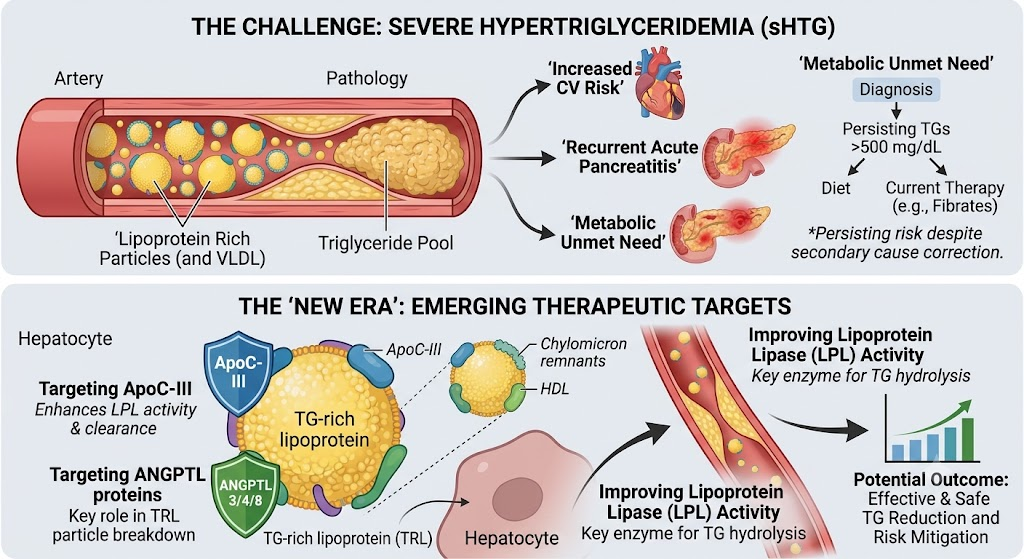
  • Severe hypertriglyceridemia (sHTG, TG >500 mg/dL) affects approximately 1 in 88 adults in pooled global estimates and is linked to elevated risks of acute pancreatitis and atherosclerotic cardiovascular disease.

  • Current pharmacologic options often fail to achieve sustained triglyceride control. The siRNA therapy plozasiran, which targets apoC-III, has shown robust TG reductions and reduced pancreatitis risk in the Phase III PALISADE trial.

  • Pediatric sHTG management, particularly for hospitalized children, lacks dedicated guidelines; genetic causes are common in this population.

  • Prevalence estimates vary widely by region and definition, underscoring the need for standardized thresholds and longitudinal incidence studies.

Background

Hypertriglyceridemia (HTG) is an established independent risk factor for cardiovascular disease. Severe HTG (sHTG), defined by most current guidelines as fasting triglycerides (TG) >500 mg/dL, and extreme HTG (>1,000 mg/dL) are associated with a markedly increased risk of recurrent acute pancreatitis and represent a substantial unmet medical need. Despite the availability of lifestyle interventions, fibrates, omega‑3 fatty acids, and statins, many patients fail to achieve adequate TG lowering, particularly those with monogenic disorders such as familial chylomicronemia syndrome (FCS) or polygenic forms compounded by secondary factors such as obesity, insulin resistance, and poorly controlled diabetes. In 2025–2026, a wave of novel therapies has begun to reshape the treatment landscape. This article synthesizes recent evidence on emerging pharmacologic strategies, epidemiology, and pediatric management of sHTG, drawing from a contemporary review, a Phase III trial on apoC‑III inhibition, a pediatric management chapter, and a comprehensive prevalence study.

MedXY registered readers

Sign in free to continue reading

Create or use your MedXY account to unlock the complete article.

This article was created using several editorial tools, including AI, as part of the process. Human editors reviewed this content before publication.

Related articles

Open language-specific specialty feeds and department pages.

Impact of Combined Transcatheter Mitral and Tricuspid Edge-to-Edge Repair in Patients with Moderate Mitral Regurgitation and Severe Tricuspid RegurgitationThis propensity-matched study shows that in patients undergoing tricuspid TEER for severe TR, untreated moderate MR is linked to worse survival, while combined mitral and tricuspid TEER improves mortality and functional outcomes, highlightiSep 11, 2026Impact of Preoperative Serotonergic Antidepressants on Post-Rhinoplasty Outcomes: A Propensity Score-Matched StudyPreoperative use of serotonergic antidepressants is linked to increased short-term postoperative complications after rhinoplasty, including higher rates of bleeding, readmission, and opioid use, without affecting long-term revision rates.Aug 4, 2026Olezarsen Significantly Lowers Triglycerides and Cuts Pancreatitis Risk in Severe Hypertriglyceridemia: CORE‑TIMI 72a/CORE2‑TIMI 72b ResultsTwo randomized trials found monthly olezarsen (50 mg and 80 mg) produced large, dose-dependent triglyceride reductions and a marked decrease in acute pancreatitis compared with placebo in patients with severe hypertriglyceridemia; higher doNov 10, 2025
Loading comments...
MedXY briefing

Get the free newsletter

Evidence-led clinical news, trends, and analysis—delivered to your inbox.

Ask MedXY AI

Most popular

Intimate Health
Five Benefits for Women Continuing Sexual Activity After Menopause
Intimate Health
Why Some Women Have a Strong Sex Drive—And Why Men Shouldn't Worry About It
Nursing & care
How often should a couple have sex?
Intimate Health
Classic Intimacy Recommendations: How to Help Women Reach Orgasm and Enjoy Mutual Pleasure
Intimate Health
What Makes a Woman "Physiologically Addicted" Is Never Money, But These Two Relationship Qualities
© 2026 MedXY
Contact usAbout usPrivacy PolicyMedXY story
Targeting APOC3 with Olezarsen in Moderate Hypertriglyceridemia: Advances in Antisense Therapies for Triglyceride Reduction
Olezarsen, a GalNAc-conjugated antisense oligonucleotide targeting APOC3 mRNA, significantly reduces triglyceride levels in moderate hypertriglyceridemia, offering a promising therapeutic advance with favorable safety in cardiovascular risk
Oct 6, 2025