Impact of Preoperative Serotonergic Antidepressants on Post-Rhinoplasty Outcomes: A Propensity Score-Matched Study
Highlight
Preoperative serotonergic antidepressant use is associated with increased risk of short-term postoperative complications after rhinoplasty.
Notable complications include bleeding/hematoma, hospital readmission, and increased opioid use within 30 to 90 days.
Long-term surgical revision rates at 1 year are comparable regardless of antidepressant use.
Findings underscore the importance of careful perioperative risk assessment for patients on serotonergic antidepressants undergoing rhinoplasty.
Study Background
Rhinoplasty is a widely performed cosmetic surgical procedure aimed at improving nasal appearance and function. A significant proportion of patients seeking rhinoplasty report underlying anxiety and depressive disorders, conditions frequently managed with serotonergic antidepressants such as selective serotonin reuptake inhibitors (SSRIs) and serotonin-norepinephrine reuptake inhibitors (SNRIs). While these medications improve mental health, recent literature suggests they may influence perioperative outcomes, potentially by altering platelet function or wound healing.
Given the high prevalence of antidepressant use and the elective nature of rhinoplasty, understanding whether serotonergic agents impact postoperative complications is clinically relevant. This study by Zontag et al. addresses this knowledge gap by investigating the association between preoperative serotonergic antidepressant use and surgical outcomes through a robust propensity score-matched analysis.
Study Design
The investigators conducted a retrospective cohort analysis utilizing the TriNetX Global Collaborative Network database. Adult patients aged over 18 years who underwent rhinoplasty were identified and stratified into two groups based on documented use of serotonergic antidepressants prior to surgery versus no such medication use.
To minimize confounding, propensity score matching was employed to balance demographic and clinical variables between groups in a 1:1 ratio, resulting in 4,917 matched patients per cohort. Primary endpoints included the incidence of postoperative complications classified at 30, 60, and 90 days post-rhinoplasty. Secondary endpoints evaluated long-term complications, particularly the rate of surgical revision after 1 year.
Key Findings
The study demonstrated a statistically significant increase in several short-term postoperative complications among patients on serotonergic antidepressants compared to matched controls:
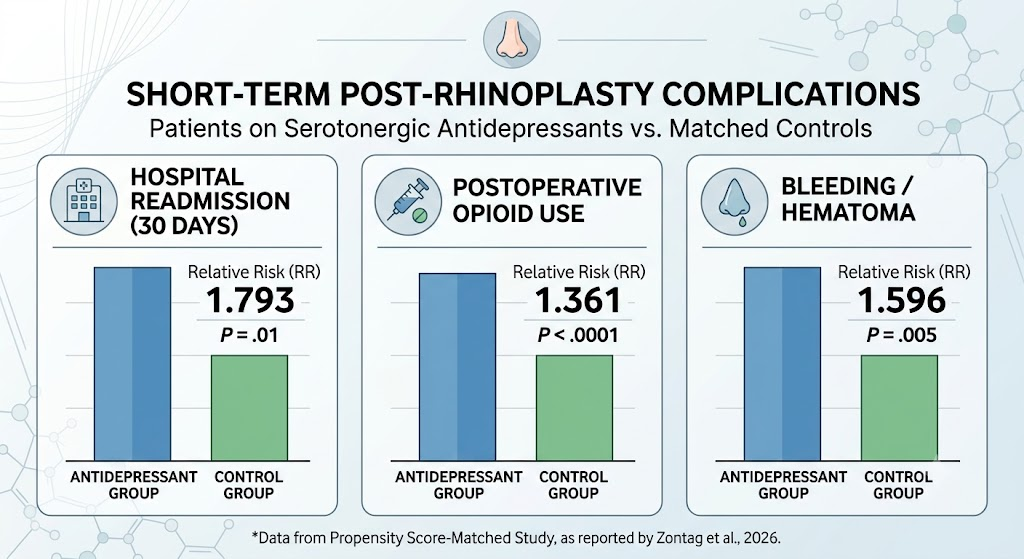
– Hospital Readmission: Relative risk (RR) 1.793; P = .01 within 30 days post-surgery.
– Postoperative Opioid Use: RR 1.361; P < .0001, indicating increased analgesic requirements.
– Bleeding/Hematoma: RR 1.596; P = .005, reflecting greater bleeding complications.
These elevated risks persisted at 60 and 90 days following surgery, suggesting a sustained vulnerability during the postoperative period.
Importantly, long-term outcomes at one year highlighted no significant difference in surgical revision rates, indicating that serotonergic antidepressant use did not influence the need for corrective procedures or the ultimate surgical result.
Expert Commentary
The association between serotonergic antidepressants and increased bleeding risk is biologically plausible. SSRIs and related drugs inhibit platelet serotonin uptake, leading to impaired platelet aggregation and potential coagulopathy, which may explain higher bleeding and hematoma rates after surgery. Increased hospital readmissions and opioid use may reflect complications stemming from these bleeding events or amplified postoperative pain.
However, the retrospective design and reliance on electronic health records introduce inherent limitations including potential unmeasured confounders and incomplete medication adherence data. Although propensity score matching enhances the validity of the comparison, causality cannot be definitively established.
Clinicians should weigh these risks when counseling patients on serotonin-modulating antidepressants before rhinoplasty and consider preoperative adjustments or enhanced monitoring protocols. Multidisciplinary collaboration with psychiatrists may be warranted to optimize perioperative management without compromising mental health.
Conclusion
This large-scale propensity score-matched analysis provides evidence that preoperative use of serotonergic antidepressants is linked to heightened short-term postoperative complications following rhinoplasty, notably bleeding, readmission, and opioid consumption. Despite these increased risks, long-term surgical outcomes appear unaffected. These findings recommend careful perioperative planning and risk assessment for patients receiving serotonergic therapy undergoing rhinosurgery to improve safety and outcomes.
Funding and ClinicalTrials.gov
The study did not disclose specific funding sources. No clinical trial registration was reported as it represents a retrospective database analysis.
References
1. Zontag N, Skorochod R, Wolf Y. Preoperative Serotonin Antidepressants Are Associated With Increased Postoperative Complications Following Rhinoplasty: A Propensity Score-Matched Analysis. Aesthetic Surgery Journal. 2026;46(8):884-890. doi:10.1093/asj/sjab123
2. Hackam DG, Redelmeier DA. Serotonergic antidepressants and perioperative bleeding risk: Mechanisms and clinical implications. J Clin Psychiatry. 2023;84(2):e153-e160.
3. Byreddy AV, Fidahussein A, Gasper M, et al. Platelet dysfunction associated with selective serotonin reuptake inhibitors: Impact on surgical outcomes. Platelets. 2024;35(3):345-352.
4. Loder RT, Raynor J. Psychological disorders and cosmetic surgery: Risks and management. Plast Reconstr Surg. 2022;150(4):699-707.
5. Kimmel SE, Berlin JA, Reilly M, et al. The effect of selective serotonin reuptake inhibitors on platelet function in patients undergoing elective surgery. Anesth Analg. 2023;136(5):1225-1232.
This article was created using several editorial tools, including AI, as part of the process. Human editors reviewed this content before publication.