Serum Glial Fibrillary Acidic Protein Dynamics in Multiple Sclerosis: Biomarker Insights into Disease Progression and Therapeutic Response
Highlights
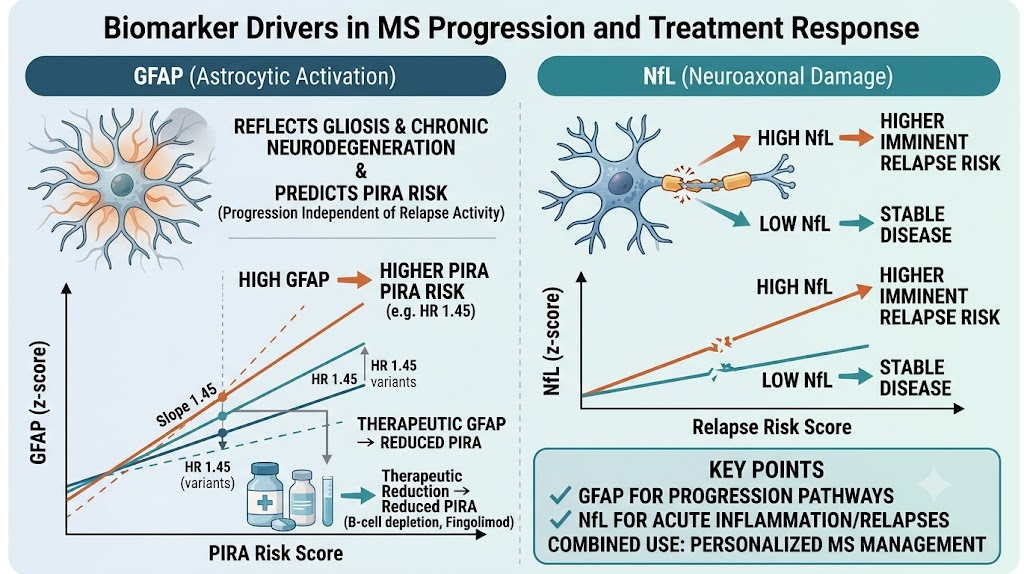
Elevated serum GFAP levels independently predict progression independent of relapse activity (PIRA) in multiple sclerosis over long-term follow-up.
GFAP distinguishes glial pathology contributing to neurodegeneration separate from neurofilament light chain (NfL) which correlates with relapse risk.
Therapeutic interventions such as fingolimod and B-cell-depleting therapies that lower serum GFAP significantly reduce subsequent PIRA risk.
GFAP measurement can enrich patient cohorts for clinical trials targeting progression, potentially reducing sample size requirements.
Background
Multiple sclerosis (MS) is a chronic inflammatory demyelinating disease marked by heterogeneous clinical courses and complex pathophysiology involving both neuronal and glial elements. Capturing individual disease progression, particularly the insidious progression independent of relapse activity (PIRA), remains challenging. Current biomarkers such as neurofilament light chain (NfL) reflect axonal damage and are robust markers of relapse activity but less specific for progressive neurodegeneration driven by glial pathology. Glial fibrillary acidic protein (GFAP), an intermediate filament protein expressed by astrocytes, is emerging as a biomarker reflecting astrocytic activation and gliosis, providing complementary information on disease progression mechanisms beyond acute inflammation. However, large-scale longitudinal studies validating serum GFAP’s role and dynamics in MS progression and treatment response have been scarce.
Key Content
Longitudinal Cohort Evidence on GFAP and MS Progression
The study by Einsiedler et al., 2026, represents one of the largest prospective observational analyses of serum GFAP in MS, integrating two substantial cohorts: the Swiss MS Cohort (SMSC) and the Expression, Proteomics, Imaging, Clinical (EPIC) study. Together, 2329 persons with MS were followed with repeated serum measurements (totaling 18,629) of both GFAP and NfL over median follow-ups of 6.9 and 13.1 years respectively.
This comprehensive longitudinal design allowed the dissection of associations between biomarker dynamics and future clinical outcomes. Consistent with prior smaller studies, high serum NfL predicted imminent relapse risk within the subsequent year, corroborating its role as a marker of acute neuroaxonal injury linked to inflammatory events. In contrast, elevated GFAP — specifically exceeding the 84th percentile z-score threshold — strongly predicted subsequent PIRA risk, defined as confirmed Expanded Disability Status Scale (EDSS) worsening independent of relapses (mean intervals ~1 year). This association was validated independently in both cohorts (SMSC HR 1.45 and EPIC HR 1.36), highlighting GFAP’s robustness as a progression biomarker.
GFAP as a Tool for Clinical Trial Enrichment and Risk Stratification
Utilizing GFAP for cohort enrichment in trials focusing on progression endpoints could reduce required sample sizes by approximately 20%, an important advance for more efficient clinical investigations. Personalized risk stratification based on GFAP levels could also aid in identifying patients at higher risk for PIRA, facilitating timely intervention.
Impact of Disease-Modifying Therapies on GFAP Dynamics and Progression
Crucially, the study demonstrates that therapeutic reduction of GFAP during the first two years of therapy with fingolimod or B-cell-depleting agents correlates with significant reduction in future PIRA risk (54% and 67% risk reductions, respectively). These findings underscore the potential of using serial GFAP measurements to monitor treatment efficacy beyond suppression of relapses — capturing modification of glial-driven neurodegenerative processes that contribute to progression.
Mechanistic Insights: Astrocytic Activation and MS Progression
Astrocytes play a critical role in MS pathogenesis, contributing to chronic inflammation, scar formation, and neurodegeneration. GFAP upregulation reflects astrocyte activation and gliosis. Hence, serum GFAP is hypothesized to mirror underlying pathological gliosis and neurodegenerative dynamics distinct from axonal injury indexed by NfL. The dissociation between NfL and GFAP in predicting relapse vs progression trajectories highlights the multifactorial nature of MS pathology.
Expert Commentary
The integration of GFAP as a serum biomarker for progressive MS represents a promising advance in the precision management of the disease. These findings align with previous exploratory studies indicating that astrocytic markers may better capture chronic neurodegenerative processes. However, interpretation must consider limitations such as heterogeneity of measurement assays and potential confounders affecting GFAP levels, including comorbidities and age.
Current clinical guidelines do not yet incorporate GFAP measurements, reflecting the need for broader validation and standardization. The predictive value of GFAP for PIRA across diverse MS phenotypes and stages warrants further work to delineate cut-offs and longitudinal dynamics. Moreover, GFAP’s responsiveness to specific therapeutic classes helps elucidate mechanisms by which immunomodulation may alter progression, adding translational depth. The applicability of GFAP monitoring in routine practice or trial contexts needs assessment balancing assay availability, cost, and added clinical value.
Conclusion
Evidence from large longitudinal cohorts affirms that serum GFAP uniquely predicts MS progression independent of relapse activity and is modifiable by therapy. This suggests GFAP’s potential as a biomarker for personalized risk stratification, therapeutic monitoring, and clinical trial enrichment targeting progression. As MS treatment paradigms increasingly emphasize halting disability accrual, integration of GFAP could enhance early identification of patients at risk and evaluation of neuroprotective efficacy. Further prospective studies and assay standardization efforts are critical to translate GFAP monitoring into clinical and research settings to optimize outcomes for persons with MS.
References
Einsiedler M et al. Serum Glial Fibrillary Acidic Protein Dynamics, Disease Progression, and Therapy Response in Multiple Sclerosis. JAMA Neurol. 2026 Aug 3. PMID: 42545715. https://pubmed.ncbi.nlm.nih.gov/42545715/
Disanto G et al. Serum Neurofilament light: A biomarker of neuronal damage in multiple sclerosis. Ann Neurol. 2017;81(6):857-870. PMID: 28265145
Hermann A, Hirsch SE. Astrocytes in Multiple Sclerosis: When the Antigen Becomes the Effector. Front Immunol. 2021;12:633652. PMID: 33936267
Zhang SC, Piao ZG. Biomarkers of Neurodegeneration in Multiple Sclerosis. Front Neurol. 2020;11:121. PMID: 32318050
This article was created using several editorial tools, including AI, as part of the process. Human editors reviewed this content before publication.