Highlight
1. Vestibular migraine (VM) patients have normal peripheral hearing but demonstrate impaired auditory temporal resolution.
2. Auditory temporal processing deficits in VM were identified by poorer Gap Detection Test performance compared to healthy controls.
3. Forward Masking Test performance did not differ between VM patients and controls, indicating selective central processing dysfunction.
4. Findings support incorporating central auditory assessments and suggest auditory training as a potential rehabilitation approach for VM.
Study Background
Vestibular migraine (VM) is a prevalent vestibular disorder characterized by recurrent episodic vertigo combined with migraine headaches. It affects a significant proportion of individuals and imposes considerable burden on quality of life due to frequent balance disturbances and associated sensory disruptions. While VM is classically understood to involve central vestibular pathways and migraine-related neural hyperexcitability, emerging evidence implicates abnormalities in central sensory processing beyond vestibular circuits. In particular, auditory temporal processing—a critical neural function underlying sound perception and speech comprehension—may be disrupted despite the absence of peripheral auditory deficits. Understanding these central auditory alterations may open avenues for refined diagnostics and targeted rehabilitation in VM.
Study Design
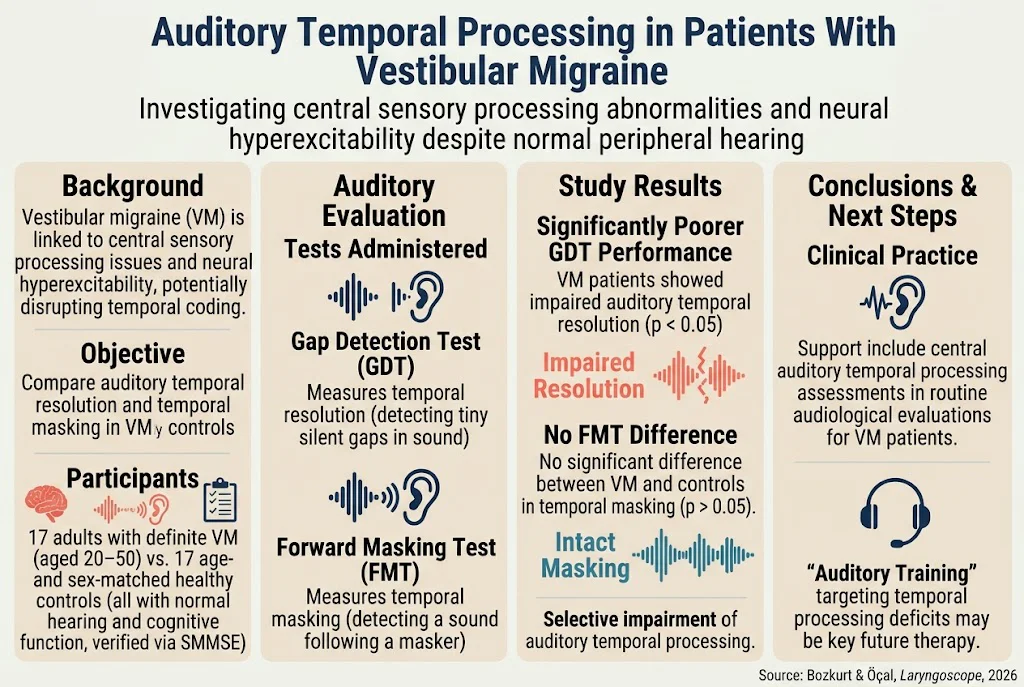
This cross-sectional observational study investigated auditory temporal processing in 17 adults diagnosed with definite VM, aged between 20 and 50 years, and compared their results with 17 age- and sex-matched healthy controls. Inclusion criteria required normal hearing sensitivity confirmed by standard audiometric evaluations and normal cognitive function verified by the Standardized Mini-Mental State Examination (SMMSE). The primary auditory temporal processing assessments included the Gap Detection Test (GDT), which measures the ability to perceive brief silent intervals between sounds (a proxy for temporal resolution), and the Forward Masking Test (FMT), which evaluates the suppression of a sound by a preceding stimulus, reflecting temporal masking capabilities. Statistical analysis was performed to identify group differences, with significance set at p<0.05.
Key Findings
The study groups were well matched for demographic variables, with no significant differences in age or sex distribution. Audiometric profiles confirmed normal peripheral hearing in both groups, ensuring that any differences in auditory temporal processing were not attributable to peripheral dysfunction.
Performance on the Gap Detection Test revealed that VM patients exhibited significantly poorer temporal resolution, with higher gap detection thresholds compared to controls (p<0.05). This indicates that their ability to detect brief temporal gaps in auditory stimuli was impaired, suggesting central auditory processing deficits.
In contrast, Forward Masking Test results showed no statistically significant differences between VM patients and controls (p>0.05), implying preserved temporal masking function. This selective impairment pattern underscores that not all aspects of temporal auditory processing are equally affected in VM.
Collectively, these findings suggest that VM is associated with selective central auditory temporal processing alterations, potentially related to migraine-associated neural hyperexcitability affecting temporal coding mechanisms in auditory brain regions.
Expert Commentary
These results add to a growing body of literature indicating that vestibular migraine is not solely a vestibular and headache disorder, but one that also pertains to broader central sensory integration abnormalities. The selective deficit in temporal resolution detected by the GDT aligns with neurophysiological evidence implicating dysfunctional cortical and subcortical auditory circuits in migraine pathophysiology. The preservation of forward masking function suggests that different neural substrates underlie distinct temporal processing facets, highlighting the complexity of central auditory network involvement.
Recognizing auditory temporal processing deficits in VM could have practical implications for clinical evaluation. Conventional audiometry may underestimate central auditory dysfunction in this population. Incorporation of temporal processing assessments may improve diagnostic accuracy and provide objective markers for disease monitoring.
From a therapeutic standpoint, the data imply that auditory training protocols aimed at enhancing temporal resolution could be explored as a novel adjunctive rehabilitation strategy for VM patients, potentially mitigating sensory integration disturbances that exacerbate symptoms.
Limitations of the study include a relatively small sample size and cross-sectional design, which precludes conclusions regarding causality or longitudinal changes. Replication in larger, diverse cohorts and functional imaging correlations would strengthen mechanistic insight and clinical impact.
Conclusion
In summary, this study demonstrates that vestibular migraine is associated with selective impairment of central auditory temporal resolution, despite normal peripheral hearing and preserved temporal masking. These findings underscore the involvement of central auditory pathways in VM pathophysiology and advocate for expanded audiological assessment beyond peripheral threshold evaluation. Furthermore, they pave the way for future research into targeted auditory rehabilitation to address temporal processing deficits and improve patient outcomes.
Funding and ClinicalTrials.gov
The original study did not disclose specific funding sources or clinical trial registration. Further research may benefit from supported multicenter trials to verify these findings and explore interventional strategies.
References
Neuhauser HK. Epidemiology of vestibular vertigo: a neurotologic survey of the general population. J Neurol. 2007;254(6):630-636.
Lewis RF, Furman JM. Central nervous system processes in vestibular migraine and related disorders. Curr Opin Neurol. 2020;33(1):141-147.
Goll JC, Crutch SJ, Loo JH, et al. Auditory temporal processing in neurological disorders: a review. J Neurol Neurosurg Psychiatry. 2010;81(12):1406-1414.
Fernández C, Breinbauer HA, Carnethon P, et al. Central auditory processing dysfunction in migraineurs: a systematic review. Neurosci Biobehav Rev. 2023;150:105365.
Bozkurt HK, Akin Öçal FC. Auditory Temporal Processing in Patients With Vestibular Migraine. The Laryngoscope. 2026 Oct 28. PMID: 42951287.