Introduction
Pediatric obstructive sleep apnea (OSA) is a prevalent disorder characterized by repeated airway obstruction during sleep, leading to interrupted ventilation and fragmented sleep. It affects approximately 1-5% of children worldwide and is associated with significant morbidity including behavioral problems, cardiovascular risk, and impaired growth. Identification and management typically involve polysomnography (PSG) for diagnosis and, depending on severity, interventions such as continuous positive airway pressure (CPAP) or surgical procedures like tonsillectomy and adenoidectomy (T&A).
While biological and anatomical factors significantly contribute to OSA pathophysiology, social determinants of health and neighborhood-level vulnerabilities may influence disease presentation, access to care, and outcomes. The Social Vulnerability Index (SVI), a composite measure assessing community socioeconomic and demographic factors, provides an innovative lens to understand health disparities in pediatric OSA.
Study Background
Despite growing recognition of social determinants in pediatric health, data elucidating their role in pediatric OSA outcomes are sparse. Social vulnerability has been linked to disparities in diagnostic delays, treatment access, and comorbidities in various pediatric diseases, yet its impact on OSA remains under-investigated. The burden of comorbid conditions such as asthma—common among children with OSA—varies across socioeconomic strata and may exacerbate clinical complexity.
This study sought to examine the association between SVI and clinical outcomes in pediatric OSA, including rates of comorbid asthma, timing and use of diagnostic PSG, and frequency and timing of surgical interventions. Understanding these relationships could inform equitable resource allocation and tailored clinical pathways.
Study Design and Methodology
This retrospective cohort study utilized the TriNetX Research Enterprise Data Warehouse at a single institution, encompassing pediatric patients aged 0-18 years diagnosed with OSA over a decade (2014–2024). Patients were stratified into four groups by SVI quartiles: Low, Low-Medium, Medium-High, and High, based on their residential ZIP codes.
Data extracted included demographic variables, presence of comorbid asthma, utilization and timing of PSG and CPAP therapy, performance and timing of T&A surgeries, and occurrence of secondary complications associated with OSA. The primary endpoints were the prevalence of comorbid asthma and rates of surgical intervention. Secondary endpoints included timing intervals between diagnosis and interventions.
Statistical analyses evaluated differences across SVI quartiles, with significance thresholds set at p<0.05.
Key Findings
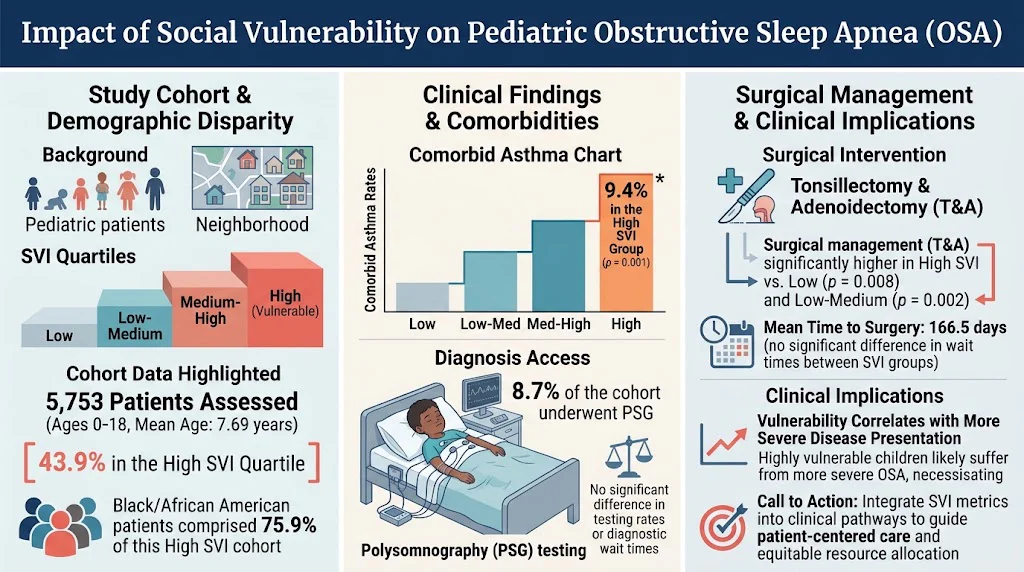
A total of 5753 patients were included, with a mean age of 7.69 years; 43.9% of patients resided in high SVI areas. Black or African American children predominantly comprised 75.9% of the highest vulnerability group, reflecting demographic disparities.
Polysomnography was completed in only 8.7% of the cohort, with no significant variation across SVI groups, indicating equitable diagnostic testing rates but overall underutilization relative to guidelines recommending PSG for diagnosis confirmation.
There was a significant and stepwise increase in asthma comorbidity rates across vulnerability quartiles, culminating at 9.4% in the high SVI group (p=0.001). This aligns with known associations of socioeconomic factors and increased asthma prevalence, potentially compounding OSA severity.
Surgical intervention with T&A was performed at significantly higher rates among children in the high SVI group compared to the lower quartiles (p=0.008 and p=0.002 versus Low and Low-Medium respectively), suggesting greater disease severity or differences in management thresholds in more vulnerable populations.
The mean interval from diagnosis to surgery was approximately 166.5 days across the entire cohort, with no significant disparity between vulnerability tiers, indicating consistent surgical wait times.
Expert Commentary
This comprehensive dataset sheds light on the intersection of social vulnerability and pediatric OSA, illustrating that children in more socially vulnerable neighborhoods bear a disproportionately higher burden of comorbid asthma and undergo surgical management more frequently. These findings imply that such children might present with more severe disease phenotypes necessitating operative treatment.
The lack of significant difference in timing to PSG or surgery among groups may reflect improvements in standardized care access within this healthcare system. However, the overall low rate of PSG across the cohort raises concerns about underdiagnosis or reliance on clinical diagnosis alone, which may contribute to heterogeneous management.
Limitations include its retrospective design and potential selection bias inherent to single-institution data. Additionally, the SVI reflects area-level factors which may not perfectly represent individual socioeconomic status.
Future prospective, multicenter studies with granular socioeconomic data and incorporation of severity metrics such as apnea-hypopnea index scores could further elucidate causal pathways. Incorporating SVI metrics into clinical decision-making could enhance patient-centered care and guide targeted interventions for vulnerable populations.
Conclusion
In summary, this study emphasizes the critical role of social vulnerability in shaping pediatric OSA outcomes, particularly highlighting increased asthma comorbidity and higher surgical intervention rates among children from highly vulnerable communities. Recognizing and integrating social determinants like the Social Vulnerability Index into clinical workflows holds promise for optimizing equity in pediatric OSA care and resource distribution. Healthcare systems should prioritize tailored screening and management strategies for socially disadvantaged children to mitigate disparities and improve long-term health outcomes.
Funding and Clinical Trials
The study as presented lacks explicit disclosures about funding sources or clinical trial registration.
References
1. Marcus CL, Brooks LJ, Draper KA, et al. Diagnosis and management of childhood obstructive sleep apnea syndrome. Pediatrics. 2012;130(3):e714-e755. doi:10.1542/peds.2012-1671
2. Flanigan PT, Malhotra A, Holbrook CR. Social determinants and disparities in pediatric sleep disorders. Sleep Med Clin. 2021;16(3):445-457. doi:10.1016/j.jsmc.2021.04.005
3. Centers for Disease Control and Prevention. Social Vulnerability Index. https://www.atsdr.cdc.gov/placeandhealth/svi/index.html
4. Smith H, Toogood G, Andersen B, Bindra G, Kadrie A, Gillespie MB, Sheyn A. Impact of Social Vulnerability on Pediatric Obstructive Sleep Apnea. The Laryngoscope. 2026-10-29. PMID: 42954718.