Highlight
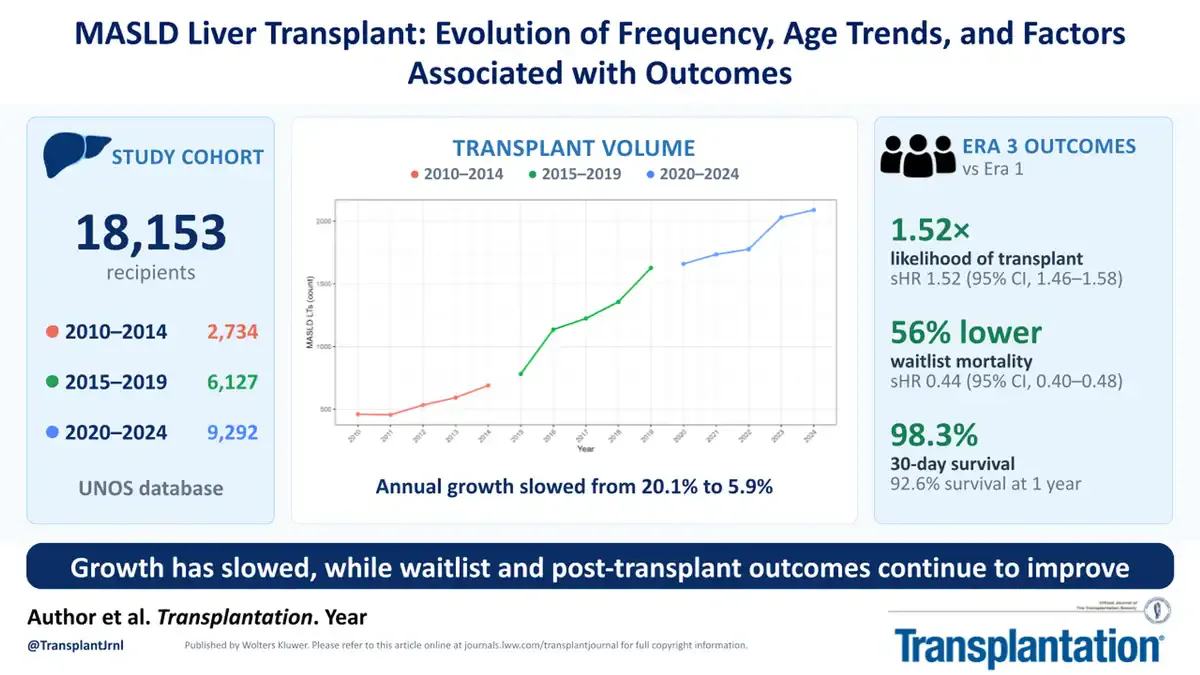
MASLD liver transplantations in the US increased significantly from 2010 to 2024, from 461 to 2090 annual cases.
The patient demographic has diversified, including notably younger recipients as young as 8 years in recent years.
Waitlist outcomes improved in the latest era, with higher transplant likelihood and lower waitlist mortality.
Post-transplant survival rates have increased, reflecting advances in patient management and selection.
Study Background
Metabolic dysfunction-associated steatotic liver disease (MASLD), formerly referred to as nonalcoholic fatty liver disease (NAFLD), represents a spectrum of liver pathology linked with metabolic risk factors such as obesity, type 2 diabetes, and dyslipidemia. In recent years, MASLD has emerged as a major cause of chronic liver disease and cirrhosis worldwide. This shift is reflected in liver transplantation (LT) data, where MASLD has become a leading indication in the United States. Despite its growing prominence, comprehensive data analyzing temporal trends in transplant frequency, recipient demographics, and outcomes remain limited. Understanding these evolving patterns is critical to optimizing care strategies, resource allocation, and preventative measures addressing this patient population’s unique risk profile.
Study Design
This observational study analyzed data from the United Network for Organ Sharing (UNOS) registry encompassing primary liver transplant recipients from 2010 through 2024. MASLD cases were identified via diagnosis codes consistent with metabolic dysfunction-associated steatotic liver disease. Transplants were divided into three chronological eras: Era 1 (2010-2014), Era 2 (2015-2019), and Era 3 (2020-2024). The study assessed total annual transplant counts and proportions attributable to MASLD, calculating annual percent changes within each era to examine growth dynamics. Donor, operative, and recipient characteristics were compared across eras. Survival outcomes were evaluated using Kaplan-Meier curves. Multivariable Cox regression models identified factors associated with post-transplant mortality, while competing-risk regression analyzed waitlist outcomes including transplant likelihood and mortality risk.
Key Findings
Over the 14-year period, 18,153 liver transplants for MASLD were recorded (Era 1: 2,734; Era 2: 6,127; Era 3: 9,292). The annual volume increased more than fourfold, beginning with 461 transplants in 2010 and reaching 2,090 in 2024. Annual percent changes revealed an initially rapid growth rate (10.6% in Era 1), accelerating further in Era 2 (20.1%) before plateauing in Era 3 (5.9%).
Recipient age profiles shifted notably. Whereas early eras predominantly involved adults, Era 3 included recipients as young as 8 years, indicating earlier disease onset or recognition. This age diversity indicates potential shifts in MASLD epidemiology, possibly linked to rising pediatric obesity and metabolic syndromes.
Waitlist analysis demonstrated improved outcomes in Era 3, with a sub-hazard ratio (sHR) of 1.52 (95% CI, 1.46-1.58) for receiving a transplant, signifying better access or prioritization. Concurrently, waitlist mortality significantly decreased (sHR 0.44, 95% CI 0.40-0.48), suggesting enhancements in patient management or allocation policies.
Regarding survival, recipients in Era 3 showed increased post-transplant survival rates compared to prior eras. The 30-day survival improved from 97.0% to 98.3%, while one-year survival increased from 90.5% to 92.6%, both statistically significant (P < 0.01). These improvements likely reflect advances in perioperative care, better patient selection, and tailored immunosuppression protocols.
Donor and operative characteristics also evolved but were less emphasized in the study. It remains important to monitor how donor organ quality and surgical techniques impact outcomes alongside patient factors.
Expert Commentary
The marked rise in MASLD-related liver transplantations mirrors global trends in metabolic disease burden but also raises critical clinical questions. The emergence of younger patients needing transplantation underlines the looming pediatric and adolescent health challenges tied to early metabolic dysfunction. Clinicians must prioritize early identification and intervention to delay disease progression requiring transplantation.
Moreover, while the plateau in transplant growth suggests a near saturation or stabilization in transplant candidacy for MASLD, the improved waitlist and post-transplant outcomes are encouraging signs that care improvements are keeping pace with disease prevalence. Optimization should now focus on prevention strategies, lifestyle interventions, and pharmacological therapies to curb MASLD progression and reduce transplant need.
The study’s reliance on registry data introduces limitations such as potential misclassification of diagnosis codes and limited granularity on comorbid conditions or lifestyle factors. Additionally, as transplant practices vary regionally, generalizability beyond the US may be constrained.
Future research should explore longitudinal patient trajectories from MASLD diagnosis through transplant candidacy, incorporating genetic, metabolic, and environmental factors. Examining pediatric MASLD in depth is also imperative given the recent demographic trends.
Conclusion
Between 2010 and 2024, MASLD has ascended as a predominant indication for liver transplantation in the United States, with considerably increased transplant volumes and greater age range among recipients, including children. While the rate of increase in transplant numbers appears to be stabilizing, improvements in waitlist outcomes and survival post-transplant signify progress in clinical management. These findings emphasize the urgent need for earlier detection and comprehensive therapeutic strategies targeting the metabolic underpinnings of MASLD to prevent progression to end-stage liver disease and reduce transplantation demand. Enhanced awareness among healthcare providers, combined with public health initiatives, may mitigate this growing clinical burden and improve patient prognoses.
Funding and Clinicaltrials.gov
The study utilized publicly available UNOS registry data without specific funding disclosures. No clinical trials were reported in relation to this analysis.
References
1. Anouti A, Dahshi H, Bartlett JA, et al. MASLD Liver Transplant: Evolution of Frequency, Age Trends, and Factors Associated With Outcomes. Transplantation. 2026 Oct 29. PMID: 42951895.
2. Younossi ZM, et al. Global epidemiology of NAFLD-MASLD: A systematic review. Hepatology. 2023.
3. Wong RJ, et al. Impact of metabolic risk factors on liver transplant outcomes. J Clin Gastroenterol. 2022.
4. Charlton MR, et al. The growing burden of MASLD in transplantation: Challenges and opportunities. Liver Transpl. 2024.