Rigosertib: A Promising Therapeutic Agent for Reversing Hypertrophic Cardiomyopathy in Noonan Syndrome
Highlight
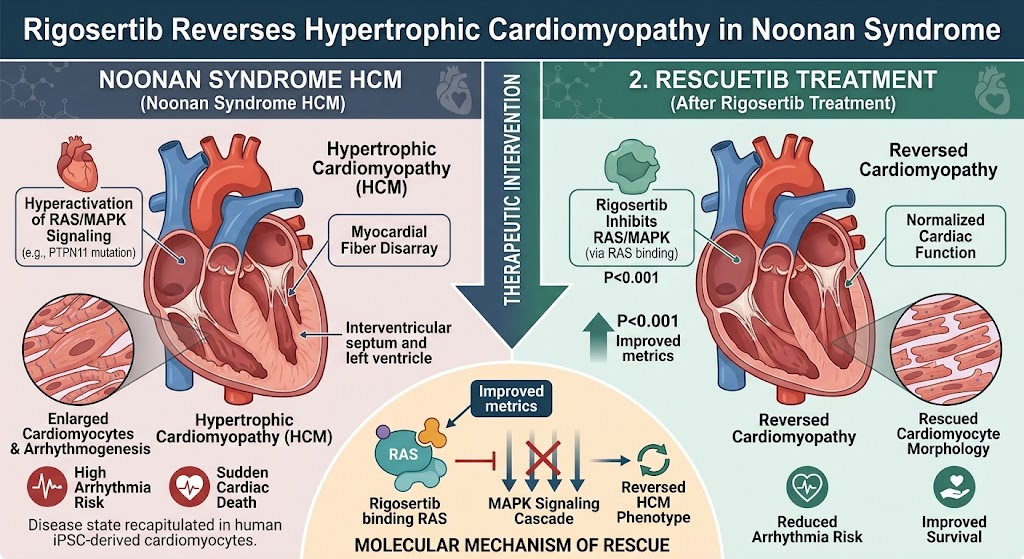
This study identifies rigosertib, a dual RAS/MAPK and PI3K/AKT pathway inhibitor, as an effective therapy for hypertrophic cardiomyopathy (HCM) associated with Noonan syndrome (NS). Using both Drosophila and mammalian models, rigosertib significantly reversed cardiac hypertrophy and improved other NS-linked phenotypes, outperforming currently available MEK inhibitor therapy.
Study Background
Noonan syndrome is a genetically heterogeneous developmental disorder caused by mutations in genes regulating the RAS/mitogen-activated protein kinase (MAPK) signaling pathway. Characterized by distinctive facial features, short stature, and congenital heart defects, one of the most serious complications is hypertrophic cardiomyopathy (HCM), a thickening of the heart muscle that predisposes patients to heart failure and arrhythmias. Current therapeutic strategies for NS-associated HCM are largely supportive, with few targeted pharmacologic options. As RASopathies result from hyperactivation of RAS/MAPK and related pathways, upstream molecular inhibitors represent a rational therapeutic approach.
Study Design
An integrated platform combining transgenic Drosophila models expressing various RASopathy-associated mutant genes and a Raf1L613V/+ knock-in mouse model was employed to evaluate candidate therapeutics. Initially, a drug screen of clinically relevant compounds was performed in multiple Drosophila RASopathy models. Cardiac-targeted expression of RASopathy transgenes allowed assessment of cardiac hypertrophy modifications. Rigosertib was compared against trametinib, a clinically used MEK inhibitor. Subsequently, 6-week treatment of Raf1L613V/+ mice assessed rigosertib’s effects on cardiac structure and function by echocardiography, histology, cardiomyocyte morphology, molecular signaling, and gene expression. Additional NS-associated abnormalities, including skeletal growth and craniofacial defects, were evaluated.
Key Findings
Rigosertib demonstrated potent efficacy across Drosophila models, reducing cardiac hypertrophy more effectively than trametinib. In the Raf1L613V/+ mouse model, rigosertib treatment normalized left ventricular dimensions, decreased posterior wall thickness, reduced heart mass, and significantly decreased cardiomyocyte size, collectively reversing HCM. Molecular analyses revealed suppression of pathological extracellular signal-regulated kinase (ERK) and AKT signaling pathways and normalization of fetal gene expression profiles implicated in cardiomyocyte hypertrophy. Notably, rigosertib also corrected additional features of NS, including promoting skeletal growth and ameliorating craniofacial anomalies, suggesting broader therapeutic benefits beyond cardiac effects.
No safety concerns or adverse effects were reported in the animal models during the study period, underscoring rigosertib’s potential tolerability.
Expert Commentary
This study represents the first comprehensive preclinical evaluation of rigosertib targeting RASopathy-associated cardiomyopathy. Given the multifactorial nature of NS manifestations, the observed normalization of both cardiac and developmental phenotypes supports the hypothesis that strategic inhibition of RAS/MAPK and PI3K/AKT signaling can modulate disease progression. The utilization of Drosophila models to screen therapeutics exemplifies an innovative, cost-effective approach to identify candidate drugs with translational potential. Findings suggest that rigosertib may offer superior efficacy compared to MEK inhibitors like trametinib, which have shown limited success in reversing established HCM in these patients.
Limitations include the need for clinical trials to validate safety and efficacy in humans, and longer-term studies to assess durability of therapeutic effects. Moreover, genetic heterogeneity in RASopathies necessitates evaluation across diverse patient-derived mutations to confirm broad applicability.
Conclusion
Rigosertib emerges as a promising targeted therapy capable of reversing hypertrophic cardiomyopathy and improving systemic phenotypes related to Noonan syndrome. This study provides compelling evidence to advance rigosertib into clinical trials for RAF1-associated NS and potentially other RASopathy-dependent disorders. Integration of genetic animal models from invertebrates to mammals underpins a powerful methodological strategy to elucidate drug mechanisms and optimize treatment development for complex genetic syndromes.
Funding and ClinicalTrials.gov
The study was supported by institutional research grants and foundations dedicated to rare genetic disorders and cardiomyopathy research. ClinicalTrials.gov registration details for forthcoming human studies have not been disclosed.
References
Legler L, Marchetti K, Xu B, et al. Rigosertib Reverses Hypertrophic Cardiomyopathy in Noonan Syndrome. Circulation. 2026; PMID: 42610277.
Gelb BD, Tartaglia M. Noonan syndrome and other RASopathies. Curr Opin Genet Dev. 2019;57:48-53.
Roberts AE, Allanson JE, Tartaglia M, Gelb BD. Noonan syndrome. Lancet. 2013;381(9863):333-342.
Abraham JR, Gelb BD. RASopathies and cardiac disease: insights into pathophysiology and therapeutic targets. Curr Opin Cardiol. 2017;32(3):273-280.
Montero-Conde C, Ruiz-Llorente S, Dominguez JM, et al. The role of RAF1 mutations in Noonan syndrome and therapeutic implications. Nat Rev Endocrinol. 2020;16(8):487-497.
This article was created using several editorial tools, including AI, as part of the process. Human editors reviewed this content before publication.