We use cookies

Our website uses essential cookies and, with your consent, additional cookies to measure performance and improve our services. Cookie Policy.

You can change your choice at any time.

MMedXYNews
HomeVideos
MedXY AI/MedXY News/Section: Neurology

Revealing Brain Connectivity Disruptions to Predict Long-Term Seizure Recurrence After Temporal Lobe Epilepsy Surgery

MedXY Editorial Team•Aug 17, 2026•Neurology
brain network hubstemporal lobe epilepsySeizure recurrenceMRI connectomicssurgical outcomessurgical outcomes
Highlight

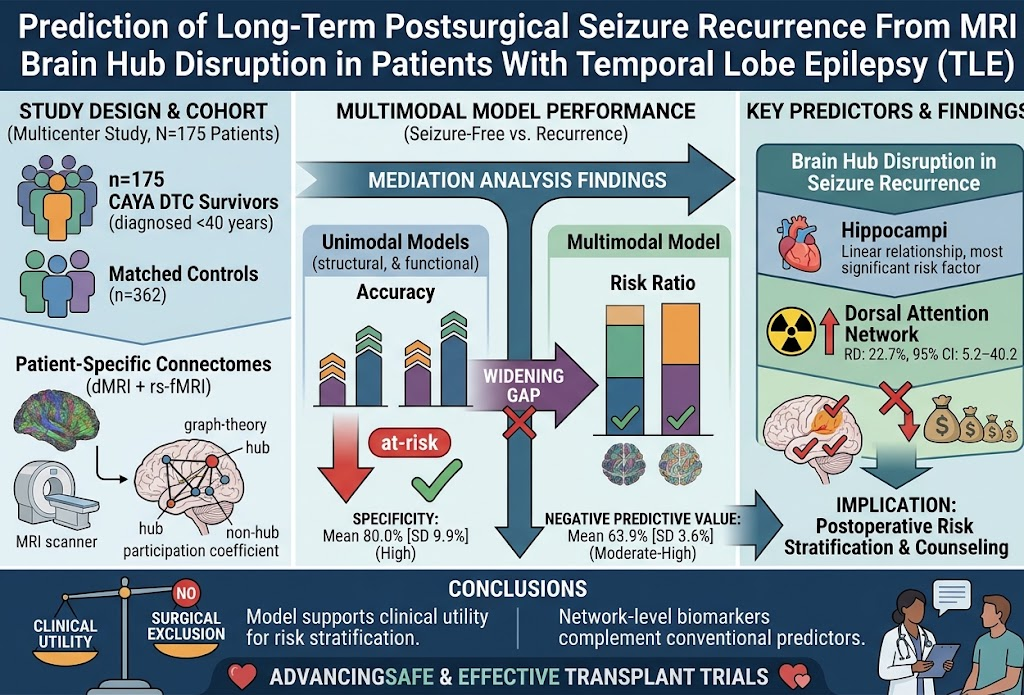
  • Long-term seizure recurrence after temporal lobe epilepsy surgery is linked to disruption in brain network hubs, notably the hippocampi and dorsal attention network.
  • Combining structural and functional MRI-derived connectomes enhances the accuracy of predicting seizure recurrence over clinical variables alone.
  • Machine learning models using normative hub disruption metrics demonstrate high specificity and have potential for clinical risk stratification post-surgery.
  • Identified biomarkers indicate seizure recurrence drivers may extend beyond resected temporal regions, suggesting broader network involvement.

Study Background

MedXY registered readers

Sign in free to continue reading

Create or use your MedXY account to unlock the complete article.

This article was created using several editorial tools, including AI, as part of the process. Human editors reviewed this content before publication.

Related articles

Open language-specific specialty feeds and department pages.

Prophylactic Mesh Placement Significantly Reduces Incisional Hernia Risk After Hepatobiliopancreatic SurgeryA randomized clinical trial demonstrates that synthetic mesh reinforcement during subcostal abdominal closure notably decreases incisional hernia incidence without increasing postoperative complications, improving patient recovery after hepSep 15, 2026Evaluating Early Outcomes of Robotic versus Laparoscopic and Open Cholecystectomy in the US: A Nationwide AnalysisA national multipayer analysis demonstrates robotic cholecystectomy offers comparable safety to laparoscopic methods while improving key outcomes versus open surgery, signaling maturation of robotic biliary surgery.Sep 12, 2026Unraveling Central Autonomic Network Disruptions Underlying Cardiorespiratory Dysfunction in Temporal Lobe EpilepsyThis study reveals that central autonomic network alterations in temporal lobe epilepsy patients contribute to interictal cardiorespiratory dysfunction, potentially increasing SUDEP risk, and highlights connectivity changes post-surgery impSep 6, 2026
Loading comments...
MedXY briefing

Get the free newsletter

Evidence-led clinical news, trends, and analysis—delivered to your inbox.

Ask MedXY AI

Most popular

Intimate Health
Five Benefits for Women Continuing Sexual Activity After Menopause
Intimate Health
Why Some Women Have a Strong Sex Drive—And Why Men Shouldn't Worry About It
Nursing & care
How often should a couple have sex?
Intimate Health
Classic Intimacy Recommendations: How to Help Women Reach Orgasm and Enjoy Mutual Pleasure
Intimate Health
What Makes a Woman "Physiologically Addicted" Is Never Money, But These Two Relationship Qualities
© 2026 MedXY
Contact usAbout usPrivacy PolicyMedXY story
Hidden Costs of Healing: Financial Burdens After Distal Upper Extremity Nerve Injuries
Despite nearly universal insurance coverage, nearly half of patients with distal upper extremity nerve injuries face significant financial hardship, influenced by injury location, surgical complexity, and preexisting debt. Targeted financia
Sep 2, 2026
Long-Term Outcomes of Strabismus Surgery in Children with Perinatal Brain Injury: Insights and Clinical ImplicationsChildren with perinatal brain injury exhibit lower long-term success rates following strabismus surgery, mainly due to undercorrection despite comparable surgical dosing. Larger preoperative deviations predict poorer outcomes, underscoringAug 24, 2026
Impact of Neighborhood Socioeconomic Deprivation on Breslow Thickness and Clinical Outcomes in Head and Neck Cutaneous Melanoma: A Comprehensive ReviewThis review synthesizes evidence linking neighborhood socioeconomic deprivation with increased Breslow thickness and delayed surgical management in head and neck cutaneous melanoma, highlighting potential mechanisms and clinical implicationAug 24, 2026