We use cookies

Our website uses essential cookies and, with your consent, additional cookies to measure performance and improve our services. Cookie Policy.

You can change your choice at any time.

MMedXYNews
HomeVideos
MedXY AI/MedXY News/Section: Gastroenterology

Rapid Skeletal Muscle Loss in Cirrhosis: Predictors, Outcomes, and Implications for Clinical Management
MedXY Editorial Team•Aug 4, 2026•Gastroenterology
cirrhosisSarcopeniaMELD-Namuscle losswaitlist mortality

Highlight

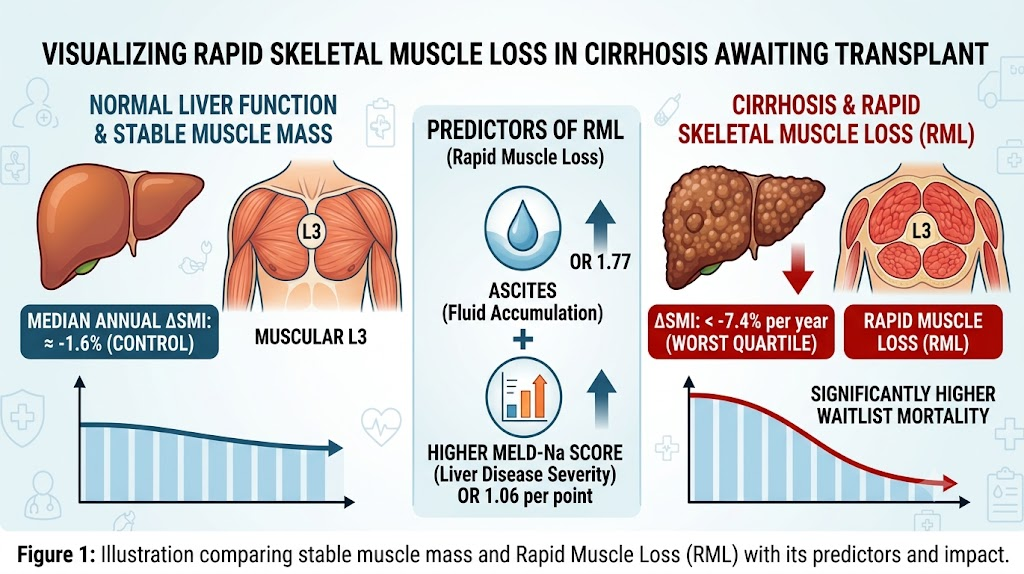
  • Median annual skeletal muscle loss in patients with cirrhosis awaiting liver transplantation is approximately 1.6%.

  • Rapid muscle loss (RML), defined as the worst quartile of muscle loss (< -7.4% per year), predicts significantly higher waitlist mortality independent of MELD-Na score.

  • Ascites and higher MELD-Na scores independently associate with increased risk of RML.

  • Understanding the rate of muscle loss and its predictors informs prognostication and potential interventions targeting sarcopenia in cirrhosis.

Study Background

MedXY registered readers

Sign in free to continue reading

Create or use your MedXY account to unlock the complete article.

This article was created using several editorial tools, including AI, as part of the process. Human editors reviewed this content before publication.

Related articles

Open language-specific specialty feeds and department pages.

Comparative Effectiveness of Carvedilol Versus Other Nonselective β-Blockers in Cirrhosis: A Clinical ReviewCarvedilol demonstrates superior effectiveness over nadolol and propranolol in reducing portal hypertension and preventing cirrhosis decompensation events, with emerging evidence supporting its preferential use in both compensated and decomAug 27, 2026Optimizing Diabetes Management in Cirrhosis: A Practical Clinical GuideCirrhosis entwined with diabetes presents unique clinical challenges. This article offers a pragmatic framework for diagnosis, tailored therapies, and multidisciplinary care to enhance outcomes across liver disease stages.Aug 18, 2026New A-TANGO Organ Failure Score Refines ACLF Diagnosis and Risk Stratification in Global CohortsA new organ failure score, A-TANGO, improves ACLF diagnosis and risk stratification compared to standard CLIF-C criteria, validated in large international cohorts.Jul 26, 2026Circulating Methylated SEPT9 as a Novel Biomarker for Early Detection of Hepatocellular Carcinoma in Cirrhotic Patients
Loading comments...
MedXY briefing

Get the free newsletter

Evidence-led clinical news, trends, and analysis—delivered to your inbox.

Ask MedXY AI

Most popular

Intimate Health
Five Benefits for Women Continuing Sexual Activity After Menopause
Intimate Health
Why Some Women Have a Strong Sex Drive—And Why Men Shouldn't Worry About It
Nursing &amp; care
How often should a couple have sex?
Intimate Health
Classic Intimacy Recommendations: How to Help Women Reach Orgasm and Enjoy Mutual Pleasure
Intimate Health
What Makes a Woman "Physiologically Addicted" Is Never Money, But These Two Relationship Qualities
© 2026 MedXY
Contact usAbout usPrivacy PolicyMedXY story
Combining circulating methylated SEPT9 with alpha-fetoprotein significantly enhances early hepatocellular carcinoma detection in cirrhotic patients, outperforming AFP alone and allowing improved surveillance sensitivity and specificity.
Jul 9, 2026
HBsAg Seroclearance Lowers Hepatocellular Carcinoma Risk Beyond Viral Suppression in Cirrhosis, but Does Not Reduce Hepatic DecompensationIn NA-treated cirrhotic chronic hepatitis B with complete viral suppression, HBsAg seroclearance was linked to lower HCC risk but not lower hepatic decompensation, reinforcing functional cure as a meaningful but incomplete clinical endpointJun 10, 2026
Primary vs Specialist Palliative Care in End-Stage Liver Disease: Interpreting the 2026 Cluster Randomized Trial in the Broader Evidence BaseA major 2026 cluster randomized trial shows that palliative care delivered by trained hepatologists is noninferior to specialist palliative care for improving quality of life in end-stage liver disease, supporting scalable integrated modelsJun 9, 2026