We use cookies

Our website uses essential cookies and, with your consent, additional cookies to measure performance and improve our services. Cookie Policy.

You can change your choice at any time.

MMedXYNews
HomeVideos
MedXY AI/MedXY News/Section: Cardiology

Progress and Prognostic Insights in Fetal Cardiomyopathy: Findings from a Multicenter North American Cohort
MedXY Editorial Team•Aug 18, 2026•Cardiology
fetal cardiomyopathyfetal hydropsprenatal diagnosisCardiac Transplantation遺伝学的検査

Highlight

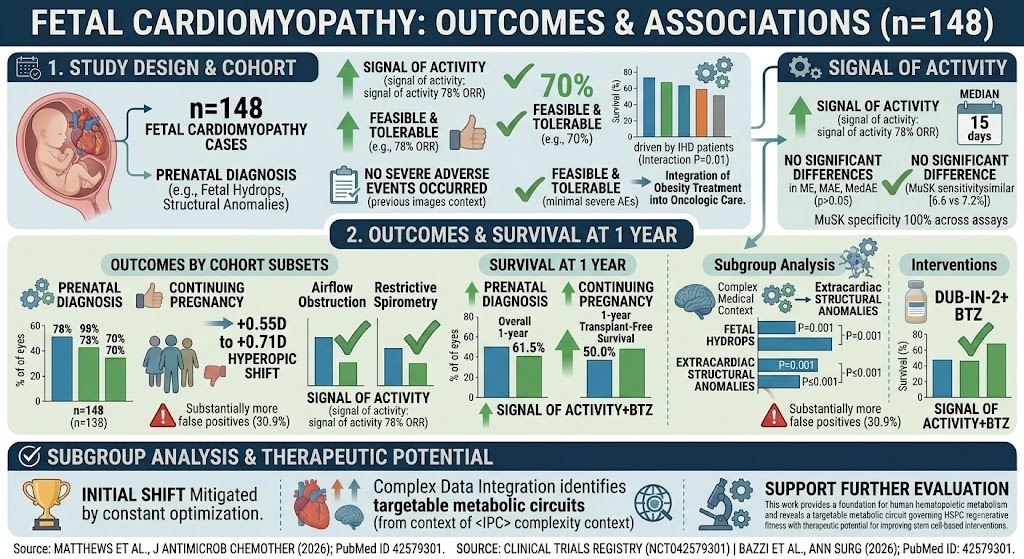
– Contemporary fetal cardiomyopathy shows improved survival but remains associated with significant mortality and transplant risk in infancy.
– Genetic testing identifies causal variants in approximately one-third of cases, informing diagnosis and potential management.
– Fetal hydrops and prenatal diagnosis of extracardiac structural anomalies predict poorer outcomes by one year of age.
– Cardiac transplantation remains a critical therapeutic option for a subset of affected neonates.

Study Background

MedXY registered readers

Sign in free to continue reading

Create or use your MedXY account to unlock the complete article.

This article was created using several editorial tools, including AI, as part of the process. Human editors reviewed this content before publication.

Related articles

Open language-specific specialty feeds and department pages.

Decoding Persistent Tachypnea of Infancy: Genetic Insights Expand Diagnostic ParadigmsComprehensive exome sequencing reveals genetic heterogeneity in persistent tachypnea of infancy (PTI/NEHI), highlighting its phenotype nature and association with neurodevelopmental disorders, advocating early genetic testing to enhance diaSep 17, 2026Enhancing MODY Diagnosis: The Clinical Value of Type 1 Diabetes Genetic Risk Scoring in Routine Genetic TestingIncorporating a type 1 diabetes genetic risk score into MODY genetic testing helps identify misdiagnosed T1D cases, particularly in children, optimizing diagnostic accuracy and reducing unnecessary testing.Aug 19, 2026The Silent Genetic Threat: Why Most Patients with Familial Hypercholesterolemia Are Still Falling Through the Clinical CracksA massive cohort study of 245,388 US adults reveals that 1 in 287 carries a familial hypercholesterolemia mutation. Despite high risks for premature heart disease, most carriers remain undertreated, with fewer than 20% of those with establiMar 6, 2026Targeted HEV Modulation: A Novel Antibody-Drug Conjugate Strategy to Overcome Cardiac Allograft Rejection
Loading comments...
MedXY briefing

Get the free newsletter

Evidence-led clinical news, trends, and analysis—delivered to your inbox.

Ask MedXY AI

Most popular

Intimate Health
Five Benefits for Women Continuing Sexual Activity After Menopause
Intimate Health
Why Some Women Have a Strong Sex Drive—And Why Men Shouldn't Worry About It
Nursing & care
How often should a couple have sex?
Intimate Health
Classic Intimacy Recommendations: How to Help Women Reach Orgasm and Enjoy Mutual Pleasure
Intimate Health
What Makes a Woman "Physiologically Addicted" Is Never Money, But These Two Relationship Qualities
© 2026 MedXY
Contact usAbout usPrivacy PolicyMedXY story
Researchers have developed a first-in-class antibody-drug conjugate targeting High Endothelial Venules via the CHST4 enzyme. This therapy promotes regulatory T cell induction and long-term heart transplant survival in murine models using si
Mar 2, 2026
Beyond Arrhythmia: High-Risk Genotypes in Dilated Cardiomyopathy Predict Progression to Advanced Heart FailureA landmark Spanish study reveals that patients with ‘arrhythmic’ genotypes in dilated cardiomyopathy face a significantly higher risk of advanced heart failure events, including heart transplantation and VAD implantation, necessJan 3, 2026
The Evolving Genetic Landscape of Parkinson’s Disease: Global Prevalence, Phenotypic Correlations, and the Precision Medicine ImperativeThis review synthesizes recent large-scale genomic evidence (ROPAD, PD GENEration, MDSGene) to outline the diagnostic yield, ethnic variations, and genotype-phenotype correlations in Parkinson’s disease, emphasizing the transition toward unDec 31, 2025