Prior Authorization Suspension Boosts Access to Diabetes Technology and Improves Glycemic Control in Underserved Populations
Highlight
Suspending prior authorization (PA) significantly increased access to continuous glucose monitoring (CGM) and insulin pumps in an underserved type 1 diabetes cohort.
There was a meaningful reduction in delays and denials for diabetes technology during the PA-free period.
Improved technology access correlated with a clinically significant reduction in HbA1c from 9.1% to 8.5%.
Residual barriers suggest ongoing structural inequities despite policy changes.
Study Background
Diabetes management technologies, such as continuous glucose monitoring (CGM) devices and insulin pumps—including automated insulin delivery systems—are proven to improve glycemic control and reduce complications in type 1 diabetes. However, access to these technologies is often limited by administrative policies like prior authorization (PA), which can delay or deny device procurement, especially in underserved populations relying on safety net clinics. Prior authorization processes, intended to control healthcare costs and ensure appropriate resource utilization, may inadvertently create barriers, delaying critical therapeutic interventions and exacerbating health disparities. This study investigates whether suspending PA requirements, due to a system failure, impacted access to diabetes technology and glycemic outcomes in an underserved adult population receiving care through a Medi-Cal supported safety net clinic.
Study Design
This retrospective chart review analyzed 105 adults with type 1 diabetes treated at a single safety net clinic. The study delineated two sequential policy periods: (1) a PA-required period where prescriptions for CGM and insulin pumps necessitated prior authorization, and (2) a PA-free period when authorization requirements were suspended for 18 months due to a centralized system failure. Data collected included the number of device prescriptions, delays to device approval, denial rates, ultimate device receipt, and glycated hemoglobin (HbA1c) values. Delays were standardized a priori as days from prescription to approval. The primary endpoint was the change in HbA1c, analyzed using paired t tests with significance set at α=0.05. Descriptive statistics summarized access metrics.
Key Findings
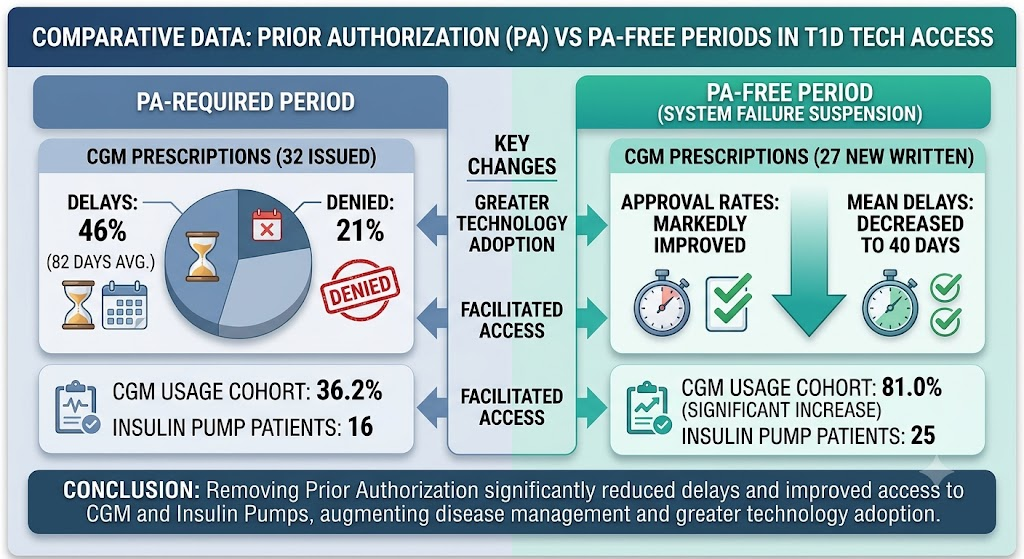
During the PA-required period, 32 CGM prescriptions were issued. Of these, 46% experienced delays with an average of 82 days from prescription to approval, and 21% were denied. In contrast, during the PA-free period, 27 new CGM prescriptions were written. Approval rates improved markedly, with mean delays decreasing to 40 days, although delays persisted in some cases. CGM usage in the cohort increased significantly from 36.2% to 81.0%, indicating greater technology adoption.
Similarly, insulin pump use increased from 16 to 25 patients in the PA-free period. This suggests that facilitating access to automated insulin delivery systems alongside CGM can augment disease management.
Crucially, glycemic control measured by HbA1c showed statistically significant improvement, decreasing from a mean of 9.1% (76 mmol/mol) during the PA-required period to 8.5% (69 mmol/mol) in the PA-free period (P = 0.032). This degree of reduction is clinically meaningful, as even modest glycemic improvements reduce diabetes-related morbidity.
Despite these benefits, residual delays and barriers highlight enduring structural inequities. The persistence of some administrative or logistic challenges underscores that removing PA alone may not fully resolve access limitations.
Expert Commentary
The findings align with mounting evidence that administrative hurdles like prior authorization can impede timely access to beneficial diabetes technologies, especially in socioeconomically vulnerable populations. As noted by Peters et al., the suspension of PA facilitated not just increased device uptake but translated into improved clinical outcomes, underscoring the direct relationship between access and glycemic control.
The study’s retrospective design and single-center setting limit generalizability; however, it provides compelling real-world evidence to support policy reevaluation. Experts emphasize that streamlining administrative processes should be coupled with broader efforts addressing social determinants of health, including insurance coverage, education, and clinic resources, to equitably optimize diabetes management.
Furthermore, as automated insulin delivery systems become standard care, reducing barriers to these technologies is essential to improving glycemic outcomes and quality of life.
Conclusion
This retrospective analysis demonstrates that suspending prior authorization requirements substantially improved access to CGM and insulin pump technologies in an underserved type 1 diabetes population, which corresponded with a significant reduction in HbA1c. The data support policy initiatives aimed at minimizing administrative burdens to enhance equitable access to advanced diabetes devices.
Nonetheless, persistent delays and access barriers indicate that policy reform alone is insufficient to eradicate structural inequities. Multidimensional approaches addressing administrative, social, and healthcare system factors remain critical.
These findings advocate for healthcare policymakers and payers to consider reducing or eliminating PA requirements for clinically appropriate patient populations to optimize diabetes care outcomes, particularly in safety net settings.
Funding and Trial Registration
The original study did not specify funding sources or clinical trial registration.
References
1. Ruelas V, Bernstein M, Flores Garcia J, Topalis K, Peters AL. Impact of Prior Authorization Suspension on Access to Diabetes Technology in an Underserved Population: A Retrospective Analysis. Diabetes Care. 2026 Aug 1;49(8):1467-1473. PMID: 42312902.
2. Beck RW, Riddlesworth TD, Ruedy K, et al. Continuous Glucose Monitoring Versus Usual Care in Patients with Type 2 Diabetes Receiving Multiple Daily Insulin Injections: A Randomized Trial. Ann Intern Med. 2017;167(6):365-374.
3. Karter AJ, Hessler D, Gregg EA, et al. Continuous glucose monitoring and glycemic control among U.S. adults with type 1 diabetes in real-world clinical practice. Diabetologia. 2022;65(1):123-132.
4. Brown A, Yingling L, Laffel L, et al. Barriers to Diabetes Technology Use: Analysis of Prior Authorization Policies. J Diabetes Res. 2023;2023:Article ID 4789052.
5. American Diabetes Association. Standards of Medical Care in Diabetes—2024. Diabetes Care. 2024;47(Suppl. 1):S1-S194.
This article was created using several editorial tools, including AI, as part of the process. Human editors reviewed this content before publication.