We use cookies

Our website uses essential cookies and, with your consent, additional cookies to measure performance and improve our services. Cookie Policy.

You can change your choice at any time.

MMedXYNews
HomeVideos
MedXY AI/MedXY News/Section: Cardiology

Pre-Transplant Left Atrial Volume Index as a Predictor of One-Year Morbidity after Kidney Transplantation: Insights and Implications

MedXY Editorial Team•Aug 12, 2026•Cardiology
Left atrial volume indexLAVIPost-transplant morbidityechocardiography肾移植,循环死亡后器官捐献,常温区域灌注,低温机器灌注,移植肾功能延迟恢复
Highlight

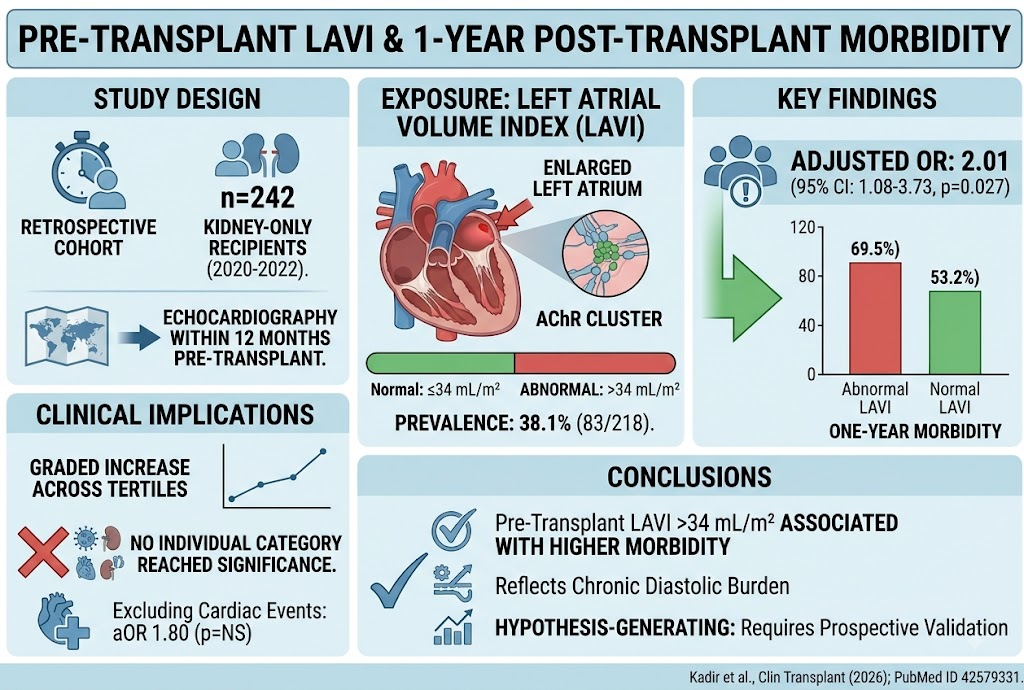
1. Pre-transplant left atrial volume index (LAVI) >34 mL/m2 was associated with increased one-year morbidity after kidney transplantation.
2. The association showed a graded relationship across LAVI tertiles, suggesting a dose-response effect.
3. No individual post-transplant complication category reached statistical significance, though non-cardiac complications showed a similar trend.
4. Other echocardiographic parameters, including left ventricular ejection fraction, were not predictive of the composite morbidity outcome.

Study Background

MedXY registered readers

Sign in free to continue reading

Create or use your MedXY account to unlock the complete article.

This article was created using several editorial tools, including AI, as part of the process. Human editors reviewed this content before publication.

Related articles

Open language-specific specialty feeds and department pages.

Cardiac Adaptations to Prolonged Spaceflight and Simulated Martian Gravity: Insights from a Longitudinal Observational StudyThis study explores cardiac structural and functional changes over prolonged spaceflight and simulated Martian gravity, revealing transient adaptations that stabilize without lasting detrimental effects, suggesting effective cardiovascularSep 17, 2026Aficamten’s Impact on Cardiac Function and Structure in Symptomatic Nonobstructive Hypertrophic Cardiomyopathy: Insights from ACACIA-HCM TrialAficamten significantly improves diastolic function and cardiac structure in symptomatic nonobstructive hypertrophic cardiomyopathy, indicating benefits beyond outflow tract gradient reduction.Sep 3, 2026Advanced Right Ventricular Phenotyping Enhances Risk Stratification in Pulmonary Arterial Hypertension Follow-UpEchocardiography-derived right ventricular phenotypes improve prognostic accuracy beyond standard risk tools in pulmonary arterial hypertension patients at first follow-up, refining survival predictions and guiding management strategies.Aug 28, 2026
Loading comments...
MedXY briefing

Get the free newsletter

Evidence-led clinical news, trends, and analysis—delivered to your inbox.

Ask MedXY AI

Most popular

Intimate Health
Five Benefits for Women Continuing Sexual Activity After Menopause
Intimate Health
Why Some Women Have a Strong Sex Drive—And Why Men Shouldn't Worry About It
Nursing & care
How often should a couple have sex?
Intimate Health
Classic Intimacy Recommendations: How to Help Women Reach Orgasm and Enjoy Mutual Pleasure
Intimate Health
What Makes a Woman "Physiologically Addicted" Is Never Money, But These Two Relationship Qualities
© 2026 MedXY
Contact usAbout usPrivacy PolicyMedXY story
Efficacy and Outcomes of Short-Course Perioperative Antiviral Prophylaxis in Hepatitis C Viremic Donor Kidney Transplantation
A 7-day perioperative sofosbuvir/velpatasvir prophylaxis in HCV-positive donor to HCV-negative recipient kidney transplants demonstrated sustained virologic response in over 92% of cases, with favorable 1-year graft survival and function.
Aug 20, 2026
Enhancing Kidney Transplant Outcomes: The Combined Role of Normothermic Regional Perfusion and Hypothermic Machine Perfusion in Donation After Circulatory Death DonorsSequential use of normothermic regional perfusion and hypothermic machine perfusion in kidney transplants from DCD donors reduces delayed graft function, highlighting enhanced organ preservation strategies.Aug 17, 2026
Decoding the U-Shaped Relationship Between Left Ventricular Size and Mortality in Heart Failure PatientsA large Chinese cohort study reveals a U-shaped association between left ventricular end-diastolic diameter and mortality in heart failure, highlighting both small and large ventricular sizes as independent risk factors.Aug 7, 2026