We use cookies

Our website uses essential cookies and, with your consent, additional cookies to measure performance and improve our services. Cookie Policy.

You can change your choice at any time.

MMedXYNews
HomeVideos
MedXY AI/MedXY News/Section: Anesthesiology

Perioperative Code Status Limitations and Early Postoperative Mortality: Insights from a Multicenter Retrospective Cohort Study
MedXY Editorial Team•Sep 15, 2026•Anesthesiology
code statusperioperative carepostoperative mortalitydo-not-resuscitate

Highlight

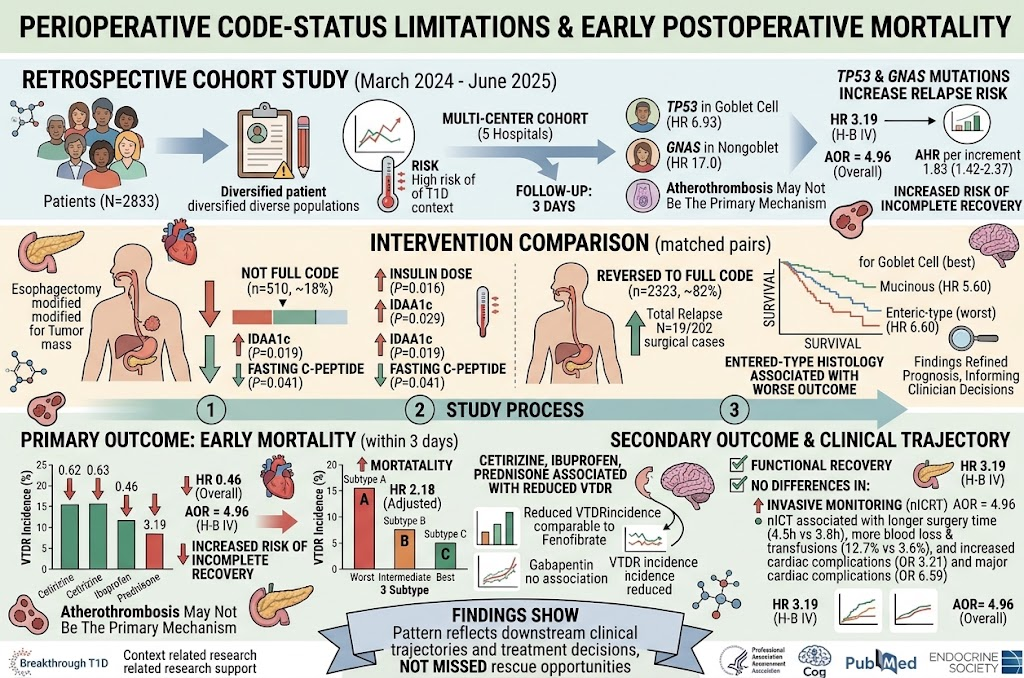
This retrospective cohort study of 2833 adults undergoing procedures with anesthesia and preexisting code-status limitations revealed that continuation of non-full code status perioperatively is associated with increased early (3-day) postoperative mortality. The findings emphasize that this higher mortality predominantly results from subsequent transitions to comfort-focused care rather than failures in acute perioperative management. Additionally, patients who remained not full code were more likely to receive invasive hemodynamic monitoring, reflecting intensive care tailored to patient preferences.

Study Background

MedXY registered readers

Sign in free to continue reading

Create or use your MedXY account to unlock the complete article.

This article was created using several editorial tools, including AI, as part of the process. Human editors reviewed this content before publication.

Related articles

Open language-specific specialty feeds and department pages.

Transforming Readmission Risk After Colorectal Surgery in Older Adults: From Nonmodifiable to Actionable Geriatric and Comorbidity FactorsThis study highlights that geriatric vulnerabilities and comorbidities, once considered nonmodifiable, play a dominant role in 30-day readmissions after colorectal surgery in older adults, emphasizing the need for integrated perioperative iAug 25, 2026Low-Yield or High-Value? Preoperative Cardiac Workup in Children With Very Severe OSAPreoperative cardiac testing in children with very severe OSA had low diagnostic yield and rarely changed management. Risk appeared highest in obese adolescents with AHI >50 events/hour.Jun 19, 2026European Perioperative Diabetes Care: Significant Practice Variation Impacts 30-Day Recovery OutcomesThe MOPED study of over 6,000 European patients reveals significant international variations in perioperative diabetes management. Findings demonstrate that higher preoperative HbA1c levels and practice inconsistencies are linked to fewer dDec 19, 2025Home-Based Prehabilitation Did Not Reduce Disability or Complications in Older Adults with Frailty: Results of a Pragmatic Multicenter RCT
Loading comments...
MedXY briefing

Get the free newsletter

Evidence-led clinical news, trends, and analysis—delivered to your inbox.

Ask MedXY AI

Most popular

Intimate Health
Five Benefits for Women Continuing Sexual Activity After Menopause
Intimate Health
Why Some Women Have a Strong Sex Drive—And Why Men Shouldn't Worry About It
Nursing & care
How often should a couple have sex?
Intimate Health
Classic Intimacy Recommendations: How to Help Women Reach Orgasm and Enjoy Mutual Pleasure
Intimate Health
What Makes a Woman "Physiologically Addicted" Is Never Money, But These Two Relationship Qualities
© 2026 MedXY
Contact usAbout usPrivacy PolicyMedXY story
A pragmatic multicenter randomized trial found that coach-supported, home-based multimodal prehabilitation before elective noncardiac surgery did not reduce 30-day postoperative disability or in-hospital complications in older adults with f
Dec 9, 2025
Biomarker-Guided Preventive Care Halves Risk of Moderate–Severe AKI After Major Surgery: Results from BigpAK-2In BigpAK-2, a multinational randomized trial, a KDIGO-based preventive bundle triggered by tubular stress biomarkers reduced moderate or severe acute kidney injury within 72 hours after major surgery (OR 0.57; NNT 12) without increasing adNov 25, 2025
Metformin Exposure Associated with Up to 81% Lower 30‑Day Mortality After Cardiac Surgery in T2DM: A Critical Appraisal of AHA 2025 MIMIC‑IV Cohort FindingsA retrospective MIMIC‑IV cohort presented at AHA 2025 found perioperative metformin exposure in T2DM patients undergoing cardiac surgery associated with markedly lower 30‑, 90‑ and 360‑day mortality. Results are compelling but observationalNov 13, 2025