Periconceptional Vitamin B12 and Folate Levels in Parents Linked to Birth Defect Risk Reduction: Insights from a Large Prospective Cohort
Highlight
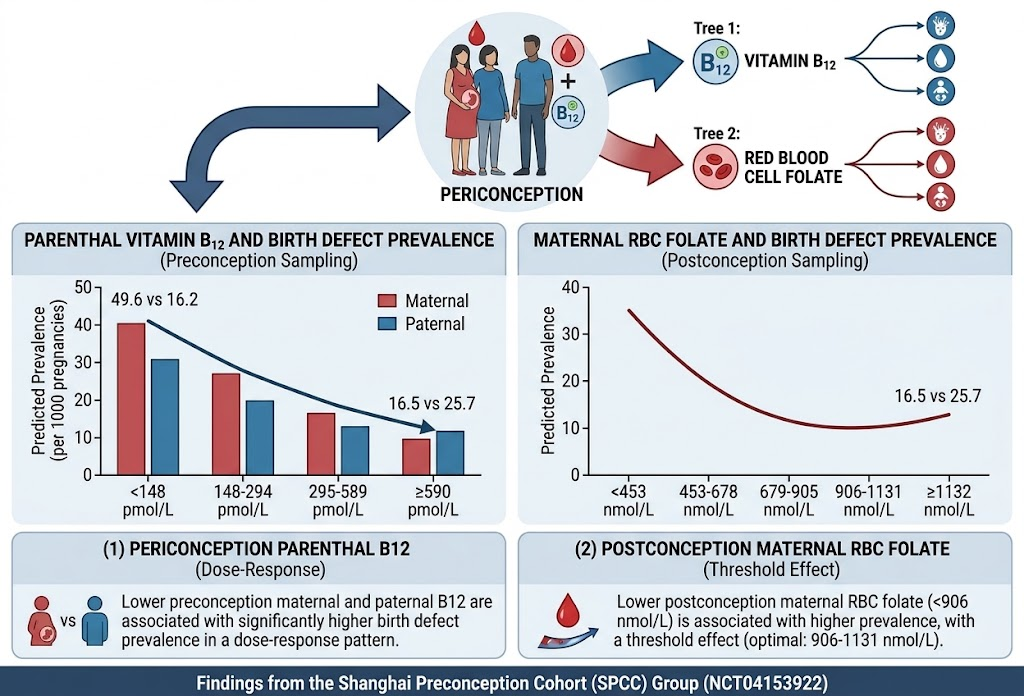
Recent evidence from the Shanghai Preconception Cohort underscores important associations between parental periconception vitamin B12 and folate status and the risk of birth defects. This large prospective study found that higher levels of both maternal and paternal vitamin B12 before conception substantially reduced predicted birth defect prevalences in offspring. In addition, higher postconception maternal red blood cell (RBC) folate was linked to further risk reduction, though with diminishing returns at very high concentrations.
These findings extend the scope of perinatal nutritional interventions beyond the traditional focus on maternal folic acid supplementation to include parental vitamin B12 optimization, offering a promising avenue to enhance birth defect prevention strategies.
Study Background and Disease Burden
Birth defects remain a significant public health challenge globally, contributing to infant morbidity, mortality, and long-term disability. Neural tube defects (NTDs) have been a focal point of prevention efforts, notably through the promotion of maternal folic acid supplementation, which unequivocally reduces NTD risk. However, emerging data suggest that other micronutrients, particularly vitamin B12, may also play crucial roles in early embryonic development and congenital anomaly prevention.
The role of paternal nutritional status in modulating birth outcomes has been less explored but is biologically plausible given the influence of paternal factors on sperm quality and epigenetic regulation. Understanding parental micronutrient status during the periconception period is critical to refining and broadening preventive strategies for birth defects.
Study Design
This investigation leveraged data from the Shanghai Preconception Cohort (SPCC), a prospective, population-based cohort study enrolling couples planning conception. The study analyzed biomarker data from 3,032 couples sampled within 4 months before conception and from 17,765 women sampled during the first four months of pregnancy.
Exposure variables included parental serum vitamin B12 and RBC folate measurements assessed via standardized assays. The primary outcome was the occurrence of birth defects, identified among live births, stillbirths, and elective terminations due to fetal abnormalities.
The investigators employed weighted logistic regression techniques to estimate standardized predicted prevalences of birth defects across biomarker categories, facilitating an assessment of dose-response relationships with micronutrient levels.
Key Findings
The study revealed robust inverse associations between higher preconception parental vitamin B12 levels and birth defect risk in offspring. For maternal vitamin B12, predicted birth defect prevalence decreased notably from 49.6 cases per 1000 pregnancies at the lowest concentration (<148 pmol/L) to 16.2 cases per 1000 pregnancies at the highest concentration (≥590 pmol/L). Paternal vitamin B12 showed a similar but somewhat attenuated dose-response pattern, with predicted prevalence decreasing from 55.5 to 24.0 per 1000 pregnancies across the same concentration range.
Preconception parental RBC folate levels showed a less consistent, though generally inverse, pattern with birth defect prevalence, suggesting potential benefit but with less precision in estimates.
Among women sampled during early pregnancy, higher RBC folate levels correlated with reduced birth defect prevalence. Specifically, prevalence fell from 25.7 per 1000 pregnancies at folate levels below 453 nmol/L to 16.5 per 1000 pregnancies at levels between 906 and 1131 nmol/L, with minimal additional reductions beyond this range.
Postconception maternal vitamin B12 data indicated stable prevalence rates across lower concentrations but a significant drop at the highest category (≥590 pmol/L) compared with moderate levels.
The observed associations persisted despite adjustments, though residual confounding cannot be fully excluded. Importantly, the study encompassed multiple birth defect types, reinforcing the potential generalizability of micronutrient effects beyond NTDs.
Expert Commentary
These findings add compelling evidence to the evolving paradigm that optimal periconception nutrition entails more than folic acid alone. Vitamin B12, essential for DNA synthesis and methylation, may synergize with folate to ensure proper embryogenesis and reduce teratogenic risk. The dose-dependent relationship observed particularly emphasizes the need to consider vitamin B12 screening and supplementation as part of preconception care in populations at risk of deficiency.
The paternal effects, though somewhat weaker, are biologically plausible and underscore the importance of including both parents in periconception health strategies. Given that vitamin B12 deficiency can be common in certain populations due to dietary patterns or malabsorption, routine evaluation may be warranted.
Limitations include potential residual confounding by unmeasured factors such as other nutritional variables or socioeconomic status. Additionally, the study’s observational nature precludes definitive causal inferences, and replication in diverse cohorts would strengthen external validity.
Conclusion
The Shanghai Preconception Cohort study robustly demonstrates that higher parental vitamin B12 levels before conception, alongside adequate maternal RBC folate in early pregnancy, are associated with substantially lower birth defect prevalences. These findings advocate for expanding periconception nutritional recommendations to integrate vitamin B12 assessment and supplementation, potentially reducing congenital anomalies beyond the well-established effects of folic acid alone.
Future research should explore mechanistic pathways, optimal supplementation regimens, and the interplay of paternal and maternal micronutrient status to refine guidelines and improve perinatal outcomes globally.
Funding
This study was supported by the National Key Research and Development Program of China, the National Natural Science Foundation of China, and the Chinese Academy of Medical Sciences.
References
Chen H, Chen X, Zhang Y, et al. Periconception Parental Red Blood Cell Folate, Vitamin B12, and Birth Defects in Offspring: A Prospective Cohort Study. Ann Intern Med. 2026; PMID:42673604. Available at https://pubmed.ncbi.nlm.nih.gov/42673604/.
De-Regil LM, Peña-Rosas JP, Fernández-Gaxiola AC, et al. Effects and safety of periconceptional folate supplementation for preventing birth defects. Cochrane Database Syst Rev. 2015;(12):CD007950.
Green R. Vitamin B12 deficiency from the perspective of a practicing hematologist. Blood. 2017;129(19):2603-2611.
Crider KS, Bailey LB, Berry RJ. Folic acid food fortification—its history, effect, concerns, and future directions. Nutrients. 2011;3(3):370-384.
This article was created using several editorial tools, including AI, as part of the process. Human editors reviewed this content before publication.