Optimizing Task-Shared Psychosocial Interventions for Depression and Anxiety: Key Components and Personalized Approaches
Introduction
Common mental disorders like depression and anxiety affect hundreds of millions of people worldwide. Yet, access to specialized mental health care remains limited, especially in low-resource settings. Task-sharing, where non-specialist providers such as community health workers deliver psychosocial interventions, has emerged as a promising strategy to expand treatment reach. However, not all components of these interventions contribute equally to their success. Understanding which elements drive effectiveness and tailoring interventions to individual needs can optimize outcomes.
This article explores a landmark Bayesian component network meta-analysis involving over 10,000 participants from 34 randomized controlled trials (RCTs) that dismantled task-shared psychosocial interventions into their active components. The study identifies which components offer the greatest benefit and offers insights into personalizing interventions based on patient profiles.
What Does the Data Tell Us?
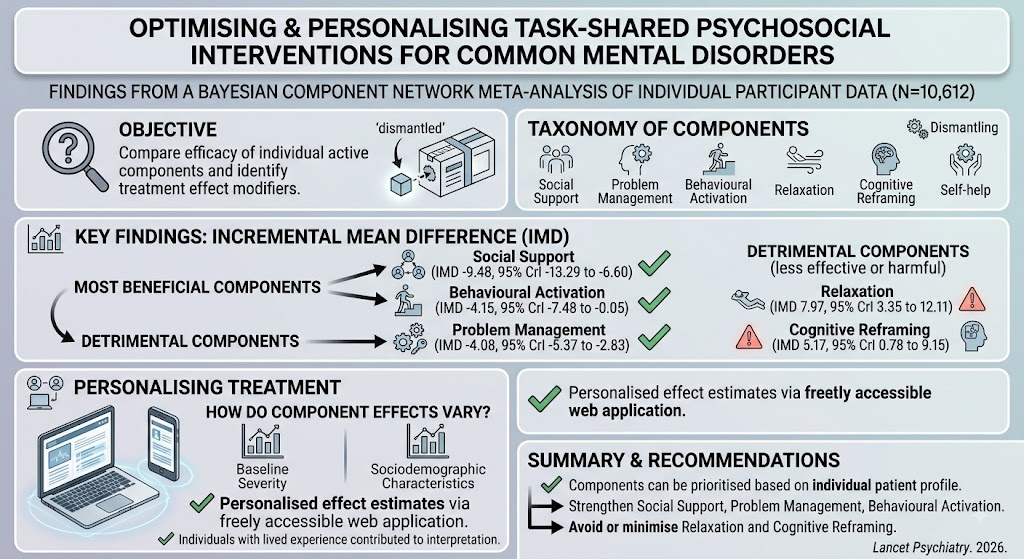
Researchers conducted a comprehensive systematic review of RCTs comparing task-shared psychosocial interventions with control conditions for adults experiencing depression or anxiety. Importantly, they retrieved individual participant data from 30 trials encompassing 10,612 individuals with a mean age of around 37 years, the majority of whom were women.
Using a specialized taxonomy, the interventions were broken down into components such as social support enhancement, behavioral activation, problem management, relaxation techniques, and cognitive reframing. A Bayesian statistical framework then estimated each component’s incremental effect on symptom reduction.
The key findings included:
– Strengthening Social Support: This component showed the strongest benefit (mean difference -9.48), highlighting that helping participants build and deepen social connections significantly reduces symptoms.
– Behavioral Activation: Encouraging individuals to engage in meaningful activities had a clear positive effect (mean difference -4.15).
– Problem Management: Teaching practical coping skills to solve life challenges also improved outcomes substantially (mean difference -4.08).
Conversely, some components were surprisingly associated with worse outcomes. Relaxation techniques (mean difference +7.97) and, less decisively, cognitive reframing (mean difference +5.17) appeared detrimental in this context.
The study further found that these effects varied depending on baseline symptom severity and sociodemographic factors, underscoring the importance of a personalized approach. Unfortunately, ethnicity data were not available to explore potential cultural influences.
Dispelling Misconceptions: The Complex Nature of Psychosocial Components
One might assume that relaxation techniques and cognitive reframing—commonly used elements in many therapies—would consistently help reduce anxiety and depression. However, this analysis challenges that view.
Why might some components be unhelpful or even harmful in certain contexts? Possible reasons include:
– Mismatch with Needs: Relaxation may not address the core challenges faced by individuals struggling with practical problems or social isolation.
– Skill Delivery Quality: Non-specialist providers might deliver certain components less effectively, leading to confusion or frustration.
– Participant Expectations: If a participant expects tangible problem-solving support but receives relaxation training instead, this can reduce engagement or hope.
This underscores that psychosocial interventions are complex and their success depends on selecting and tailoring components to fit a person’s circumstances.
Practical Recommendations for Clinicians and Program Developers
Given these insights, clinicians and mental health program planners should consider prioritizing components demonstrated to have the greatest incremental benefit when designing or adapting task-shared interventions:
1. Focus on Social Support: Facilitate opportunities for building meaningful relationships, peer support, and community networks.
2. Emphasize Behavioral Activation: Encourage structured activity engagement to improve mood and routine.
3. Incorporate Problem Management Skills: Equip participants with practical tools to address daily challenges and stressors.
4. Evaluate the Use of Relaxation and Cognitive Reframing: Consider patient preferences, context, and delivery capacity before including these components.
5. Utilize Personalization Tools: The study’s authors provide an open-access web application enabling calculation of personalized expected benefits based on participant characteristics—an innovative resource for tailoring interventions.
Expert Insights and Commentary
Dr. Valerie Greene, a clinical psychologist specializing in community mental health, comments:
“This large-scale analysis brings critical clarity to what really makes psychosocial interventions work when delivered by non-specialists. While it may seem surprising that relaxation techniques didn’t show benefit, this challenges us to carefully consider how we craft and deliver treatments. The findings reinforce the importance of social connection and practical problem-solving, especially in resource-limited settings.”
Another contributor, Dr. Arun Patel, highlights the value of personalization:
“By moving beyond one-size-fits-all approaches and accounting for individual differences in symptom severity and demographics, we can better match people to interventions that will help them most. This study provides tools to advance this effort.”
Case Vignette: Emily’s Journey to Recovery
Emily, a 35-year-old teacher battling moderate depression, was offered a community-based psychosocial program delivered by a trained peer counselor. The intervention emphasized social support, encouraging Emily to join a local support group, engage in pleasurable activities she once enjoyed, and develop skills to manage work-related stress. Over 12 weeks, her mood improved significantly.
Reflecting on her experience, Emily says, “Being part of a group where I felt understood really lifted me. I learned ways to tackle problems instead of feeling stuck. Relaxation exercises didn’t help much for me, but getting active again and connecting with others made a real difference.”
Emily’s story illustrates how the key components identified by the research translate into real-world benefits.
Conclusion
This extensive Bayesian component network meta-analysis of task-shared psychosocial interventions has pinpointed strengthening social support, behavioral activation, and problem management as the most effective building blocks for treating common mental disorders such as depression and anxiety. Equally important, it reveals that some frequently used components may be less effective or even detrimental depending on context.
The findings advocate for a personalized, evidence-driven approach to designing and delivering mental health interventions by non-specialists, maximizing their impact and expanding access to millions in need.
Funding
This research was funded by the European Commission, underscoring its significance and the global commitment to improving mental health access.
References
Papola D, Tedeschi F, Efthimiou O, Harrer M, Ramia JA, Acarturk C, et al. Optimising and personalising task-shared psychosocial interventions for common mental disorders: a Bayesian component network meta-analysis of individual participant data. Lancet Psychiatry. 2026 Aug 3; PMID: 42546730. https://pubmed.ncbi.nlm.nih.gov/42546730/
Cuijpers P, Furukawa TA, et al. Evidence-based psychotherapies for depression—an update. World Psychiatry. 2019;18(2):259-269.
Patel V, Weiss HA, Chowdhary N, et al. Effectiveness of an intervention led by lay health counsellors for depressive and anxiety disorders in primary care in Goa, India (MANAS): a cluster randomized controlled trial. Lancet. 2010;376(9758):2086-95.
Additional Resources
The personalized effect estimation tool referenced in the study is publicly available and can be used by clinicians and researchers to tailor interventions based on individual profiles, helping translate data into practice.
This article was created using several editorial tools, including AI, as part of the process. Human editors reviewed this content before publication.